A carpet cleaner is the one floor-care machine most people could rent instead. Whether buying one makes sense comes down to how often you would actually use it — and the honest number is lower than you think.
Everyone in this category says they tested twenty vacuums. We have not tested any, and we say so. What we do instead is read the manuals, compile the published specifications, and work out what each machine costs to run for three years — the method is written out in full.
We earn a commission if you buy through the links on this page, at no extra cost to you. It never changes what we recommend or the order we recommend it in. Full disclosure.
Worth it if you will use it three times a year or more; not worth it below that. A carpet cleaner is unusual among floor-care machines because a genuine alternative exists — you can rent one for a weekend, and the rental machines are often larger than anything you would buy. Owning wins on frequency and on immediacy: pet accidents and toddler spills do not schedule themselves around a rental counter. Renting wins on capability per session and on never storing a 20 lb machine you use twice a year. Everything below is the arithmetic that decides which you are.
What a carpet cleaner actually does
It sprays a water-and-detergent mix into carpet pile, agitates with a driven brush, and extracts the dirty liquid back out into a separate tank. That extraction step is the whole product — it is what separates a carpet cleaner from a wet mop, which leaves the water and the soil where it was. The naming is a mess in this category, and "carpet cleaner", "extractor" and "shampooer" all describe the same machine.
Two things follow from that description. First, the machine is only worth owning if you have carpet, rugs or fabric furniture — on hard floors it does nothing a mop cannot. Second, its job is deep soil and stains, not routine dirt. Routine dirt is a vacuum's job, and a carpet cleaner used on an unvacuumed floor turns dust into mud.
The case for buying
Accidents do not schedule. The strongest argument, and it is a pet argument. A urine accident needs treating within minutes, not next Saturday when the rental counter opens. If you have a pet that has accidents, owning is not really a cost calculation.
Frequency. Rental is priced per session. Past roughly three sessions a year, owning a mid-range machine costs less over a few years — and you will clean more often when the machine is in the closet, which is the real benefit.
Small jobs become possible. Nobody rents a machine for one stair tread or a single sofa cushion. Owning turns a category of small jobs from "leave it" into "ten minutes".
Storage is smaller than you think at the bottom of the range. A portable spot machine is the size of a toolbox, which removes the main objection to owning for people in apartments.
The case against
Rental machines are bigger. A commercial rental unit typically has more tank, more brush and more extraction than a consumer machine at any price you would buy. For one deep annual clean of a whole house, rental is the better tool.
Formula is forever. Every machine here needs solution, and it is an ongoing purchase for as long as you own it. It is the running cost nobody prices in at the till.
Storage and drying. A wet machine has to be rinsed and dried after every use or it smells. That is a fifteen-minute job attached to every clean, and it is the reason a lot of owned carpet cleaners end up unused in a garage.
Two of the machines on this site publish no warranty term at all, on a product category where a pump meets water every single time it runs.
Buy, rent, or hire a professional?
The three routes compared on what each is genuinely best at.
Buying
Renting
Professional
Best for
Frequent small jobs and pet accidents
One deep clean of a whole house
Restoration, heavy soil, delicate rugs
Available when you need it
Immediately
Store hours, and often booked
Days to weeks
Machine capability
Consumer-grade tanks and brushes
Commercial-grade, usually larger
Truck-mounted or professional portable
Ongoing cost
Formula, forever
Per session, plus formula
Per session
Storage and upkeep
Yours: rinse and dry after each use
None
None
Best value when
Used three or more times a year
Used once or twice a year
Once, on damage you cannot fix
We do not publish rental or professional prices, because they vary by region and date and a stale figure is worse than none. The comparison above is about capability and availability, which do not move.
Our rent-versus-buy page works through the same decision in more detail, including what happens to the arithmetic when the carpet is rented rather than owned.
#
Product
Best for
Score
Price
01
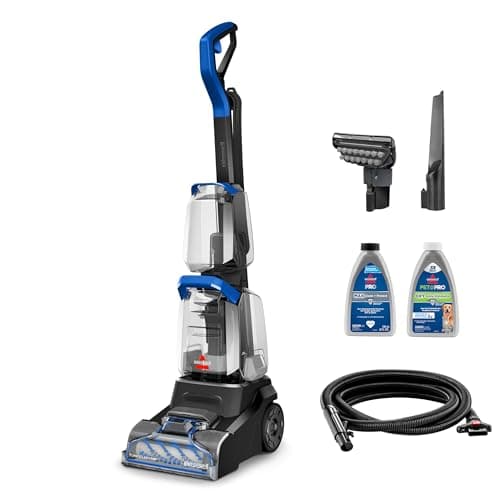
Bissell TurboClean PET Upright Carpet & Upholstery Cleaner (3948)The 3952 plus a 7-foot hose and a self-cleanout tool — and the tool is what makes it usable on stairs and a sofa.
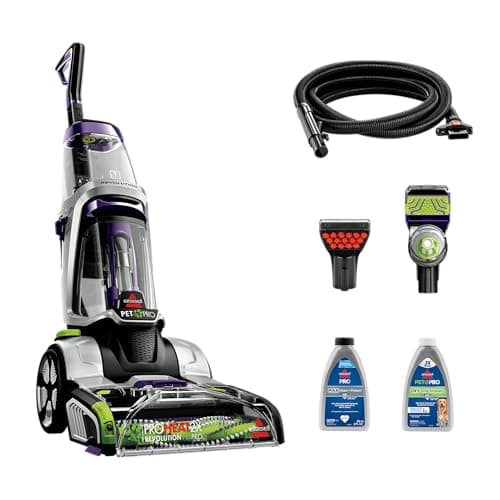
Bissell ProHeat 2X Revolution Pet Pro Plus (3588F)Dual brushrolls, a heater and an Express mode Bissell rates at about 30 minutes to dry — the only machine here that addresses drying time at all.
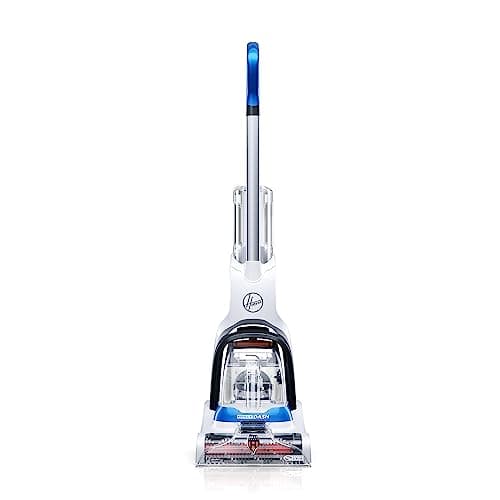
Hoover PowerDash Pet Compact Carpet Cleaner12.5 lb with HeatForce drying — the only full-size machine here light enough to carry upstairs without thinking about it.
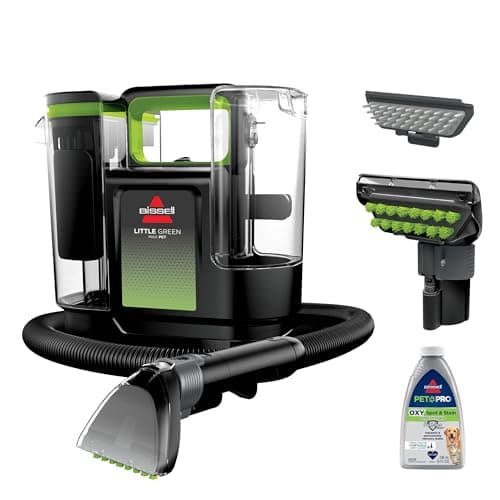
Bissell Little Green Max Pet Portable Carpet Cleaner (3860)The self-cleaning stain tool is the feature that decides whether a portable gets used twice, and this is the cheapest machine here that publishes one alongside a pet hair tool.
Four machines at four levels of commitment, from a spot cleaner to a full-size extractor. If you decide the answer is yes, this is the order we would consider them in.
01 · Best for pet messes
Bissell TurboClean PET Upright Carpet & Upholstery Cleaner (3948)
The 3952 plus a 7-foot hose and a self-cleanout tool — and the tool is what makes it usable on stairs and a sofa.
Every figure above is the manufacturer's own published number. Where a manufacturer publishes nothing, the row says "Not published" rather than an estimate.
What the numbers say
+The self-cleanout tool rinses itself in one press, which is the single most annoying job on any extractor
+7-foot hose reaches a full flight of stairs from the landing
+Same 1-gallon tank and 4-row brush as the cheaper 3952
Where it stops
−19.2 lb, nearly three pounds more than the 3952
−Still no heater
−Pet formula costs more per bottle than the standard version
Who it is for
Pet households where the messes are on stairs, sofas and pet beds as much as the floor.
Skip it if
You only ever clean flat open carpet. The hose and tools are the entire price difference and you would never unclip them.
Our score: 7.4 out of 10
Tank capacity8.5
Brush system7.5
Tools and reach8.5
Weight and handling6.0
Running cost6.5
Scored against the published rubric on How We Pick. These are judgments about spec sheets, not measurements.
02 · Best heated cleaner
Bissell ProHeat 2X Revolution Pet Pro Plus (3588F)
Dual brushrolls, a heater and an Express mode Bissell rates at about 30 minutes to dry — the only machine here that addresses drying time at all.
MAX Clean, and Express Clean rated to leave carpets dry in about 30 minutes
Hose
8 feet
Tools
2-in-1 pet upholstery tool and 3" tough stain tool
Pre-treatment
CleanShot pre-treater with OXY, built in
Formulas
Pro Max Clean + Protect and Pet Pro Oxy Urine Eliminator, both included
Machine weight
Not published in a comparable form on the listing
Every figure above is the manufacturer's own published number. Where a manufacturer publishes nothing, the row says "Not published" rather than an estimate.
What the numbers say
+Dual counter-rotating brushrolls double the agitation of the single-brush machines
+A published drying-time claim, which almost nobody in this category makes
+Built-in pre-treater means you are not carrying a spray bottle around as well
+8-foot hose, the longest here
Where it stops
−Two formulas included means two formulas to keep buying
−The most expensive machine on this page
−Bissell does not publish a comparable machine weight for this model
Who it is for
Households with recurring pet accidents, where the same spots get cleaned repeatedly.
Skip it if
You clean carpets twice a year. This is a machine that repays frequent use; for occasional deep cleans, renting is the better arithmetic.
Our score: 7.6 out of 10
Tank capacity8.5
Brush system9.5
Tools and reach9.0
Weight and handling5.5
Running cost5.5
Scored against the published rubric on How We Pick. These are judgments about spec sheets, not measurements.
03 · Lightest full-size extractor
Hoover PowerDash Pet Compact Carpet Cleaner
12.5 lb with HeatForce drying — the only full-size machine here light enough to carry upstairs without thinking about it.
HeatForce technology for faster drying, manufacturer-stated
Warranty
1 year
Formula
Hoover carpet solution — an ongoing consumable; sample included
Every figure above is the manufacturer's own published number. Where a manufacturer publishes nothing, the row says "Not published" rather than an estimate.
What the numbers say
+12.5 lb, nearly four pounds lighter than the cheapest Bissell upright
+Antimicrobial brushroll, which is Hoover addressing the smell problem at the source
+Small enough to store in an apartment closet
Where it stops
−0.5-gallon tank is half the Bissell uprights' — twice the sink trips
−1-year warranty against Bissell's 2-year on the ProHeat line
−No above-floor hose on this model
Who it is for
Apartments, condos and RVs — Hoover's own stated use case, and an accurate one.
Skip it if
You have a lot of carpet. The half-gallon tank turns a big room into a refill exercise, and the Bissell 3952 costs about the same.
Our score: 6.4 out of 10
Tank capacity4.5
Brush system7.0
Tools and reach4.0
Weight and handling8.5
Running cost7.0
Scored against the published rubric on How We Pick. These are judgments about spec sheets, not measurements.
04 · Most tools in the box
Bissell Little Green Max Pet Portable Carpet Cleaner (3860)
The self-cleaning stain tool is the feature that decides whether a portable gets used twice, and this is the cheapest machine here that publishes one alongside a pet hair tool.
Two-tank, clean and dirty separated. Capacity not published in ounces or liters
Suction claim
30% more powerful than "the competitive portable deep cleaner" — the machine it is compared against is not named
Self-cleaning
One-touch hose and tool cleanout on the Tough Stain Tool
Tools
Self-cleaning Tough Stain Tool and a specialized pet hair removal tool
Formula
8 oz trial of PET PRO OXY with urine eliminator; ongoing purchase required
Hose and cord
Published as longer than the brand's smaller models; no length stated in feet
Warranty
Not published on the listing
Every figure above is the manufacturer's own published number. Where a manufacturer publishes nothing, the row says "Not published" rather than an estimate.
What the numbers say
+A self-cleaning hose and tool rinse, published — the single feature that stops a portable turning into a smelly cupboard ornament
+A dedicated pet hair removal tool in the box, which the cheaper Little Green Mini does not include
+Two-tank separation is published, so dirty water never goes back down the hose
Where it stops
−Bissell publishes no tank capacity in any unit, so it cannot be compared with the Hoover's stated 1.18 liters
−The 30% suction claim names no competitor and no test method, which makes it unverifiable
−No warranty length published on the listing
Who it is for
Pet households that want the rinse-out tooling without stepping up to the larger Pet Pro, and are willing to accept an unpublished tank size.
Skip it if
You need to know how many trips to the sink a job will take. With no published tank figure, the one number that decides how a portable feels to use is missing.
Our score: 6.5 out of 10
Tank capacity5.0
Brush system4.0
Tools and reach9.0
Weight and handling8.0
Running cost6.5
Scored against the published rubric on How We Pick. These are judgments about spec sheets, not measurements.
If the answer is yes, buy at the right level
The most common mistake is buying the wrong size rather than the wrong brand. Three levels, in order of commitment:
A portable spot cleaner if the job is accidents, upholstery and car seats. Toolbox-sized, and the machine most households actually need. The portable roundup is here.
A compact full-size machine if you have carpet in two or three rooms and want to do them yourself a few times a year.
A full-size extractor if you have wall-to-wall carpet through the house, pets, and the intention to clean seasonally. This is also the level at which renting stops being obviously better.
What a carpet cleaner will not fix
It will not fix worn pile — traffic lanes that look darker because the fibers are crushed and abraded do not come back with water. It will not remove a stain that has dyed the fiber rather than sitting on it, which is common with red drinks and some pet accidents. It will not sanitize: only one machine on this site publishes a heat figure, and heat is what a sanitization claim would need. And it will not replace vacuuming — if anything it demands more of it, because extracting an unvacuumed carpet drives loose grit deeper.
We have not used any of these machines, and we have not tested any cleaning outcome. Everything here is reasoning from published specifications and from what each machine is designed to do. Our method page states exactly where our evidence stops.
The verdict in one paragraph
If you have a pet that has accidents, buy one today and buy the portable — the immediacy is worth more than any specification on the machine. If you have carpet through the house and clean it seasonally, buy a full-size machine; three sessions a year is the crossover where owning wins. If you clean your carpets once a year before Christmas, rent, and spend the money on a better vacuum instead. And if the carpet is stained rather than dirty, none of the three helps and a professional is the honest answer.
Common questions
Are carpet cleaners worth buying?+−
If you will use one three or more times a year, yes — that is roughly where owning beats renting on cost, and immediacy matters more than cost for pet accidents. Below that, rent: rental machines are usually larger than consumer ones, and you avoid storing and drying a machine you barely use.
Is it cheaper to buy or rent a carpet cleaner?+−
Renting is cheaper for one or two sessions a year and buying is cheaper past about three, though the exact crossover depends on rental prices where you live, which we do not publish because they move. The costs people forget on the buying side are formula, which is forever, and the fifteen minutes of rinsing and drying after every use.
Do carpet cleaners actually work?+−
On soil and most stains, yes — spraying, agitating and extracting removes what a vacuum cannot reach. On worn traffic lanes, no: crushed and abraded fibers look darker and water does not restore them. On stains that have dyed the fiber rather than sitting on it, also no. Knowing which of the three you have is most of the decision.
How often should you use a carpet cleaner?+−
For a typical household, deep-cleaning carpet once or twice a year plus spot-treating accidents as they happen is the pattern most manufacturers design around. More frequent deep cleaning is not better — it puts more water into the pile and the underlay, and a carpet that does not dry properly is a worse outcome than a slightly dirty one.
Do you need to vacuum before using a carpet cleaner?+−
Yes, and it is the step people skip. A carpet cleaner sprays water into the pile; if loose grit is still there, the water turns it to mud and drives it deeper. Vacuum thoroughly first, and on a deep pile go over it twice in different directions.
Can a carpet cleaner replace a vacuum?+−
No, and the relationship runs the other way: owning a carpet cleaner means you need to vacuum more carefully, not less. A carpet cleaner handles deep soil and stains a few times a year; a vacuum handles the loose dirt every week that would otherwise become deep soil.
Sources
Manufacturer-published specifications — Every runtime, wattage, capacity, weight, filtration and warranty figure quoted on this page is the manufacturer's own published number for that model, retrieved September 1, 2026. Where a manufacturer publishes no figure, the page says 'Not published' rather than estimating one.
Sweep & Suction — How We Pick — Our published method, including the scoring rubric, the three-year running-cost formula and an explicit statement of what published specifications cannot tell you.