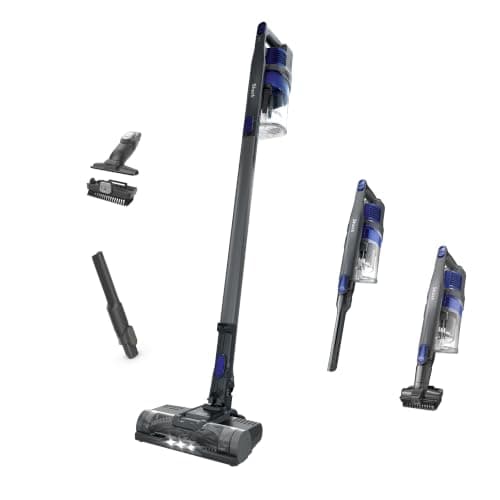
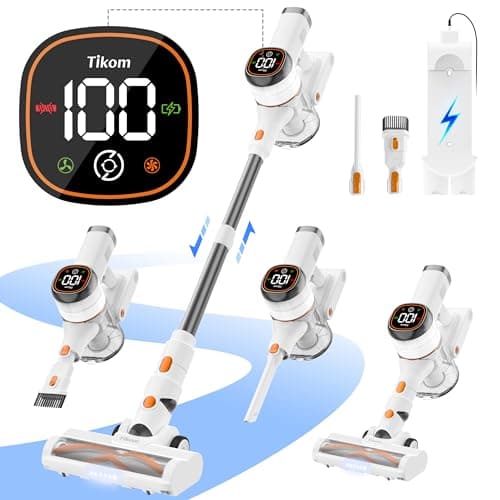
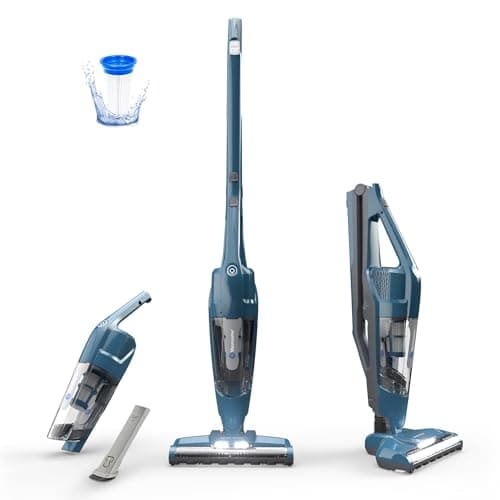
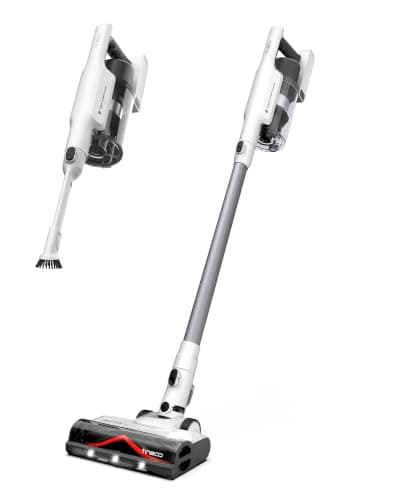
Seven machines with almost identical runtime claims, separated by the numbers the box does not lead with: bin capacity, weight, and whether the battery comes out.
Everyone in this category says they tested twenty vacuums. We have not tested any, and we say so. What we do instead is read the manuals, compile the published specifications, and work out what each machine costs to run for three years — the method is written out in full.
We earn a commission if you buy through the links on this page, at no extra cost to you. It never changes what we recommend or the order we recommend it in. Full disclosure.
The short answer: the Tineco A30S. It publishes a suction figure (160 W), the longest usable runtime here (40 minutes with the powered brush, 60 with the crevice tool), a 1-liter bin and the lowest noise rating on this page at 67.1 dB — and it does all that at 5.3 lb. If you want a brand with a deeper parts network, the Shark IY143H is the pick instead.
Why these eight, and why runtime did not decide it
Six of the eight machines below publish a headline runtime of 40 minutes or better. So does the Dyson V8, which costs several times as much. Runtime does not separate this field, and buying on it is how people end up disappointed by a machine that met its specification exactly.
So we ranked on the figures that do vary, and that people complain about after a month of ownership: bin capacity (0.34 quarts to 1.3 liters across this group — nearly a fourfold spread), weight (4.4 lb to 7.9 lb), whether the battery is published as removable, and whether the brand publishes a runtime breakdown at all rather than a single flattering headline.
What we looked at
Published runtime, and how it is qualified. A number with a stated measurement condition beats a bigger number with none.
Bin capacity, because emptying is the interruption people resent, and it varies far more than runtime does.
Weight, because a 7.9 lb machine and a 5.3 lb machine feel completely different doing stairs.
Filtration, and whether the claim names a standard. Shark and Levoit both cite ASTM F1977-22; most of the field states a bare percentage.
Battery serviceability, which is the difference between replacing a cell and replacing a vacuum.
Parts availability, which is not a spec but is the single biggest risk in this price band.
#
Product
Best for
Score
Price
01
Tineco A30S Cordless VacuumSixty minutes on the crevice tool and forty with the powered head, published separately — and 67 dB, which is the quietest figure on this page.
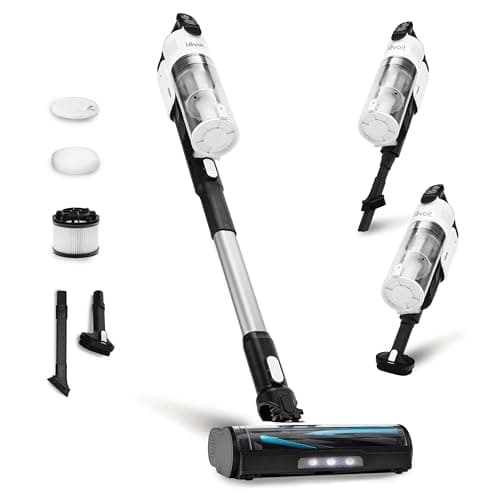
Levoit Anti-Tangle Cordless VacuumThe only listing in this price band that publishes runtime three ways instead of quoting the flattering number and hoping you do not ask.
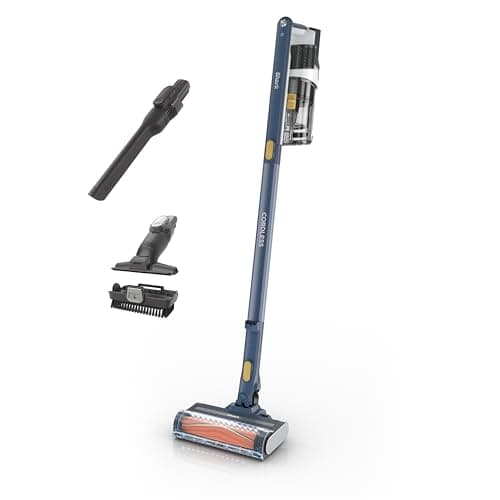
Shark Cordless Pet (IY143H)Doubles the dust cup over the IX141 and adds the self-cleaning brushroll, which is the single feature that matters if a dog lives here.
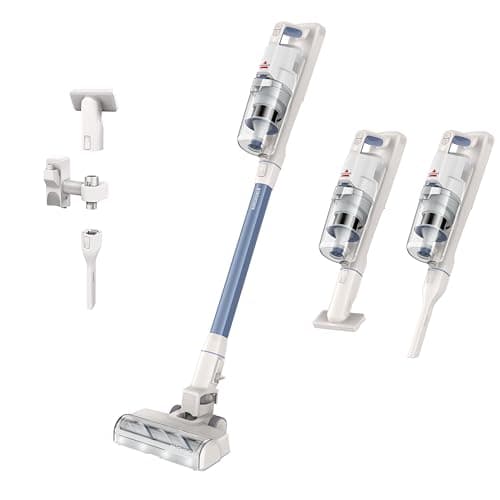
Bissell PowerClean 200W Self-Standing Cordless (4173)The only machine here that stands up on its own when you stop, which sounds trivial until you have leaned a vacuum against a wall for the tenth time.
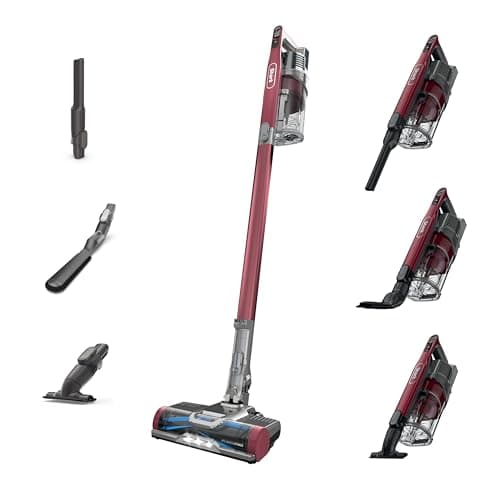
Shark Anti-Allergen Cordless (IZ362H)Same 181 W platform as the rest, but the removable battery is the spec that decides whether this machine is alive in year four.
Shark Pet Cordless Stick Vacuum (IX141)The cheapest machine here from a brand that still sells parts in five years, and the runtime is honest about where it was measured.
Tikom V500 Cordless VacuumA 1.3-liter bin and a published 40 kPa figure, undercut by a 32-minute runtime that the listing states plainly rather than burying.
Vacmaster VSD1001 10.8V 2-in-1 CordlessA 24-minute, 10.8 V machine that does not pretend to be anything else — which at the bottom of the market is the rarest feature of all.
Scores are ours, from the published rubric on the How We Pick page. They are editorial judgments about published specifications — not test results. We have not handled these machines.
01 · Longest published runtime
Tineco A30S Cordless Vacuum
Sixty minutes on the crevice tool and forty with the powered head, published separately — and 67 dB, which is the quietest figure on this page.
Up to 60 minutes with the 2-in-1 crevice brush; 40 minutes with the ZeroTangle brush
Suction
160 W suction, manufacturer-stated
Weight
5.3 lb
Dust cup
1 liter
Filtration
HEPA
Rated noise
67.1 dB
Brushroll
ZeroTangle
First charge
4-5 hours before first use, manufacturer-stated
Every figure above is the manufacturer's own published number. Where a manufacturer publishes nothing, the row says "Not published" rather than an estimate.
What the numbers say
+Publishes a suction figure (160 W) at all, which most of this price band refuses to do
+1-liter bin, 5.3 lb, and the runtime split is stated by tool
+67.1 dB rated — around 13 dB below the Shark line, which is a large perceived difference
Where it stops
−Tineco's spare parts network is thinner than Shark's or Bissell's
−The 60-minute headline is the crevice-tool figure; the number that matters is 40
−No stated battery-cycle rating, so battery life over years is unknowable from the sheet
Who it is for
Apartments and shared walls, where 67 dB versus 80 dB is the difference between cleaning at 9pm and not.
Skip it if
You want to buy replacement parts at a big-box store in three years. Shark and Bissell consumables are on shelves; Tineco's mostly are not.
Our score: 8.0 out of 10
Published power7.5
Runtime8.5
Bin and filtration8.5
Weight and handling9.0
Running cost6.5
Scored against the published rubric on How We Pick. These are judgments about spec sheets, not measurements.
02 · Best published runtime detail
Levoit Anti-Tangle Cordless Vacuum
The only listing in this price band that publishes runtime three ways instead of quoting the flattering number and hoping you do not ask.
Up to 50 minutes in Eco with the crevice or pet tool; 30 minutes with the powered floor head; 12 minutes in Turbo
Motor
180 watts
Battery
22.2 V
Weight
6.2 lb
Dust cup
0.75 liters
Filtration
5-stage, rated to capture 99.9% of particles down to 0.3 microns, tested per ASTM F1977-22
Filter replacement interval
Every 3 months, manufacturer-stated
Suction in air watts or Pa
Not published
Every figure above is the manufacturer's own published number. Where a manufacturer publishes nothing, the row says "Not published" rather than an estimate.
What the numbers say
+Publishes runtime by mode and by tool, which is the honest way to state it and almost nobody does
+6.2 lb, the lightest full-size stick here
+Lies flat at 180 degrees to get under furniture
+Names its filtration test standard (ASTM F1977-22) instead of claiming a bare percentage
Where it stops
−12 minutes in Turbo is the real number for deep carpet work and it is short
−Manufacturer-stated 3-month filter interval is the shortest here, and that is a running cost
−Explicitly dry-messes only
Who it is for
Hard floors and rugs, someone who wants the lightest machine and reads the footnotes.
Skip it if
You have deep pile carpet throughout. Twelve minutes of Turbo will not finish a carpeted house, and running it in Eco on pile is not deep cleaning.
Our score: 7.7 out of 10
Published power6.5
Runtime8.0
Bin and filtration8.5
Weight and handling9.0
Running cost6.5
Scored against the published rubric on How We Pick. These are judgments about spec sheets, not measurements.
03 · Best for long pet hair
Shark Cordless Pet (IY143H)
Doubles the dust cup over the IX141 and adds the self-cleaning brushroll, which is the single feature that matters if a dog lives here.
HEPA with Complete Seal, rated to capture over 99.97% of dust and allergens
Brushroll
Self-cleaning Turbo Pro, published as anti-hair-wrap
Floor detection
FloorDetect, adjusts brushroll speed by floor type
Suction in air watts or Pa
Not published
Every figure above is the manufacturer's own published number. Where a manufacturer publishes nothing, the row says "Not published" rather than an estimate.
What the numbers say
+0.7-quart cup is double the IX141's, which is the difference between one empty and three
+Self-cleaning brushroll is published as anti-hair-wrap, and that claim is specific rather than decorative
+FloorDetect removes the nozzle-swapping step between rug and hardwood
Where it stops
−Still no published suction figure
−Heavier than the IX141 by 0.2 lb, which you notice on stairs and nowhere else
−Battery is not published as user-removable on this model
Who it is for
Pet households with a mix of rug and hard floor, where hair wrap is the actual daily annoyance.
Skip it if
Your floors are entirely hard surface and nothing sheds. You are paying for the anti-tangle brushroll, and on bare floor it does nothing for you.
Our score: 7.5 out of 10
Published power6.0
Runtime7.0
Bin and filtration8.5
Weight and handling7.5
Running cost8.0
Scored against the published rubric on How We Pick. These are judgments about spec sheets, not measurements.
Every figure above is the manufacturer's own published number. Where a manufacturer publishes nothing, the row says "Not published" rather than an estimate.
What the numbers say
+Publishes BOTH runtime figures — 40 minutes low and 13 Turbo — which is the honest disclosure
+Self-standing, so it does not need a wall dock or a wall
+Bissell consumables are stocked in ordinary stores
Where it stops
−13 minutes of Turbo is short if carpet is your main surface
−0.5-liter bin is mid-pack
−The under-$200 suction claim is Bissell's own, against an unnamed comparison set
Who it is for
Small homes with nowhere to drill a dock, and anyone tired of a vacuum that falls over.
Skip it if
You need a wall-mounted charge dock for storage. This one is designed to stand in a corner, and there is no wall mount in the box.
Our score: 7.4 out of 10
Published power6.5
Runtime6.5
Bin and filtration7.5
Weight and handling8.0
Running cost8.5
Scored against the published rubric on How We Pick. These are judgments about spec sheets, not measurements.
05 · Best for allergy households
Shark Anti-Allergen Cordless (IZ362H)
Same 181 W platform as the rest, but the removable battery is the spec that decides whether this machine is alive in year four.
Every figure above is the manufacturer's own published number. Where a manufacturer publishes nothing, the row says "Not published" rather than an estimate.
What the numbers say
+Removable battery — you can replace the cell instead of the machine, which is rare below $250
+Sealed HEPA system rather than a HEPA filter in a leaky body
+Comes with crevice, upholstery and anti-allergen dusting tools
Where it stops
−0.34-quart cup, same small bin as the IX141
−Buying a spare battery costs real money and that changes the value maths
−No published suction number
Who it is for
Allergy households, and anyone who has already thrown away one cordless vacuum because the battery died.
Skip it if
You are buying purely on price. The removable battery is what you are paying extra for, and if you plan to replace the whole vacuum in three years it buys you nothing.
Our score: 7.4 out of 10
Published power6.0
Runtime7.0
Bin and filtration7.5
Weight and handling7.5
Running cost9.0
Scored against the published rubric on How We Pick. These are judgments about spec sheets, not measurements.
06 · Best overall under $200
Shark Pet Cordless Stick Vacuum (IX141)
The cheapest machine here from a brand that still sells parts in five years, and the runtime is honest about where it was measured.
Up to 40 minutes, measured at the hand vac in standard mode
Motor
181 watts
Battery
21.6 V
Weight
6.9 lb
Dust cup
0.34 quarts
Filtration
HEPA and foam
Rated noise
80 dB
Suction in air watts or Pa
Not published
Every figure above is the manufacturer's own published number. Where a manufacturer publishes nothing, the row says "Not published" rather than an estimate.
What the numbers say
+Runtime figure states where it was measured, which most listings in this price band do not
+Converts to a handheld, and the crevice plus pet multi-tool are in the box
+Freestanding storage clips at the base of the wand, so it does not need a wall mount
Where it stops
−0.34-quart cup is the smallest of the Shark cordless line and needs emptying mid-clean in a house
−Bristle brushroll, not the self-cleaning PowerFins head on the dearer models
−No suction figure published in any unit, so it cannot be compared numerically to a Dyson
Who it is for
One-bedroom or two-bedroom homes, mostly hard floor with rugs, where 40 minutes is two full cleans rather than half of one.
Skip it if
You have long-haired pets and no patience for cutting hair off a brushroll. This model publishes no anti-hair-wrap claim; the IY143H and IZ376H do.
Our score: 7.2 out of 10
Published power6.0
Runtime7.0
Bin and filtration6.0
Weight and handling8.0
Running cost8.5
Scored against the published rubric on How We Pick. These are judgments about spec sheets, not measurements.
07 · Biggest bin for the money
Tikom V500 Cordless Vacuum
A 1.3-liter bin and a published 40 kPa figure, undercut by a 32-minute runtime that the listing states plainly rather than burying.
21.6 V, 6 x 2000 mAh, detachable for separate charging
Weight
5.5 lb
Dust cup
1.3 liters
Filtration
7-stage HEPA cyclone, rated at 99.99% of microscopic dust
Rated noise
70 dB
Every figure above is the manufacturer's own published number. Where a manufacturer publishes nothing, the row says "Not published" rather than an estimate.
What the numbers say
+1.3-liter bin is the largest here by a distance
+Detachable battery pack, so a spare is possible
+Publishes both a Pa figure and a wattage
Where it stops
−32 minutes is the shortest headline runtime on the page
−Pa figures are not comparable across brands and Tikom does not publish air watts
−Small brand, so parts availability in year three is a genuine unknown
Who it is for
Someone doing one big weekly clean of a small space who would rather not stop to empty.
Skip it if
You want a machine you can still buy a brushroll for in 2030. Buy the Shark or the Bissell instead and accept the smaller bin.
Our score: 7.2 out of 10
Published power7.0
Runtime5.5
Bin and filtration9.0
Weight and handling8.5
Running cost6.0
Scored against the published rubric on How We Pick. These are judgments about spec sheets, not measurements.
08 · Cheapest that is still a real vacuum
Vacmaster VSD1001 10.8V 2-in-1 Cordless
A 24-minute, 10.8 V machine that does not pretend to be anything else — which at the bottom of the market is the rarest feature of all.
Every figure above is the manufacturer's own published number. Where a manufacturer publishes nothing, the row says "Not published" rather than an estimate.
What the numbers say
+4.4 lb and self-standing with a foldable handle
+Honest 24-minute claim rather than a 70-minute headline on the lowest setting
+Converts to a hand vac for cars
Where it stops
−10.8 V is half the voltage of the Shark and Tineco machines and it will show on carpet
−24 minutes is a room or two, not a house
−No published suction figure of any kind
Who it is for
Studios, dorm rooms, cars, and as a second vacuum that lives upstairs.
Skip it if
Carpet is more than about a third of your floor. This is a hard-floor and quick-cleanup machine and it will disappoint on pile.
Our score: 6.4 out of 10
Published power4.0
Runtime4.5
Bin and filtration7.0
Weight and handling9.0
Running cost8.5
Scored against the published rubric on How We Pick. These are judgments about spec sheets, not measurements.
The one to skip
Skip the Vacmaster VSD1001 if you have any meaningful amount of carpet. It is on this page because it is honest — a 10.8 V machine that publishes 24 minutes and does not pretend otherwise — and at 4.4 lb it is a genuinely good second vacuum for stairs and a car — though a dedicated car vacuum costs less and reaches further under a seat. But 10.8 V is half the voltage of everything else here, and on pile that difference is not marketing. Buying it as your only vacuum is the mistake this page exists to prevent.
There is a second, subtler skip: do not buy the Tikom V500 as a ten-year machine. Its 1.3-liter bin is the largest here and its 40 kPa figure is published, both genuine positives. But it is a small brand, its 32-minute runtime is the shortest headline on the page, and if a brushroll or a battery fails in year three, you are unlikely to be able to buy one. That is a fine trade at the right price and a bad one if you expect longevity.
What you give up against the flagship
Every figure below is manufacturer-published. The comparison is Dyson's own V8, the cheapest current flagship.
Published figure
Dyson V8
Shark IY143H
Tineco A30S
What the difference means
Rated runtime
40 min
40 min
40 min (powered brush)
Identical. The money is not buying minutes.
Bin capacity
0.14 gal
0.7 qt
1 L
Both budget machines hold MORE than the flagship.
Weight
5.6 lb
7.1 lb
5.3 lb
The Tineco is lighter than the Dyson.
Suction, comparable unit
Not published for the V8
Not published
160 W stated
Nobody in this field publishes air watts except Dyson's dearer models.
Warranty
2 years
Not published on the listing
Not published on the listing
This is a real gap and it is where the money goes.
Filtration claim
99.99% to 0.3 microns
Over 99.97%, Complete Seal
HEPA
Comparable on the face of it; only Shark names a test standard elsewhere in its range.
Read that table honestly and the conclusion is narrow but real: on published runtime, capacity and weight, the budget machines match or beat the entry-level flagship. What the extra money buys is a stated 2-year warranty, a manufacturer that will still sell you a battery in 2034, and materials that survive being knocked into skirting boards. Those are worth buying. They are just not what the runtime number on the box implies you are buying. The full arithmetic is on the Dyson alternatives page.
What we cannot tell you
We have not used any of these machines and we are not going to imply otherwise. Published specifications cannot tell you how a vacuum feels to push, how loud 80 dB is in your specific hallway, whether the trigger gets tiring, how the plastic holds up after three years, or how well any of them actually lift embedded grit from a particular carpet pile. Those are real questions and a spec sheet does not answer them. Our method page sets out exactly where our evidence stops.
How to choose in one paragraph
If your floors are mostly hard with rugs and you want the best sheet, buy the Tineco A30S. If a dog lives there, buy the Shark IY143H for the anti-tangle brushroll and the parts network. If you have thrown away a cordless vacuum because the battery died, buy the Shark IZ362H for the removable cell. If your budget is genuinely tight, buy a corded machine instead and read cordless versus corded first — it is the honest answer more often than this category likes to admit.
Common questions
What is the best budget cordless vacuum?+−
On published specifications, the Tineco A30S: 160 W of stated suction, 40 minutes with the powered brush, a 1-liter bin, 5.3 lb and a 67.1 dB noise rating — the strongest sheet on this page. For a pet household or for long-term parts availability, the Shark IY143H is the better buy.
How much should I spend on a cordless vacuum?+−
The useful features arrive between roughly $120 and $200: a driven anti-tangle brushroll, sealed HEPA filtration, and a bin over half a liter. Above that you are largely paying for build quality, warranty length and parts supply, which are real but do not change how clean the floor gets.
Do cheap cordless vacuums lose suction over time?+−
The published mechanism is battery degradation rather than motor wear: lithium cells lose capacity with cycles, and most brands in this band publish no cycle rating at all. That is why a removable battery, which the Shark IZ362H and Tikom V500 both publish, matters more than any suction figure.
Is 40 minutes of runtime enough?+−
For a one or two-bedroom home, comfortably — that is two full cleans. Bear in mind the qualifier: Shark measures its 40 minutes at the handheld in standard mode with no powered floor head, and Levoit's equivalent figure with the powered head attached is 30 minutes, falling to 12 in Turbo.
Which budget cordless vacuum is best for pet hair?+−
The Shark IY143H, on published features: a self-cleaning anti-tangle brushroll, a 0.7-quart bin (double the IX141's), and HEPA with a Complete Seal. Anti-tangle is the specification that matters here — everything else is secondary if you are cutting hair off a brushroll every week.
Are Pa suction numbers worth comparing?+−
Not between brands. Pascals measure sealed static pressure, every manufacturer measures it differently, and none publish their method. A 55,000 Pa claim and a 40,000 Pa claim from two different brands are not a comparison.
Sources
Manufacturer-published specifications — Every runtime, wattage, capacity, weight, filtration and warranty figure quoted on this page is the manufacturer's own published number for that model, retrieved September 1, 2026. Where a manufacturer publishes no figure, the page says 'Not published' rather than estimating one.
ASTM F1977 — standard test method for vacuum cleaner filtration efficiency — Named by Shark (tested by IBR Laboratories, per ASTM F1977-22) and by Levoit (ASTM F1977-22) in their own published filtration claims. Where a brand names this standard we treat the claim as checkable; where a brand states a bare percentage we do not.
Sweep & Suction — How We Pick — Our published method, including the scoring rubric, the three-year running-cost formula and an explicit statement of what published specifications cannot tell you.