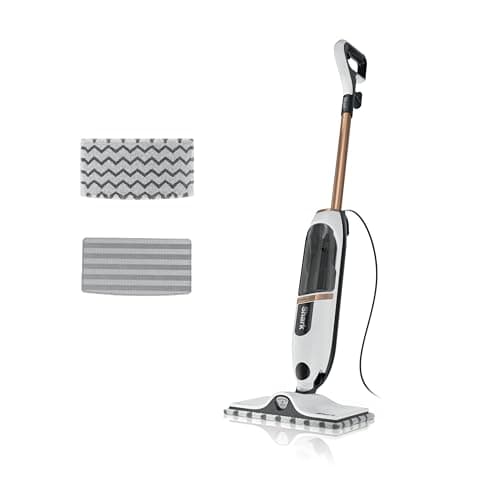
One buys a bottle forever and cleans with chemistry. The other buys a machine once and cleans with heat. The floors in your house decide which of those is even permitted.
Everyone in this category says they tested twenty vacuums. We have not tested any, and we say so. What we do instead is read the manuals, compile the published specifications, and work out what each machine costs to run for three years — the method is written out in full.
We earn a commission if you buy through the links on this page, at no extra cost to you. It never changes what we recommend or the order we recommend it in. Full disclosure.
The verdict: buy the steam mop unless your floor rules it out. Steam uses tap water, washable pads and no chemistry, which means the running cost after the purchase is electricity and nothing else — and two machines here publish a sanitization claim that no liquid cleaner and pad system on this page matches. The case for a solution-based mop is narrower and real: it applies no heat and no standing moisture, which makes it the compliant answer on floors whose own warranty excludes steam, and it is the cheaper thing to put in a cart today.
They are not doing the same thing
A liquid floor cleaner is chemistry on a pad. A surfactant loosens soil, the pad picks it up, and whatever the pad does not lift stays on the floor and dries. A steam mop is heat and moisture with no chemistry at all: the water is converted to vapor, the vapor softens what is stuck, and a microfiber pad wipes it away. Neither of them extracts — that is a carpet cleaner's job and a different machine — so on both systems the pad is the part doing the collecting.
The practical consequence is that they fail differently. A solution mop can leave residue, and residue attracts soil, which is the mechanism behind floors that look dull a week after being cleaned. A steam mop cannot leave residue because it has nothing to leave — but it applies heat and moisture to a surface, and that is exactly what some floors are not rated for.
The comparison, on published figures
Every figure is the manufacturer's own published claim for that product.
Steam (Shark S2001)
Steam (Bissell 1940A)
Solution and pad (Swiffer PowerMop)
Cleaning agent
Tap water only
Tap water only
Proprietary pre-mixed solution, purchased forever
Heat
1,200 W, three steam modes plus a burst
1,500 W, three steam settings
None
Sanitization claim
Removes 99.9% of common household bacteria using water alone
Kills 99.9% of germs, bacteria and viruses when used as directed
None published
Pads
Washable Dirt Grip and scrub pads
Washable pad
Disposable; refills purchased forever
Published surface rating
All sealed hard floors
Sealed hardwood, tile and ceramic, granite, marble
All finished floors; not unfinished, oiled or waxed wood, non-sealed tile, or carpet
Recurring cost
Electricity only
Electricity only
Pads plus solution plus batteries
Warranty
Not published on the listing
2-year limited
Not published on the listing
The two sanitization claims are the manufacturers' own wording. Neither names a test standard, so we treat both as claims rather than measurements.
Where the steam mop genuinely wins
No consumable. Washable pads and tap water. Once the machine is bought, the only recurring cost is electricity, and at the U.S. average residential price of 18.34 cents per kWh a 1,050 W mop run 30 minutes a week costs about $15.02 over three years. The full arithmetic is here.
A sanitization claim. Shark publishes removal of 99.9% of common household bacteria using water alone; Bissell publishes killing 99.9% of germs, bacteria and viruses when used as directed. No solution-and-pad system on this page publishes anything comparable. Neither steam claim names a test standard, so read them as claims — but they are claims the other side of this comparison does not make at all.
No residue, by construction. There is no chemistry to leave behind, which is the failure mode people describe when a floor looks dull shortly after mopping.
Nothing to run out of at 9pm. Tap water is always in the house. A refill bottle is not.
Where the solution mop is the right answer
When your floor warranty excludes steam. This is the big one and it is not rare. Laminate and some luxury vinyl warranties rule out steam regardless of the machine, and no steam mop's own rating overrides your flooring manufacturer's document. A mop applying no heat and no standing moisture is the compliant option, and being compliant beats being better. Which floors are safe for steam sets out the general rules, and the laminate and vinyl roundup quotes each machine's own surface list.
When the floor is unsealed. Unsealed tile, unfinished, oiled or waxed wood — Swiffer publishes those exclusions explicitly, and every steam mop on this site excludes them too. On those floors neither system is ideal, and a barely-damp traditional mop is the honest answer.
When you want to spend the least today. A solution mop costs a fraction of a steam mop up front. It costs more over years, which is the trade, but the up-front number is the one some households actually have.
When there is no outlet. The Swiffer runs on batteries with no mains cord. Every steam mop here needs a wall socket and publishes a cord length — 18 feet on the Shark S1000, 23 on the Bissell 1940A.
#
Product
Best for
Score
Price
01
Shark SteamSpot with Steam Blaster (S2001)A 500 ml tank and three steam modes at under 5 lb — the most usable combination of numbers on this page.
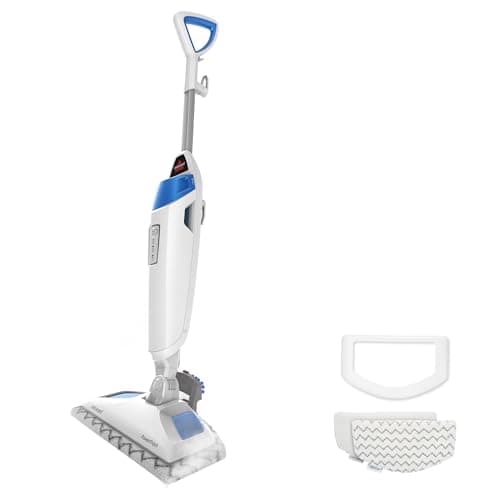
Bissell PowerFresh Steam Mop (1940A)Three steam settings, a flip-down scrubber and a 23-foot cord, with a two-year warranty that is double everything Shark offers.
Shark Steam Pocket Mop (S3501)Double-sided pads flip mid-clean, which halves how often you stop to change them — a small idea that beats a bigger tank in practice.
Swiffer PowerMop Mopping KitThe cheapest thing on the shelf and the most expensive over three years — it is here as the comparison, not the recommendation.
Scores are ours, from the published rubric on the How We Pick page. They are editorial judgments about published specifications — not test results. We have not handled these machines.
01 · Best big tank under 5 lb
Shark SteamSpot with Steam Blaster (S2001)
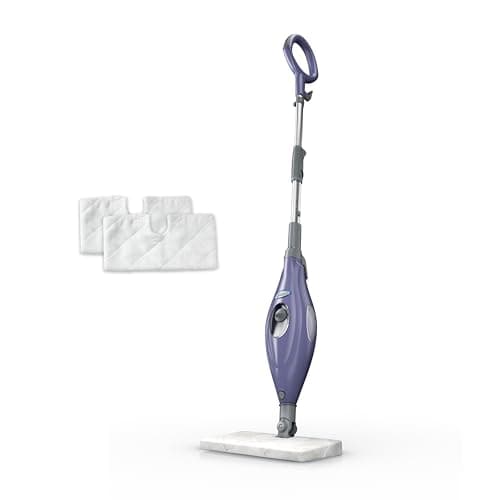
A 500 ml tank and three steam modes at under 5 lb — the most usable combination of numbers on this page.
3 — Light, Normal, Deep, plus a targeted Steam Blaster burst
Stain-removal claim
Up to 50% better stuck-on stain removal versus a traditional steam mop
Pads
1 Dirt Grip pad and 1 stiffer scrub pad, both washable
Sanitization claim
Removes 99.9% of common household bacteria using water alone
Rated surfaces
All sealed hard floors
Every figure above is the manufacturer's own published number. Where a manufacturer publishes nothing, the row says "Not published" rather than an estimate.
What the numbers say
+500 ml is the largest tank here and it comes in under 5 lb, which no other machine on this page manages
+Three steam modes plus the targeted blaster
+Two pad types in the box — one for maintenance, one for scrubbing
Where it stops
−Only one of each pad, so you are doing laundry sooner than with the four-pad Steam & Scrub
−No rotating scrub head, so it is 50% better rather than the Steam & Scrub's 2x
−The 50% claim does not name its test standard, unlike the S8001's
Who it is for
Anyone who wants the fewest refills and the least weight, which is most people.
Skip it if
You need mechanical scrubbing. This is steam plus a textured pad; if a flat pad has already failed on your floors, buy the S8001.
Our score: 8.6 out of 10
Steam control9.0
Tank size9.5
Weight and handling9.0
Pad system6.5
Running cost9.0
Scored against the published rubric on How We Pick. These are judgments about spec sheets, not measurements.
02 · Best for tile and grout
Bissell PowerFresh Steam Mop (1940A)
Three steam settings, a flip-down scrubber and a 23-foot cord, with a two-year warranty that is double everything Shark offers.
Flip-down Easy Scrubber for dried-on messes and grout
Cord
23 feet
Cleaning path
12 inches
Sanitization claim
Kills 99.9% of germs, bacteria and viruses when used as directed
Warranty
2-year limited
Rated surfaces
Sealed hard floors — sealed hardwood, tile and ceramic, granite, marble
Every figure above is the manufacturer's own published number. Where a manufacturer publishes nothing, the row says "Not published" rather than an estimate.
What the numbers say
+Three steam settings — the only genuinely variable machine under $110 here
+Built-in flip-down scrubber is the correct tool for grout and nobody else at this price has one
+23-foot cord, the longest published here
+2-year warranty, double Shark's across the line
Where it stops
−6.2 lb, the heaviest steam mop on this page
−Scent discs are an optional consumable that quietly adds up if you start using them
−1,500 W is the highest draw here, which matters if the outlet is shared
Who it is for
Tile and grout kitchens and bathrooms, where the mess is baked on rather than dusty.
Skip it if
Your floors are all sealed hardwood. You are paying for a grout scrubber you will never flip down, and the lighter Shark units suit hardwood better.
Our score: 7.7 out of 10
Steam control9.0
Tank size6.5
Weight and handling6.5
Pad system7.5
Running cost8.5
Scored against the published rubric on How We Pick. These are judgments about spec sheets, not measurements.
03 · Best pad value
Shark Steam Pocket Mop (S3501)
Double-sided pads flip mid-clean, which halves how often you stop to change them — a small idea that beats a bigger tank in practice.
2 double-sided washable microfiber Dirt Grip pads, plus a filling flask
Sanitization claim
Removes 99.9% of common household bacteria using water alone
Warranty
1-year limited
Rated surfaces
All sealed hard floors
Every figure above is the manufacturer's own published number. Where a manufacturer publishes nothing, the row says "Not published" rather than an estimate.
What the numbers say
+Double-sided pads: flip the head and keep going instead of walking to the laundry
+15.2 fl oz, 20% more than the S1000
+Filling flask included, which sounds trivial and is not
+Published bacteria-removal claim with the chemical-free qualifier stated
Where it stops
−Still a single steam output with no modes
−Rectangular head is worse in corners than a triangular one
−1-year warranty
Who it is for
Whole-floor cleans where the interruption you actually resent is swapping a dirty pad.
Skip it if
You want variable steam for a mix of delicate laminate and greasy kitchen tile. Buy the SteamSpot or the Bissell for that.
Our score: 7.3 out of 10
Steam control4.0
Tank size5.5
Weight and handling8.5
Pad system9.0
Running cost9.5
Scored against the published rubric on How We Pick. These are judgments about spec sheets, not measurements.
04 · The disposable-pad alternative
Swiffer PowerMop Mopping Kit
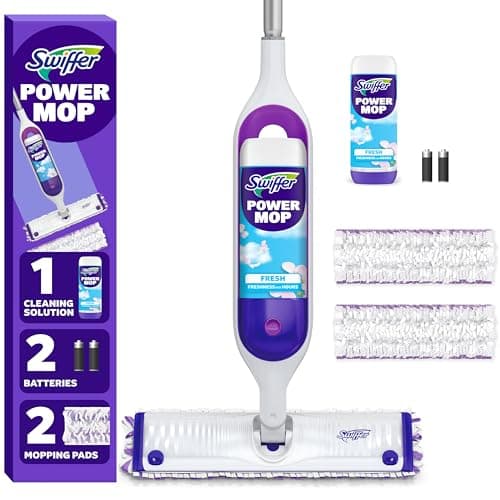
The cheapest thing on the shelf and the most expensive over three years — it is here as the comparison, not the recommendation.
All finished floors. Manufacturer states: do NOT use on unfinished, oiled or waxed wood, non-sealed tile, or carpet
Weight
Published as a kit weight only
Every figure above is the manufacturer's own published number. Where a manufacturer publishes nothing, the row says "Not published" rather than an estimate.
What the numbers say
+Lowest possible entry price and it lives in a cupboard taking up nothing
+No cord, no heat-up, no tank to fill
+The swivel head genuinely does reach under furniture
Where it stops
−Pads AND solution are both consumables you buy forever — this is the razor-and-blades model
−No heat and no sanitization claim, so it is not doing what a steam mop does
−Batteries are another consumable
Who it is for
Renters staying under a year, and anyone who genuinely will not maintain a machine.
Skip it if
You will still own the floor in two years. Run the arithmetic on our steam-mop-versus-Swiffer page first; the crossover comes fast.
Our score: 4.3 out of 10
Steam control1.0
Tank size5.0
Weight and handling9.5
Pad system4.0
Running cost2.0
Scored against the published rubric on How We Pick. These are judgments about spec sheets, not measurements.
The cost, over three years
This is where the comparison stops being close. A steam mop's recurring cost is electricity — call it fifteen to twenty-two dollars over three years depending on wattage, on the EIA's published average residential rate. A solution mop's recurring cost is disposable pads plus proprietary refill solution plus batteries, bought at whatever they cost on the day you run out, forever.
We are not going to put a dollar figure on the refills, because refill pricing moves and this site does not publish a price it has not verified through its own live lookup. What we will say is the shape: the machine that costs more today costs less every year after, and the crossover is not far out. That is the same argument steam mop versus Swiffer runs in detail.
What we cannot tell you
Which one gets a specific floor visibly cleaner. There is no shared test standard for household floor cleaning, the two sanitization claims here come from two manufacturers using their own methods, and we have not run either system. We also cannot read your flooring warranty for you — and on this particular question that document outranks everything on this page.
How to choose in one paragraph
Check the floor warranty first. If steam is allowed, buy the Shark SteamSpot S2001 for the biggest tank in the lightest body, or the Bissell PowerFresh 1940A if the floors are tile and grout and you want the longest published warranty on this page. If steam is excluded, or the floor is unsealed, buy the Swiffer PowerMop and treat the refills as the price of compliance. And if what you are actually trying to clean is carpet, neither of these is the machine — an extractor is.
Common questions
Is a steam mop better than a floor cleaner?+−
On running cost and on published sanitization claims, yes: steam uses tap water and washable pads, so the only recurring cost is electricity, and two machines on this site publish a 99.9% bacteria claim that no solution-and-pad system here matches. The exception is any floor whose own warranty excludes steam, where a no-heat solution mop is the only compliant option.
Do steam mops need cleaning solution?+−
No, and adding it is usually against the manufacturer's instructions. Every steam mop on this site is designed around plain tap water — the heat does the work. That is also why their running cost is electricity and nothing else.
Does a steam mop disinfect better than a floor cleaner?+−
Both steam mops on this page publish a 99.9% claim — Shark for common household bacteria using water alone, Bissell for germs, bacteria and viruses when used as directed. The Swiffer PowerMop publishes no sanitization claim at all. Neither steam claim names a test standard, so treat them as manufacturer claims rather than measurements.
Which is cheaper, a steam mop or a solution mop?+−
The solution mop is cheaper today and more expensive every year after. Its pads are disposable and its solution is proprietary, both bought forever. A steam mop's pads are washable and its water comes from the tap, so after purchase the only recurring cost is electricity — about $15 to $22 over three years at the EIA's average residential rate, depending on wattage.
Can you use a floor cleaner solution on laminate?+−
More often than steam, yes — a mop that applies no heat and no standing moisture is what many laminate warranties permit when steam is excluded. Swiffer publishes its PowerMop as rated for all finished floors, with unfinished, oiled or waxed wood, non-sealed tile and carpet excluded. Your flooring manufacturer's warranty is still the authority.
Will a steam mop leave streaks?+−
It has no chemistry to leave behind, which is the mechanism behind residue and the dull look that follows it. What steam mops can leave is moisture if the pad is saturated, which is why the machines with three published steam settings are easier to run light on a delicate floor than the ones with a single fixed output.
Sources
Manufacturer-published specifications — Every runtime, wattage, capacity, weight, filtration and warranty figure quoted on this page is the manufacturer's own published number for that model, retrieved September 1, 2026. Where a manufacturer publishes no figure, the page says 'Not published' rather than estimating one.
Sweep & Suction — How We Pick — Our published method, including the scoring rubric, the three-year running-cost formula and an explicit statement of what published specifications cannot tell you.