Bagless machines have won the market on running cost. Bagged machines are still right for one specific household, and it is worth knowing whether you are it.
Everyone in this category says they tested twenty vacuums. We have not tested any, and we say so. What we do instead is read the manuals, compile the published specifications, and work out what each machine costs to run for three years — the method is written out in full.
We earn a commission if you buy through the links on this page, at no extra cost to you. It never changes what we recommend or the order we recommend it in. Full disclosure.
Buy bagless unless someone in the house has a dust allergy. Bagless is cheaper to own — washable filters, no consumable — and it is what almost every machine on this site is. Bagged is the better answer for one specific problem: emptying a bagless bin releases a cloud of exactly what you just collected, and a sealed bag does not.
The running cost is the whole bagless argument
A bagless machine's consumable is a filter, and on most of the machines here it is not even that. The Bissell CleanView Compact publishes a washable disk filter. The Eureka Whirlwind publishes washable HEPA and states outright that it has no maintenance cost. The Shark NV356E publishes washable HEPA plus foam. Rinse, dry, refit — the running cost rounds to zero.
A bagged machine's consumable is a bag, and bags never stop costing money. Over five years that is a real recurring number, and it is the single reason the market moved. It is also a supply risk: a bagged vacuum whose specific bag is discontinued becomes scrap, whereas a bagless machine with a washable filter has nothing to discontinue.
The bagged argument is about the moment you empty it
This is the part the running-cost comparison misses. Emptying a bagless cup means opening a container of concentrated fine dust, usually over a bin, usually indoors. Whatever your filtration rating, that moment puts a proportion of what you collected straight back into the air you are standing in.
A bagged machine's bag is sealed and goes in the bin closed. That is the whole allergy case, and it is a good one — which is why the Kenmore Intuition is on this site at all, with HEPA filtration, a two-motor design and a Hair Eliminator brushroll. If someone in the house reacts to dust, the bag is worth its ongoing cost — and the bagged roundup ranks the eight machines that offer it.
The published figures
Manufacturer-published filtration and consumable details.
The Shark NV356E is worth noting: it is bagless AND names its filtration test standard and the laboratory that ran it, which is more specificity than the bagged machine publishes.
What people get wrong
"Bagged vacuums have better filtration." Not necessarily, and the sheets here say otherwise: the bagless Shark NV356E names ASTM F1977-22 and the lab that tested it, while the bagged Kenmore publishes "HEPA" and no standard. Filtration quality is a property of the machine, not of the bag.
"Bagless machines lose suction as the bin fills." Both do — a full bag restricts airflow at least as much as a full bin. What is true is that a bagless bin is transparent, so you can see the problem, whereas a bag hides it until performance drops.
"Washable filters mean no maintenance." They mean no cost, not no maintenance. A washable filter needs to be fully dry before it goes back in, and refitting a damp filter is the most common way people quietly ruin a bagless vacuum. Eureka and Bissell both publish the rinse-and-dry instruction; almost nobody follows it.
#
Product
Best for
Score
Price
01
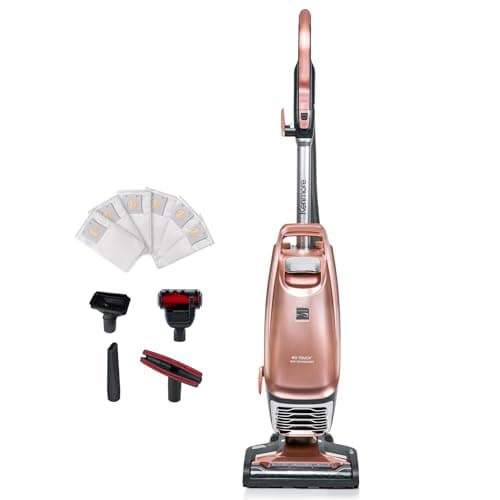
Kenmore Intuition Bagged UprightA two-motor bagged upright with HEPA and a hair-eliminator brushroll: the argument for bags, if you are going to make one.
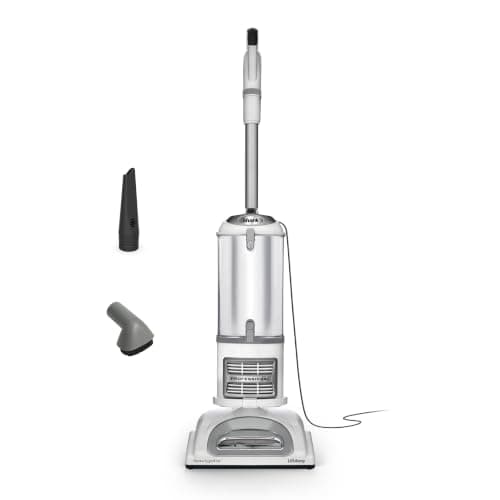
Shark Navigator Lift-Away (NV356E)1,200 W with a genuinely sealed HEPA system and a detachable pod, at a price the cordless machines cannot match on either count.
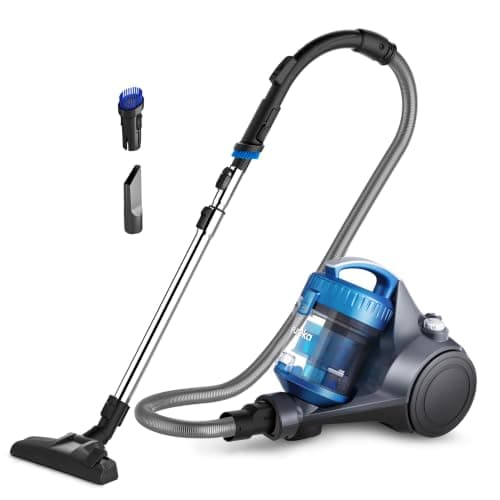
Eureka Whirlwind Bagless Canister (NEN110A)960 W, a 2.5-liter bin, automatic cord rewind and washable filters — the canister case, made cheaply and made honestly.
Scores are ours, from the published rubric on the How We Pick page. They are editorial judgments about published specifications — not test results. We have not handled these machines.
01 · Best bagged option
Kenmore Intuition Bagged Upright
A two-motor bagged upright with HEPA and a hair-eliminator brushroll: the argument for bags, if you are going to make one.
Pet Handi-Mate powered tool, 3-in-1 combination tool
Runtime
Unlimited — corded
Bag cost
Ongoing consumable — see the running-cost table on the bagged-vs-bagless page
Every figure above is the manufacturer's own published number. Where a manufacturer publishes nothing, the row says "Not published" rather than an estimate.
What the numbers say
+Bagged emptying does not put a dust cloud back into the room, which matters for allergies
+Two motors means brushroll speed does not fall away as suction loads up
+HEPA plus a powered pet tool
Where it stops
−Bags are a permanent running cost the bagless machines do not have
−Heavier and bulkier than the bagless uprights here
−Bag availability is the long-term risk with any bagged machine
Who it is for
Allergy households who empty a bagless cup and immediately regret it.
Skip it if
You want the lowest possible cost of ownership. Bags never stop costing money, and over five years that is the whole argument against.
Our score: 7.7 out of 10
Published power8.0
Runtime10.0
Bin and filtration9.0
Weight and handling5.5
Running cost6.0
Scored against the published rubric on How We Pick. These are judgments about spec sheets, not measurements.
02 · Best sealed HEPA under $200
Shark Navigator Lift-Away (NV356E)
1,200 W with a genuinely sealed HEPA system and a detachable pod, at a price the cordless machines cannot match on either count.
Washable HEPA plus foam, Anti-Allergen Complete Seal; rated to trap 99.9% of dust and allergens per ASTM F1977-22, tested by IBR Laboratories
Rated noise
80 dB
Lift-Away
Detachable pod for above-floor cleaning
Runtime
Unlimited — corded
Every figure above is the manufacturer's own published number. Where a manufacturer publishes nothing, the row says "Not published" rather than an estimate.
What the numbers say
+Names its filtration test standard AND the lab that ran it — the most specific filtration claim on this site
+1,200 W on a driven brushroll deep-cleans carpet properly
+Lift-Away pod covers stairs, which is where most uprights fail
Where it stops
−13.7 lb is the heaviest machine we recommend anywhere
−Washable filters need genuine drying time, and people skip it
−Corded, with everything that implies
Who it is for
Allergy households on carpet who want measured filtration rather than a bare percentage.
Skip it if
You have a lot of stairs and no storage. It is heavy, it is bulky, and the Lift-Away pod only partly solves that.
Our score: 8.4 out of 10
Published power9.0
Runtime10.0
Bin and filtration9.5
Weight and handling4.5
Running cost9.0
Scored against the published rubric on How We Pick. These are judgments about spec sheets, not measurements.
03 · Best canister under $120
Eureka Whirlwind Bagless Canister (NEN110A)
960 W, a 2.5-liter bin, automatic cord rewind and washable filters — the canister case, made cheaply and made honestly.
Telescoping metal wand with integrated crevice tool
Every figure above is the manufacturer's own published number. Where a manufacturer publishes nothing, the row says "Not published" rather than an estimate.
What the numbers say
+2.5-liter bin and washable HEPA — no bags, no filter bills
+The body stays on the floor, so stairs and above-floor work are far easier than with an upright
+Automatic cord rewind, which is a small luxury that is missing at this price everywhere else
Where it stops
−No powered brushroll, so deep pile carpet is not its job
−Dragging a canister around furniture annoys some people permanently
−82 dB
Who it is for
Hard floors, stairs, cars and upholstery — the classic canister case.
Skip it if
Wall-to-wall carpet is your main floor. Suction alone does not agitate pile; you want a driven brushroll.
Our score: 8.4 out of 10
Published power8.5
Runtime10.0
Bin and filtration8.5
Weight and handling7.0
Running cost9.5
Scored against the published rubric on How We Pick. These are judgments about spec sheets, not measurements.
04 · Best under $80
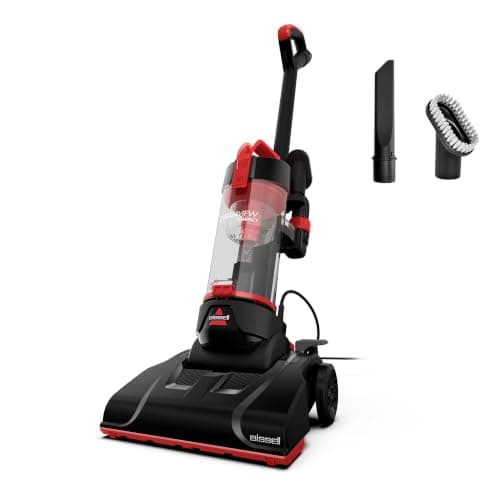
Bissell CleanView Compact (3508)
Under 8 lb, corded, 1-liter tank and a washable filter — the cheapest way to own a vacuum with no battery to replace.
Every figure above is the manufacturer's own published number. Where a manufacturer publishes nothing, the row says "Not published" rather than an estimate.
What the numbers say
+No battery, so the three-year running cost is a washable filter and nothing else
+Scatter-free hard floor design, which is the usual failing of a cheap upright
+Light enough to carry upstairs one-handed
Where it stops
−You are tethered to an outlet, and that is the whole trade
−No HEPA claim
−Small machine, so a whole-house clean means moving the plug a lot
Who it is for
Apartments, dorms and anyone who wants the lowest possible cost of ownership over five years.
Skip it if
The reason you are shopping is that you hate cords. Nothing about this machine will change your mind and you will not use it.
Our score: 7.9 out of 10
Published power6.0
Runtime10.0
Bin and filtration6.5
Weight and handling8.5
Running cost9.5
Scored against the published rubric on How We Pick. These are judgments about spec sheets, not measurements.
How to decide
Anyone in the house reacts to dust? Bagged, and accept the ongoing cost.
Lowest cost of ownership? Bagless with a washable filter. The Eureka Whirlwind and the Bissell CleanView both publish exactly that.
Keeping the machine ten years? Bagless, on supply risk alone — a discontinued bag ends a bagged vacuum's life.
Hate touching dust but no allergy? Look at Shark's CleanTouch Dirt Ejector, published on the IX141 and IZ376H, which empties the cup without you reaching into it.
What we cannot tell you
How much dust a specific bagless bin actually releases when emptied. No manufacturer publishes that measurement, and we have not made one. The mechanism is obvious and the magnitude is not, so we describe the trade rather than quantify it.
Common questions
Are bagged vacuums better for allergies?+−
The emptying moment is the difference: a sealed bag goes into the bin closed, while a bagless cup releases a proportion of what it collected back into the room. That is the genuine allergy case. Filtration quality itself is a property of the machine — the bagless Shark NV356E names a stricter, more checkable standard than the bagged Kenmore does.
Do bagless vacuums cost less to run?+−
Yes, and the gap is structural. Most bagless machines here publish washable filters, which means no consumable at all. Bags never stop costing money, and a discontinued bag can end a machine's usable life.
Do vacuums lose suction as the bag or bin fills?+−
Both do — a full bag restricts airflow at least as much as a full bin. The practical difference is that a bagless bin is transparent, so you see it happening, while a bag hides it until performance drops.
How often should I wash a washable filter?+−
Follow the manufacturer's stated interval — Levoit publishes every 3 months for replacement, and Eureka and Bissell publish rinse-and-dry instructions for their washable filters. The important part is letting it dry completely; refitting a damp filter is the most common way a bagless vacuum gets quietly ruined.
Is a self-emptying robot dock the same as a bagged vacuum?+−
It is the same trade in miniature. iRobot, Roborock, Lefant and ILIFE all use bagged docks — sealed and allergen-rated, with a consumable forever. Shark's AV2501AE dock is bagless with true HEPA — no consumable, but you handle the dust when you empty it.
Sources
Manufacturer-published specifications — Every runtime, wattage, capacity, weight, filtration and warranty figure quoted on this page is the manufacturer's own published number for that model, retrieved September 1, 2026. Where a manufacturer publishes no figure, the page says 'Not published' rather than estimating one.
ASTM F1977 — standard test method for vacuum cleaner filtration efficiency — Named by Shark (tested by IBR Laboratories, per ASTM F1977-22) and by Levoit (ASTM F1977-22) in their own published filtration claims. Where a brand names this standard we treat the claim as checkable; where a brand states a bare percentage we do not.
Sweep & Suction — How We Pick — Our published method, including the scoring rubric, the three-year running-cost formula and an explicit statement of what published specifications cannot tell you.