Sand is the mess that kills vacuums. It is dense enough to fill a bin by weight, fine enough to pass a cheap filter, and abrasive enough to wear a motor from the inside.
Everyone in this category says they tested twenty vacuums. We have not tested any, and we say so. What we do instead is read the manuals, compile the published specifications, and work out what each machine costs to run for three years — the method is written out in full.
We earn a commission if you buy through the links on this page, at no extra cost to you. It never changes what we recommend or the order we recommend it in. Full disclosure.
The short answer: the Eureka Whirlwind NEN110A. No powered brushroll to fling granules across a hard floor, 960 watts of suction, a 2.5-liter bin and washable HEPA — and nothing to buy again, which matters when the mess is endless. If the sand is getting everywhere and somebody reacts to dust, the Kenmore 600 Series seals it into a HEPA cloth bag, which is the cleanest way to get fine grit out of the house. And if this is a beach rental cleaned hard and often, the Sanitaire SC679K publishes 500 hours of motor life and an 18-quart shake-out bag that costs nothing to empty.
Why sand is a different mess
Three properties, each of which breaks a different assumption a vacuum is built on.
It is heavy. Sand is several times denser than household dust. A bin that holds two weeks of normal debris holds one hallway of tracked sand, and the machine gets noticeably heavier to push as it fills — which is a thing you feel long before the bin looks full.
It is abrasive. Fine silica through a motor is exactly what a motor is not designed for. This is why filtration on a sand machine is not an allergy question but a survival question: what the filter misses goes through the fan.
It scatters. On a hard floor a brushroll at full speed fires heavy granules sideways out of the suction path — the same problem as cat litter and tile, and more pronounced because sand grains are heavier than dust and lighter than litter.
What we looked at
Filtration, as a durability criterion. Two machines here publish a figure with a particle size; two publish HEPA or washable HEPA without one; two publish no claim at all. On sand this is the row that decides how long the machine lasts, not just how clean the air is.
Whether the head scatters. Two machines here have no powered brushroll at all, which on a hard floor is exactly right for heavy granules.
Capacity, read as weight rather than volume. Published capacities run from 2.5 liters to 18 quarts across this page, and one publishes none. Sand fills whichever you buy faster than you expect.
What emptying costs. A bagged machine seals the grit and costs money forever; a bagless bin is free and puts a cloud of fine dust back in the room. One machine here has a shake-out bag that is neither.
Sealed body, not just a sealed filter. A filter only helps if the air is forced through it. Most of this shelf publishes a filter and leaves the air path unstated, and we say so.
Whether it survives the job. One machine here publishes a motor-life figure. Nothing else on this site does.
The published figures side by side
Manufacturer-published figures. "Not published" means the listing gives no figure.
Machine
Type
Brushroll on hard floors
Filtration claim
Capacity
Emptying
Eureka Whirlwind NEN110A
Bagless canister
None fitted
Washable HEPA, no figure
2.5 L
Bagless bin, no consumable
Kenmore 600 Series 81615
Bagged canister
Pet PowerMate is separate and optional
Triple HEPA, 99.97%
Not published
Sealed HEPA cloth bag
Sanitaire SC679K
Commercial upright
Fixed
None published
18 quarts, shake-out
Emptied and reused, no consumable
Vacmaster UB0302E
Bagged upright
Not stated
99.97% at 0.3 microns
2.6 L
One-click bag drop, no touching
Bissell Zing 2154A
Bagged canister
None fitted
None published; washable filters
2.5 L
Sealed bag
Eureka 3670M
Bagged canister
None fitted
None — foam filter only
2.5 L
Sealed bag
Compiled from each machine's own published listing. Not one of the six names a filtration test standard for its claim.
The uncomfortable result in that table: the machine with the biggest capacity and the best durability figure publishes the weakest filtration, and the machine with the best filtration figure publishes no capacity at all. There is no single machine here that wins every column, which is why the picks below are ordered by rubric and the paragraph at the end sorts them by household.
Bagged or bagless, for sand specifically
Sand makes the bagged case stronger than usual. A bagless bin of fine beach sand opened over a trash can releases a visible cloud — you can watch it happen — and that is the dust that was supposed to leave the house. A sealed bag goes into the trash closed. The Vacmaster's one-click bag drop takes that a step further by never opening the dust at all.
Against that: sand fills bags, bags cost money, and a beach house gets through them. The Sanitaire's shake-out bag is the third option — emptied by hand and reused, so it costs nothing and puts you straight back in the dust cloud. The full bagged-versus-bagless arithmetic is here; sand is the mess that makes every trade in it sharper.
#
Product
Best for
Score
Price
01
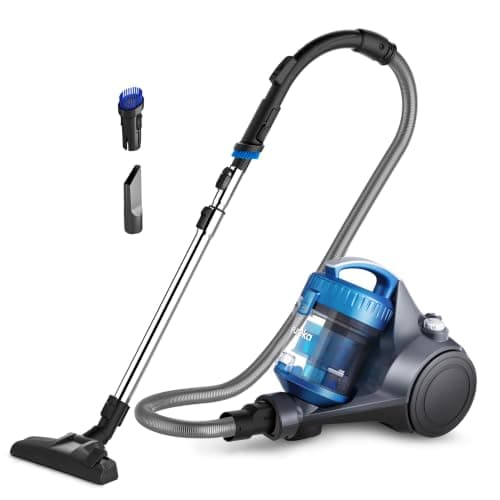
Eureka Whirlwind Bagless Canister (NEN110A)960 W, a 2.5-liter bin, automatic cord rewind and washable filters — the canister case, made cheaply and made honestly.
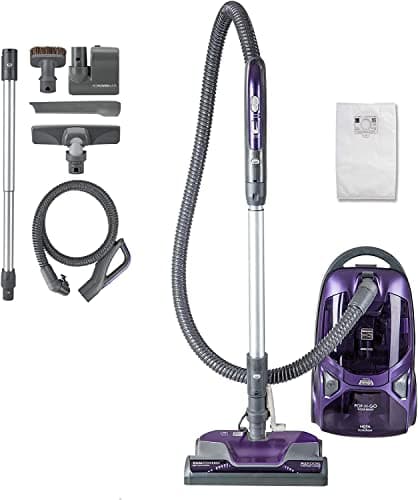
Kenmore 600 Series Pet Friendly Bagged Canister (81615)The only canister on this site that publishes a motorized floor tool and a suction figure measured at the hose end, which together fix the two things canisters are usually bad at.
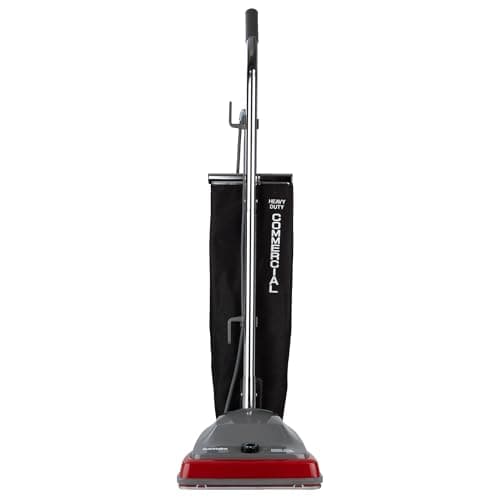
Sanitaire Tradition Upright Commercial Bagged Vacuum (SC679K)An 18-quart shake-out bag, a published motor life of 500 hours and a 30-foot cord, at 12.2 lb. It is the only bagged machine here with no bag to buy — and the only one with no filtration claim at all.
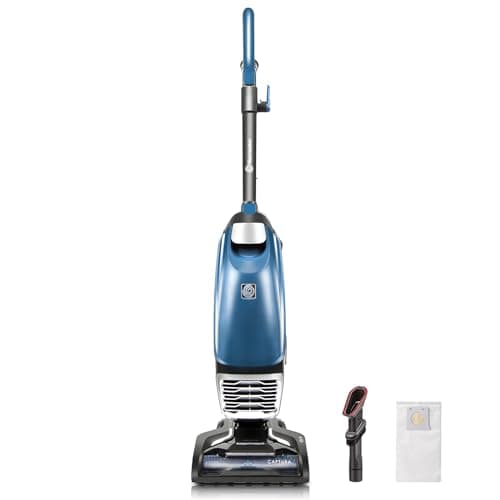
Vacmaster Bagged Upright with HEPA Bags (UB0302E)HEPA bags rated to 99.97% at 0.3 microns, a one-click bag drop so you never touch the dust, and a bag-change indicator — on the cheapest machine on this page.
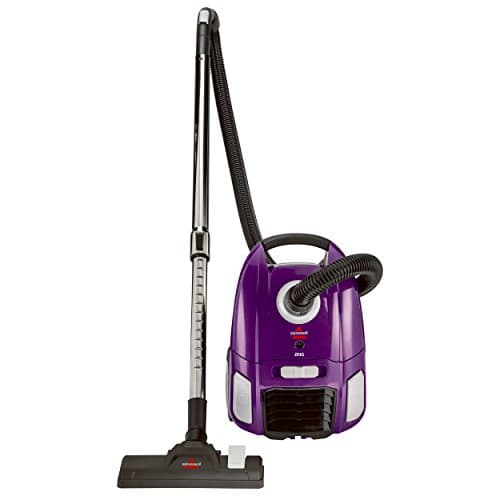
Bissell Zing Bagged Canister (2154A)Seven and a half pounds with automatic cord rewind and a 2.5-liter bag — the canister shape at its lightest, as long as you never need to know how many watts it draws.
Eureka Bagged Canister (3670M)Eight and a half pounds, a 2.5-liter bag and five bags in the box, at the lowest price any real brand charges for a canister — with a foam filter and 90 dB to show for it.
Ranked by our published rubric. For sand specifically, read the filtration row and the capacity row — sand is dense, so a bin fills by weight long before it looks full.
01 · Best canister under $120
Eureka Whirlwind Bagless Canister (NEN110A)
960 W, a 2.5-liter bin, automatic cord rewind and washable filters — the canister case, made cheaply and made honestly.
Telescoping metal wand with integrated crevice tool
Every figure above is the manufacturer's own published number. Where a manufacturer publishes nothing, the row says "Not published" rather than an estimate.
What the numbers say
+2.5-liter bin and washable HEPA — no bags, no filter bills
+The body stays on the floor, so stairs and above-floor work are far easier than with an upright
+Automatic cord rewind, which is a small luxury that is missing at this price everywhere else
Where it stops
−No powered brushroll, so deep pile carpet is not its job
−Dragging a canister around furniture annoys some people permanently
−82 dB
Who it is for
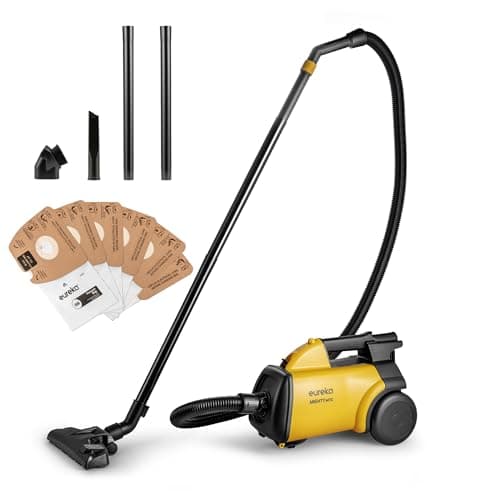
Hard floors, stairs, cars and upholstery — the classic canister case.
Skip it if
Wall-to-wall carpet is your main floor. Suction alone does not agitate pile; you want a driven brushroll.
Our score: 8.4 out of 10
Published power8.5
Runtime10.0
Bin and filtration8.5
Weight and handling7.0
Running cost9.5
Scored against the published rubric on How We Pick. These are judgments about spec sheets, not measurements.
02 · The only powered brush here
Kenmore 600 Series Pet Friendly Bagged Canister (81615)
The only canister on this site that publishes a motorized floor tool and a suction figure measured at the hose end, which together fix the two things canisters are usually bad at.
12 amps, two-motor system. The listing's own specification table separately prints 5 amps and 600 watts, which does not reconcile with the bullet
Agitation
Pet PowerMate motorized attachment, plus a Pop-N-Go bare-floor brush
Filtration
Triple HEPA filter system, stated to trap 99.97% of dirt, with a HEPA cloth bag. No test standard named
Cord
28 feet, retractable
Hose reach with attachments
10 feet
Wand
Aluminum telescoping
Cleaning width
14 inches
Weight
22.6 lb
Rated noise
75 dB
Warranty
1 year manufacturer
Dust bag capacity
Not published
Every figure above is the manufacturer's own published number. Where a manufacturer publishes nothing, the row says "Not published" rather than an estimate.
What the numbers say
+A motorized Pet PowerMate is in the box, which is the one thing that stops a canister being the wrong tool for carpet
+183 W measured at the hose end is the only figure in this category that describes suction where the dirt is rather than power at the wall
+28 feet of retractable cord plus 10 feet of hose reach is the longest working radius of any canister on this site
Where it stops
−22.6 lb is the heaviest machine in this category, three times the Bissell Zing
−Bagged, so there is a consumable for as long as you own it — and Kenmore does not publish the bag's capacity anywhere
−The listing publishes 12 amps in its bullets and 5 amps in its specification table, and both cannot be true
Who it is for
A house with carpet or rugs and a shedding pet, where every other canister's missing brushroll is the reason a canister was ruled out in the first place.
Skip it if
You are buying a canister specifically because you are tired of heaving a vacuum around. At 22.6 lb this is heavier than most uprights on this site, and it only stays easy while it is rolling behind you.
Our score: 8.3 out of 10
Published power9.5
Runtime10.0
Bin and filtration8.5
Weight and handling7.5
Running cost6.0
Scored against the published rubric on How We Pick. These are judgments about spec sheets, not measurements.
An 18-quart shake-out bag, a published motor life of 500 hours and a 30-foot cord, at 12.2 lb. It is the only bagged machine here with no bag to buy — and the only one with no filtration claim at all.
Shake-out bag holding up to 18 quarts — a bag you empty rather than replace. The listing publishes no disposable-bag option and no replacement interval
Motor
800 watts published. The same listing publishes 5 amps, and 5 A at 120 V is 600 W, so the two figures do not reconcile
Motor life
More than 500 hours of commercial-grade cleaning, published as a figure — the only durability rating on this page
Weight
12.2 lb
Cord
30 feet, commercial grade, published as covering up to 4,680 sq ft from one outlet
Maintenance
Tool-free brush roll and belt replacement; metal clip bag release
Build
Polycarbonate hood
Rated noise
78 dB
Filtration
"Bag" is the only filter type the listing states. No HEPA claim, no percentage, no test standard
Surfaces
Carpet. The listing names no hard-floor use
Warranty
1 year, parts and labor
Above-floor reach
Not published. The listing names no hose, wand or tools
Every figure above is the manufacturer's own published number. Where a manufacturer publishes nothing, the row says "Not published" rather than an estimate.
What the numbers say
+A shake-out bag means the running cost of the one consumable every other bagged machine here has is zero
+500 hours of motor life is a published durability figure, and nobody else on this page publishes one at all
+Tool-free brush roll and belt replacement, which are the two parts that actually fail on an upright
Where it stops
−No filtration claim of any kind, which removes the main reason most people buy bagged in the first place
−Carpet only, with no published tools, hose or above-floor reach
−The published 800 watts and the published 5 amps cannot both be true at 120 volts
Who it is for
A carpeted house, a rental, a shop or an office where the vacuum needs to survive being used hard and never cost anything again.
Skip it if
You are buying bagged for allergies. A shake-out bag is emptied by hand into a trash can, which is exactly the dust cloud a sealed bag exists to prevent, and this machine publishes no HEPA claim to catch what escapes.
Our score: 8.2 out of 10
Published power8.0
Runtime10.0
Bin and filtration6.5
Weight and handling7.0
Running cost9.5
Scored against the published rubric on How We Pick. These are judgments about spec sheets, not measurements.
04 · Cheapest HEPA-bag upright
Vacmaster Bagged Upright with HEPA Bags (UB0302E)
HEPA bags rated to 99.97% at 0.3 microns, a one-click bag drop so you never touch the dust, and a bag-change indicator — on the cheapest machine on this page.
HEPA filtration bags, published as capturing 99.97% of dust as small as 0.3 microns. No test standard is named
Bag disposal
Bag Drop function: one click releases the bag into the trash without touching it
Bag indicator
Check-bag indicator
Capacity
2.6 liters
Motor
Two-motor system. No wattage or amperage is published anywhere on the listing
Above-floor reach
7 feet of extended reach
Weight
12.7 lb
Rated noise
78 dB
Tools
3-in-1 combination tool
Surfaces
Carpet and hard floor
Extras
LED headlight
Warranty
Not published on the listing
Every figure above is the manufacturer's own published number. Where a manufacturer publishes nothing, the row says "Not published" rather than an estimate.
What the numbers say
+The touch-free bag drop is the single feature that makes the bagged argument real, and it is on the cheapest machine here
+A published filtration figure with a particle size attached, which two more expensive machines on this page do not manage
+7 feet of above-floor reach and a combination tool, on a 12.7 lb machine
Where it stops
−No wattage, no amperage and no suction figure in any unit — "two-motor system" is the entire power specification
−No warranty term is published on the listing, on the only brand here without a long parts history
−2.6 liters is a fraction of the Sanitaire's 18 quarts, so bags get changed more often and each one costs money
Who it is for
An allergy household on a tight budget, where the sealed bag and the no-touch disposal matter more than knowing the motor rating.
Skip it if
You want to know what you are buying before you buy it. This listing publishes no power figure and no warranty, and on a corded machine those are the two things a spec sheet is for.
Our score: 7.9 out of 10
Published power7.0
Runtime10.0
Bin and filtration8.0
Weight and handling7.5
Running cost7.0
Scored against the published rubric on How We Pick. These are judgments about spec sheets, not measurements.
05 · Best bagged under $100
Bissell Zing Bagged Canister (2154A)
Seven and a half pounds with automatic cord rewind and a 2.5-liter bag — the canister shape at its lightest, as long as you never need to know how many watts it draws.
9 amps. The listing separately prints 220 volts and 1,200 watts, neither of which can be right for a machine sold on US 120-volt mains
Dust bag capacity
2.5 liters
Weight
7.5 lb
Filtration
Washable, reusable pre-motor and post-motor filters. No HEPA claim and no test standard published
Hose length
6 feet
Cord
Automatic rewind. Length not published
Wand
Telescoping
Floor nozzle
Multi-surface, carpet-to-hard-floor switch. Not powered
Rated noise
80 dB
Warranty
Limited 1 year
Every figure above is the manufacturer's own published number. Where a manufacturer publishes nothing, the row says "Not published" rather than an estimate.
What the numbers say
+7.5 lb is the lightest canister on this site, and a third of what the Kenmores weigh
+A 2.5-liter bag is the same published capacity as the Eureka Whirlwind's bin, in a machine that seals it shut before you throw it away
+Both filters are published as washable and reusable, which keeps the running cost down to bags alone
Where it stops
−The published electrical specification is self-contradictory, so the only figure worth quoting is 9 amps
−No HEPA claim at all, which is unusual in a bagged machine — the sealed-bag advantage is not backed by a filtration one
−A 6-foot hose and an unpublished cord length mean the working radius is the shortest here that we can actually check
Who it is for
A small home or an apartment where the vacuum has to be carried up a flight of stairs and stored in a closet, and where 2.5 liters is several cleans between bags.
Skip it if
You want the bagged machine for allergy reasons. Bissell publishes no HEPA claim and names no standard on this model; the Kenmores and the Miele all do.
Our score: 7.6 out of 10
Published power6.5
Runtime10.0
Bin and filtration7.0
Weight and handling8.0
Running cost6.5
Scored against the published rubric on How We Pick. These are judgments about spec sheets, not measurements.
06 · Cheapest canister here
Eureka Bagged Canister (3670M)
Eight and a half pounds, a 2.5-liter bag and five bags in the box, at the lowest price any real brand charges for a canister — with a foam filter and 90 dB to show for it.
1,200 watts and a 12-amp motor, both published on the same listing. Twelve amps at 120 volts is 1,440 watts, so the two figures do not reconcile
Dust bag capacity
2.5 liters
Weight
8.6 lb
Filtration
Foam filter. No HEPA claim of any kind
Rated noise
90 dB
Hose length
1.7 feet, per the listing's own field
Tools
Two extension wands, crevice tool, dusting brush, and five dust bags in the box
Wheels
Two
Warranty
1 year
Cord length
Not published
Motorized floor tool
Not included
Every figure above is the manufacturer's own published number. Where a manufacturer publishes nothing, the row says "Not published" rather than an estimate.
What the numbers say
+The cheapest machine in this category by a clear margin, from a brand with a parts network behind it
+Five dust bags ship in the box, which is the first year of consumables handed to you
+8.6 lb and two extension wands make it genuinely good at ceilings, vents and car interiors
Where it stops
−A foam filter and no HEPA claim, which is the weakest filtration specification of any machine in this category
−90 dB is the loudest rating on this page by 10 decibels
−The listing publishes a 1.7-foot hose and no cord length, so you cannot work out its working radius before it arrives
Who it is for
A second vacuum, a garage, a rental, or a first canister bought to find out whether the shape suits you before spending more.
Skip it if
Anyone in the house reacts to dust. A foam filter and a bagged machine is the wrong half of both arguments: you get the consumable cost of bags without the filtration that usually justifies them.
Our score: 7.1 out of 10
Published power6.5
Runtime10.0
Bin and filtration6.0
Weight and handling6.5
Running cost6.5
Scored against the published rubric on How We Pick. These are judgments about spec sheets, not measurements.
The ones to skip
Skip a wet/dry floor washer for sand. This is the one that surprises people. Running a wet/dry vacuum mop over a sandy floor makes mud, packs grit into the roller and the recovery path, and puts abrasive slurry through a pump. Vacuum the sand first, wash second — always in that order.
Skip a robot as the main machine in a sandy house. A robot that runs daily genuinely helps keep a tracked trail down, and that is a real argument for one. But small bins fill in a single pass with something this dense, and no budget robot on this site publishes a sealed-filtration claim to protect its own motor from what it is picking up.
And skip a cordless stick as the only answer. Sand is heavy, so it is precisely the mess where 160 to 185 watts of published suction against 960 to 1,200 watts of motor shows. A stick is a good companion machine for a daily doormat pass; it is not the machine that cleans the hallway after a beach weekend.
What sand does that you cannot undo
Sand that has worked down into a carpet pile to the backing does not fully come out. Repeated vacuuming lifts what has migrated back up, and each pass gets a little more, but a rug that has lived in a beach house has grit in it permanently. That is not a failure of the vacuum, and no machine on this page — or anywhere else on this site — claims otherwise. A hard floor with rugs you can take outside and beat is a genuinely better arrangement for a sandy house than wall-to-wall carpet.
We have not used any of these machines, on sand or otherwise. A spec sheet cannot tell you how quickly a filter clogs with silica, how a bag behaves when it is full of something this heavy, or how a motor sounds after three summers. Our method page states exactly where our evidence stops.
How to choose in one paragraph
Hard floors, occasional sand, tight budget: the Eureka Whirlwind NEN110A — no brushroll to scatter granules, 2.5 liters, washable HEPA, nothing to buy again. Sand every day and somebody in the house reacts to dust: the Kenmore 600 Series, which seals it into a HEPA cloth bag. A beach rental cleaned hard: the Sanitaire SC679K, 18 quarts, a published 500 hours of motor life and a bag you never replace. Allergies on the tightest budget: the Vacmaster UB0302E, 99.97% at 0.3 microns with a no-touch bag drop. A small place where the machine has to be carried and stored: the Bissell Zing 2154A at 7.5 lb. And if this is a second machine for a garage or a porch, the Eureka 3670M is the cheapest bagged canister here — with the caveat that a foam filter and fine silica is the worst pairing on this page.
Common questions
What is the best vacuum for sand?+−
On published specifications, the Eureka Whirlwind NEN110A: no powered brushroll to scatter heavy granules, 960 watts of suction, a 2.5-liter bin and washable HEPA with no consumable. If fine sand dust is the problem, the Kenmore 600 Series seals it into a HEPA cloth bag and publishes triple HEPA at 99.97%.
Can sand damage a vacuum?+−
Yes, and this is the reason filtration matters more on sand than on almost anything else. Fine silica is abrasive, and whatever the filter misses passes through the motor. A machine with a weak or unsealed filter used daily on sand is being worn from the inside, which is why we treat filtration here as a durability criterion rather than an allergy one.
Should I use a bagged or bagless vacuum for sand?+−
Bagged has the stronger case. A bagless bin of fine beach sand opened over a trash can releases a visible cloud — the dust you were trying to remove. A sealed bag goes into the trash closed. The trade is that sand fills bags fast and bags cost money, which is why a shake-out bag that is emptied and reused is the third option worth knowing about.
Why does my vacuum scatter sand instead of picking it up?+−
A brushroll spinning at full speed on a hard floor fires heavy granules sideways out of the suction path. The fix is a machine with no powered brushroll — a canister with a bare floor head — or an upright with a published brushroll shutoff. On carpet the brushroll is helping, so a machine that can do both is the flexible answer.
Will a robot vacuum handle sand?+−
For keeping a tracked trail under control day to day, running one daily genuinely helps. The problems are that a small bin fills in a single pass with something this dense, and that no budget robot on this site publishes a sealed-filtration claim — so the abrasive grit it picks up is going past its own filter. Most sandy houses end up running a robot daily and a sealed full-size machine weekly.
How do you get sand out of carpet?+−
Repeated slow passes with a machine whose head can be raised, because sand migrates down toward the backing and only some of it comes back up per pass. The honest limit is that a rug lived on in a beach house keeps grit permanently. Hard floors with rugs you can take outside and beat are a better arrangement for a sandy house than wall-to-wall carpet.
Sources
Manufacturer-published specifications — Every runtime, wattage, capacity, weight, filtration and warranty figure quoted on this page is the manufacturer's own published number for that model, retrieved September 1, 2026. Where a manufacturer publishes no figure, the page says 'Not published' rather than estimating one.
Sweep & Suction — How We Pick — Our published method, including the scoring rubric, the three-year running-cost formula and an explicit statement of what published specifications cannot tell you.