Litter is two messes pretending to be one: heavy granules a brushroll flings across the room, and clay dust fine enough to come straight back out of the exhaust.
Everyone in this category says they tested twenty vacuums. We have not tested any, and we say so. What we do instead is read the manuals, compile the published specifications, and work out what each machine costs to run for three years — the method is written out in full.
We earn a commission if you buy through the links on this page, at no extra cost to you. It never changes what we recommend or the order we recommend it in. Full disclosure.
The short answer: the Eureka Whirlwind NEN110A. It has no powered brushroll to fling granules, 960 watts of suction, a 2.5-liter bin and washable HEPA, at the cheapest end of this page. If the litter dust is the part that bothers you, the Kenmore 600 Series seals it into a HEPA cloth bag and publishes a triple HEPA system, so emptying does not put clay dust back in the air. And for the two feet around the box itself, a hand vacuum like the Black+Decker dustbuster is the machine you will actually use daily, which matters more than any figure here.
Litter is two different messes
The granules. Clumping litter is heavy, angular grit, and it gets tracked out of the box on paws in a trail that reaches further than most owners expect. A vacuum with a brushroll spinning at full speed on a hard floor does not collect that trail — it fires a proportion of it sideways, out of the suction path and under the furniture. This is the same physics that makes a brushroll wrong on tile, and with litter you can actually hear it happening.
The dust. Clay and bentonite litters shed extremely fine particles. That is the half of the job filtration decides, and it is why a machine that picks litter up beautifully can still make a litter room smell worse — because what it collected went through the motor and came out of the exhaust. On this page, four of six machines publish a HEPA claim and two publish a figure with a particle size attached.
What we looked at
Whether the brushroll can stop, or was never there. Two machines here have no powered brush at all and one publishes a shutoff. That is the difference between collecting a litter trail and redistributing it.
Filtration with a number. A percentage and a particle size beats the word HEPA on its own. Two machines here publish 99.97%; two publish HEPA with no figure; two publish washable filters and no claim.
How the dirt leaves the machine. A sealed bag goes in the trash closed. A bagless bin is opened over one, which with clay dust is the moment that undoes the clean. One machine here publishes a no-touch bag drop.
Capacity, because litter is dense. Granules fill a small cup fast and add real weight. Bins here run from 0.31 quarts on the corded stick to 2.6 liters on the bagged upright.
Whether it reaches the box. The mess concentrates in a corner, often behind or beside a box, and a full-size upright is the wrong shape for that specific square yard.
Sealed body, not just a sealed filter. A HEPA filter only helps if the air is forced through it. One machine here publishes a whole-system seal claim and one seals the dust into a bag instead; the rest publish a filter and leave the air path unstated.
The published figures side by side
Manufacturer-published figures. "Not published" means the listing gives no figure.
Machine
Type
Brushroll on hard floors
Filtration claim
Capacity
How it empties
Eureka Whirlwind NEN110A
Canister
None fitted
Washable HEPA, no figure
2.5 L
Bagless bin
Kenmore 600 Series 81615
Bagged canister
Pet PowerMate is separate and optional
Triple HEPA, 99.97%
Not published
Sealed HEPA cloth bag
Shark Navigator NV360
Upright
Shutoff published
HEPA, Anti-Allergen Complete Seal
0.9 L
Bagless bin
Vacmaster UB0302E
Bagged upright
Not stated
99.97% at 0.3 microns
2.6 L
One-click bag drop, no touching
Shark Rocket Pet HV302
Corded stick
Low-profile head
Washable foam, no claim
0.31 qt
Bagless cup
Black+Decker CHV1410L
Hand vacuum
None fitted
Washable cartridge, no claim
605 ml
Bagless bowl
Compiled from each machine's own published listing. None of the six names a filtration test standard for its claim.
The row that surprises people is the last one. Two of the best-filtering machines here are bagged, and that is not a coincidence: the filtration argument and the emptying argument point the same way with litter dust. We set the bagged trade out in full here, and litter is the household case where it is strongest.
What about the litter box mat and the tray itself?
Do not vacuum used litter out of the tray with a household vacuum. Clumping litter is designed to absorb moisture and bind, and a clump that meets a warm, slightly damp filter is how a vacuum starts smelling permanently. Scoop the tray; vacuum the floor around it. That is not a specification we can cite — it is the one piece of practical advice on this page that comes from the way the product is designed to work rather than from a spec sheet.
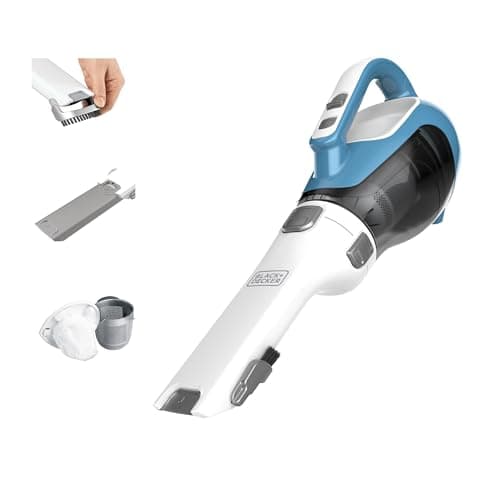
For the mat and the immediate surround, weight and grab-ability beat every other figure. The Black+Decker dustbuster on this page is 2.6 lb with a 605 ml bowl and lives on a wall bracket; the full hand-vacuum ranking is here if that is the only machine you actually need.
#
Product
Best for
Score
Price
01
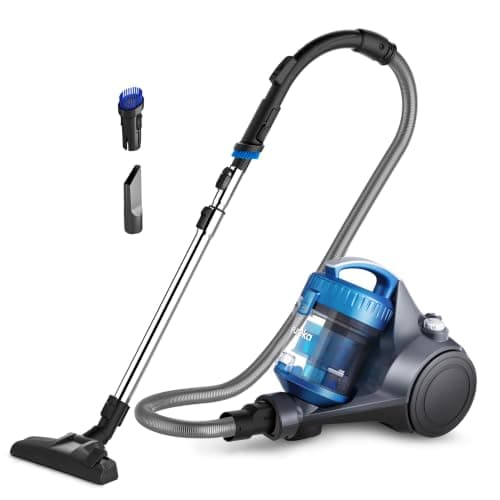
Eureka Whirlwind Bagless Canister (NEN110A)960 W, a 2.5-liter bin, automatic cord rewind and washable filters — the canister case, made cheaply and made honestly.
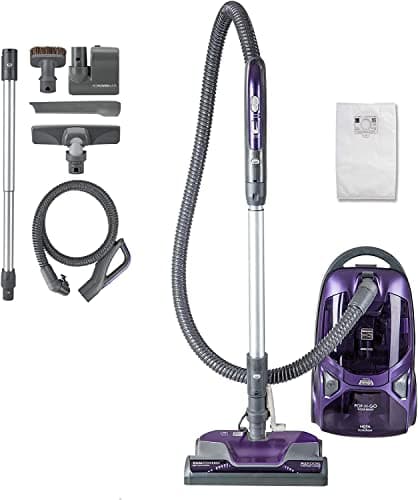
Kenmore 600 Series Pet Friendly Bagged Canister (81615)The only canister on this site that publishes a motorized floor tool and a suction figure measured at the hose end, which together fix the two things canisters are usually bad at.
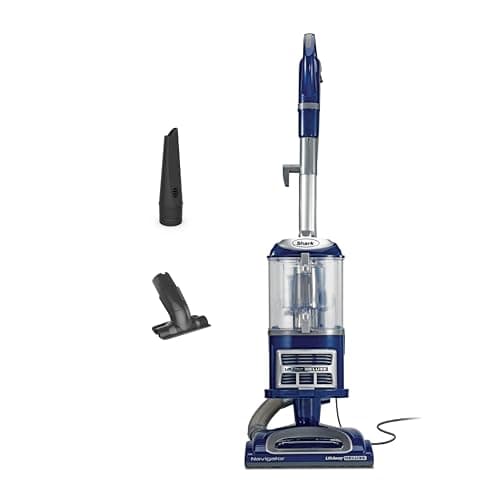
Shark Navigator Lift-Away (NV360)The entry point to Shark's Lift-Away line: the same 1,200-watt motor and sealed HEPA as the Rotator, with a shorter hose, no headlights and a brushroll shutoff the Rotator does not publish.
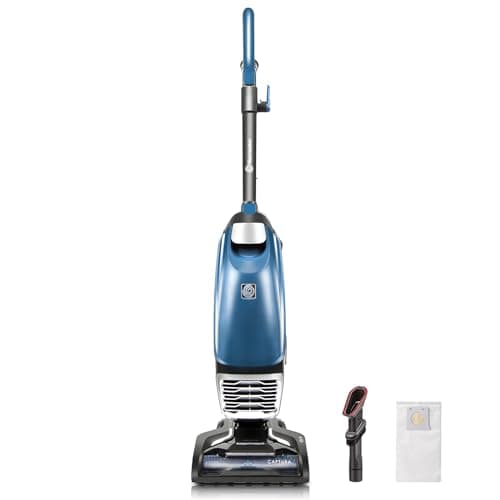
Vacmaster Bagged Upright with HEPA Bags (UB0302E)HEPA bags rated to 99.97% at 0.3 microns, a one-click bag drop so you never touch the dust, and a bag-change indicator — on the cheapest machine on this page.
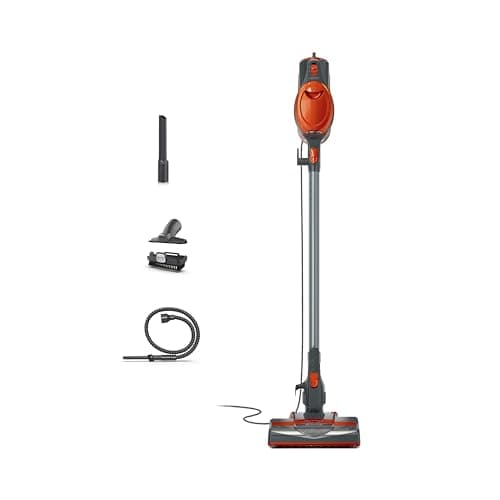
Shark Rocket Pet Corded Stick (HV302)Eight pounds, swivel steering, a 25-foot cord and a five-year warranty. The cup is small and the filter is foam, and neither is a surprise at this price.
Black+Decker dustbuster AdvancedClean 16V Hand Vacuum (CHV1410L)The classic dustbuster: a 605 ml bowl, a rotating nozzle, a two-year warranty and a charging base, at a price where most of the shelf is unbranded.
Ranked by our published rubric. For litter specifically, read two rows before the score: whether the brushroll can stop, and whether the filtration claim has a number attached.
01 · Best canister under $120
Eureka Whirlwind Bagless Canister (NEN110A)
960 W, a 2.5-liter bin, automatic cord rewind and washable filters — the canister case, made cheaply and made honestly.
Telescoping metal wand with integrated crevice tool
Every figure above is the manufacturer's own published number. Where a manufacturer publishes nothing, the row says "Not published" rather than an estimate.
What the numbers say
+2.5-liter bin and washable HEPA — no bags, no filter bills
+The body stays on the floor, so stairs and above-floor work are far easier than with an upright
+Automatic cord rewind, which is a small luxury that is missing at this price everywhere else
Where it stops
−No powered brushroll, so deep pile carpet is not its job
−Dragging a canister around furniture annoys some people permanently
−82 dB
Who it is for
Hard floors, stairs, cars and upholstery — the classic canister case.
Skip it if
Wall-to-wall carpet is your main floor. Suction alone does not agitate pile; you want a driven brushroll.
Our score: 8.4 out of 10
Published power8.5
Runtime10.0
Bin and filtration8.5
Weight and handling7.0
Running cost9.5
Scored against the published rubric on How We Pick. These are judgments about spec sheets, not measurements.
02 · The only powered brush here
Kenmore 600 Series Pet Friendly Bagged Canister (81615)
The only canister on this site that publishes a motorized floor tool and a suction figure measured at the hose end, which together fix the two things canisters are usually bad at.
12 amps, two-motor system. The listing's own specification table separately prints 5 amps and 600 watts, which does not reconcile with the bullet
Agitation
Pet PowerMate motorized attachment, plus a Pop-N-Go bare-floor brush
Filtration
Triple HEPA filter system, stated to trap 99.97% of dirt, with a HEPA cloth bag. No test standard named
Cord
28 feet, retractable
Hose reach with attachments
10 feet
Wand
Aluminum telescoping
Cleaning width
14 inches
Weight
22.6 lb
Rated noise
75 dB
Warranty
1 year manufacturer
Dust bag capacity
Not published
Every figure above is the manufacturer's own published number. Where a manufacturer publishes nothing, the row says "Not published" rather than an estimate.
What the numbers say
+A motorized Pet PowerMate is in the box, which is the one thing that stops a canister being the wrong tool for carpet
+183 W measured at the hose end is the only figure in this category that describes suction where the dirt is rather than power at the wall
+28 feet of retractable cord plus 10 feet of hose reach is the longest working radius of any canister on this site
Where it stops
−22.6 lb is the heaviest machine in this category, three times the Bissell Zing
−Bagged, so there is a consumable for as long as you own it — and Kenmore does not publish the bag's capacity anywhere
−The listing publishes 12 amps in its bullets and 5 amps in its specification table, and both cannot be true
Who it is for
A house with carpet or rugs and a shedding pet, where every other canister's missing brushroll is the reason a canister was ruled out in the first place.
Skip it if
You are buying a canister specifically because you are tired of heaving a vacuum around. At 22.6 lb this is heavier than most uprights on this site, and it only stays easy while it is rolling behind you.
Our score: 8.3 out of 10
Published power9.5
Runtime10.0
Bin and filtration8.5
Weight and handling7.5
Running cost6.0
Scored against the published rubric on How We Pick. These are judgments about spec sheets, not measurements.
03 · Cheapest Lift-Away with HEPA
Shark Navigator Lift-Away (NV360)
The entry point to Shark's Lift-Away line: the same 1,200-watt motor and sealed HEPA as the Rotator, with a shorter hose, no headlights and a brushroll shutoff the Rotator does not publish.
HEPA with Anti-Allergen Complete Seal. No test standard is named on this listing
Lift-Away
Detachable pod for stairs and above-floor work
Power levels
Two
Rated noise
80 dB
Tools
Upholstery tool, crevice tool
Warranty
5-year limited
Every figure above is the manufacturer's own published number. Where a manufacturer publishes nothing, the row says "Not published" rather than an estimate.
What the numbers say
+A published brushroll shutoff, which is the specification that stops an upright scattering grit across a hard floor
+The same 1,200-watt motor and sealed-HEPA claim as Shark uprights costing considerably more
+0.9 liters is a genuinely large cup for this price
Where it stops
−A 5-foot hose, which is the shortest published reach of any Shark upright on this site
−16 lb, the heaviest machine in Shark's Lift-Away line here
−No LED headlights, and the HEPA claim names no test standard
Who it is for
A mixed-floor home that wants sealed filtration, a detachable pod for the stairs and a brushroll that can be switched off, at the cheapest point Shark offers all three.
Skip it if
Above-floor reach matters. Five feet of hose covers a stair tread and not much else, and the Rotator NV501 publishes 8.4 feet for the households that need it.
Our score: 8.1 out of 10
Published power9.0
Runtime10.0
Bin and filtration8.5
Weight and handling4.0
Running cost9.0
Scored against the published rubric on How We Pick. These are judgments about spec sheets, not measurements.
04 · Cheapest HEPA-bag upright
Vacmaster Bagged Upright with HEPA Bags (UB0302E)
HEPA bags rated to 99.97% at 0.3 microns, a one-click bag drop so you never touch the dust, and a bag-change indicator — on the cheapest machine on this page.
HEPA filtration bags, published as capturing 99.97% of dust as small as 0.3 microns. No test standard is named
Bag disposal
Bag Drop function: one click releases the bag into the trash without touching it
Bag indicator
Check-bag indicator
Capacity
2.6 liters
Motor
Two-motor system. No wattage or amperage is published anywhere on the listing
Above-floor reach
7 feet of extended reach
Weight
12.7 lb
Rated noise
78 dB
Tools
3-in-1 combination tool
Surfaces
Carpet and hard floor
Extras
LED headlight
Warranty
Not published on the listing
Every figure above is the manufacturer's own published number. Where a manufacturer publishes nothing, the row says "Not published" rather than an estimate.
What the numbers say
+The touch-free bag drop is the single feature that makes the bagged argument real, and it is on the cheapest machine here
+A published filtration figure with a particle size attached, which two more expensive machines on this page do not manage
+7 feet of above-floor reach and a combination tool, on a 12.7 lb machine
Where it stops
−No wattage, no amperage and no suction figure in any unit — "two-motor system" is the entire power specification
−No warranty term is published on the listing, on the only brand here without a long parts history
−2.6 liters is a fraction of the Sanitaire's 18 quarts, so bags get changed more often and each one costs money
Who it is for
An allergy household on a tight budget, where the sealed bag and the no-touch disposal matter more than knowing the motor rating.
Skip it if
You want to know what you are buying before you buy it. This listing publishes no power figure and no warranty, and on a corded machine those are the two things a spec sheet is for.
Our score: 7.9 out of 10
Published power7.0
Runtime10.0
Bin and filtration8.0
Weight and handling7.5
Running cost7.0
Scored against the published rubric on How We Pick. These are judgments about spec sheets, not measurements.
05 · Best swivel corded stick
Shark Rocket Pet Corded Stick (HV302)
Eight pounds, swivel steering, a 25-foot cord and a five-year warranty. The cup is small and the filter is foam, and neither is a surprise at this price.
Swivel, with a low-profile head for under-furniture reach
Conversion
Converts to a hand vacuum at the touch of a button; the handheld hangs on a hook on the wand
Filtration
Washable foam filters. No HEPA claim published
Rated noise
80 dB
Tools
Crevice tool, pet multi-tool, precision duster
Warranty
5-year limited
Every figure above is the manufacturer's own published number. Where a manufacturer publishes nothing, the row says "Not published" rather than an estimate.
What the numbers say
+A 25-foot cord published plainly, which two other corded sticks on this page do not manage
+Three tools in the box including a pet multi-tool, on the cheaper of the two Shark sticks here
+Five-year warranty and washable filters, so the running cost is close to zero
Where it stops
−0.31 quarts is the smallest cup on this page — less than half what the HV322 and the Rocket Pro DLX hold
−Foam filtration with no HEPA claim and no named standard
−The listing's voltage field prints "100120 volts", which is two figures run together rather than one specification
Who it is for
An apartment or a single floor of hard surfaces and low-pile rugs, where light weight and swivel steering matter more than capacity.
Skip it if
Emptying annoys you. At 0.31 quarts this is a machine you will empty two or three times during one clean of a normal floor, and the DLX above doubles the cup for a small step up.
Our score: 7.9 out of 10
Published power7.0
Runtime10.0
Bin and filtration5.5
Weight and handling8.0
Running cost9.0
Scored against the published rubric on How We Pick. These are judgments about spec sheets, not measurements.
06 · Biggest bowl under $50
Black+Decker dustbuster AdvancedClean 16V Hand Vacuum (CHV1410L)
The classic dustbuster: a 605 ml bowl, a rotating nozzle, a two-year warranty and a charging base, at a price where most of the shelf is unbranded.
Rotating slim nozzle, with a pull-out crevice tool and a flip-up brush built in
Filtration
Washable cartridge filter, with cyclonic action published as keeping dust off it. No HEPA claim
Weight
2.6 lb as listed
Rated noise
78 dB
Charge time
240 minutes, on a charging station
Warranty
2-year limited
Agitation
None. No motorized tool
Suction in air watts or Pa
Not published. The listing's wattage field prints "23" with no unit
Every figure above is the manufacturer's own published number. Where a manufacturer publishes nothing, the row says "Not published" rather than an estimate.
What the numbers say
+605 ml is the largest published bowl here after the furbuster, on the cheapest machine on the page
+The crevice tool and brush are built into the nozzle, so there is nothing to lose
+Two-year warranty and a washable filter, which is the whole running-cost argument at this price
Where it stops
−11 minutes of runtime for four hours of charging
−No motorized brush, so hair bonded into upholstery is not its job
−78 dB is a real noise in a kitchen, and the listing publishes no HEPA claim
Who it is for
A kitchen counter, a set of stairs and a car door pocket — the everyday crumb-and-grit jobs a hand vac was invented for.
Skip it if
Pet hair on furniture is the reason you are shopping. Suction alone lifts hair off a hard surface; it does not pull it out of a weave, and this machine has nothing that turns.
Our score: 7.7 out of 10
Published power6.5
Runtime6.5
Bin and filtration7.5
In-car handling8.5
Running cost9.5
Scored against the published rubric on How We Pick. These are judgments about spec sheets, not measurements.
The ones to skip
Skip any upright with no published brushroll shutoff. On carpet it does not matter — the brush is doing useful work. On the hard floor between the box and the door, a brushroll you cannot stop is spraying granules at the baseboards. Plenty of otherwise good uprights on this site publish no shutoff, and for this specific job that single missing line disqualifies them.
Skip a robot vacuum as your litter solution, with one caveat. A robot running daily genuinely keeps a litter trail under control, and that is a real argument for one. But budget robots publish small bins, most publish no sealed-filtration claim, and a robot that drives through a wet clump makes a far worse mess than the one it was cleaning. If you want one anyway, the pet-hair robot roundup is the page that ranks on bin and filtration rather than suction claims.
And skip "HEPA" as a word with nothing after it. Two machines here publish 99.97% with a particle size. Two publish the word alone. With clay dust — which is exactly the particle size these claims are about — the difference between a figure and a word is the whole point of asking.
How to choose in one paragraph
One cat, hard floors, tight budget: the Eureka Whirlwind NEN110A, which has no brushroll to switch off and a 2.5-liter bin. Somebody in the house reacts to dust, or the litter room smells after vacuuming: the Kenmore 600 Series and its sealed HEPA cloth bag. Litter tracked onto carpet as well as hard floor: the Shark Navigator NV360, because the brushroll shutoff lets one machine do both properly. You want the sealed-bag advantage at the lowest price: the Vacmaster UB0302E, whose one-click bag drop means you never open the dust. A small apartment where the vacuum has to live in a cupboard: the Shark Rocket Pet HV302. And for the two feet around the box, which is where 80% of the mess is: the Black+Decker dustbuster CHV1410L, because the vacuum you can reach in four seconds is the one that gets used.
Common questions
What is the best vacuum for cat litter?+−
On published specifications, the Eureka Whirlwind NEN110A: no powered brushroll to scatter granules, 960 watts of suction, a 2.5-liter bin and washable HEPA. If the fine clay dust is the part that bothers you, the Kenmore 600 Series seals it into a HEPA cloth bag and publishes a triple HEPA system at 99.97%.
Can you vacuum cat litter?+−
The tracked litter on the floor, yes — that is what this page ranks machines for. Used litter out of the tray, no. Clumping litter is designed to absorb moisture and bind, and a damp clump inside a vacuum is how the machine starts smelling permanently. Scoop the tray, vacuum the floor.
Why does my vacuum make the litter room smell worse?+−
Almost always the exhaust. Clay and bentonite litters shed very fine dust, and a machine without sealed filtration passes a proportion of it through the motor and back into the room. That is why the filtration column on this page carries as much weight as suction, and why two of the top three picks are bagged.
Should I use a bagged or bagless vacuum for cat litter?+−
Bagged has the stronger case here than almost anywhere else. Litter dust is exactly the fine material that a bagless bin releases when you open it over a trash can, and a sealed bag goes into the trash closed. The trade is that bags are a permanent running cost, which our bagged-versus-bagless page prices out in full.
Do I need a brushroll shutoff for cat litter?+−
On hard floors, yes, or a machine with no powered brushroll at all. Litter granules are heavy and angular, and a brushroll spinning at full speed on tile or wood flicks them out of the suction path rather than collecting them. On carpet the brushroll is helping, so a machine that can do both is the flexible answer.
Is a robot vacuum good for cat litter?+−
For keeping a tracked trail under control day to day, genuinely yes — frequency beats power on this mess. The risks are a small bin that fills fast with dense granules, filtration claims that are usually weaker than a full-size machine's, and what happens if the robot meets a wet clump. Most owners end up running a robot daily and a sealed full-size machine weekly.
Sources
Manufacturer-published specifications — Every runtime, wattage, capacity, weight, filtration and warranty figure quoted on this page is the manufacturer's own published number for that model, retrieved September 1, 2026. Where a manufacturer publishes no figure, the page says 'Not published' rather than estimating one.
Sweep & Suction — How We Pick — Our published method, including the scoring rubric, the three-year running-cost formula and an explicit statement of what published specifications cannot tell you.