Everyone in this category says they tested twenty vacuums. We have not tested any, and we say so. What we do instead is read the manuals, compile the published specifications, and work out what each machine costs to run for three years — the method is written out in full.
We earn a commission if you buy through the links on this page, at no extra cost to you. It never changes what we recommend or the order we recommend it in. Full disclosure.
The verdict: buy the Shark unless you keep vacuums for a decade. On published runtime, bin capacity and weight, Shark's mid-range cordless machines match or beat the Dyson V8. What Dyson genuinely buys you is a stated 2-year warranty, a published suction figure on the dearer models, and a parts supply that will still exist in ten years. If none of those matter to you, the delta is not buying much.
The numbers, side by side
Every figure is the manufacturer's own published number for that model.
Published figure
Shark IY143H
Dyson V8
Shark IZ376H
Dyson V11 Origin
Rated runtime
40 min
40 min
40 min
60 min
Bin capacity
0.7 qt
0.14 gal
0.79 qt
0.2 gal
Weight
7.1 lb
5.6 lb
7.9 lb
Not published on the listing
Motor
181 W
Not published
181 W
185 air watts
Battery
21.6 V (IZ362H variant is removable)
21.6 V
21.6 V
25.2 V
Filtration
HEPA, Complete Seal, over 99.97%
99.99% to 0.3 microns
HEPA, Complete Seal
HEPA, 99.99% to 0.3 microns
Anti-tangle
Self-cleaning Turbo Pro
Motorbar, de-tangles
Self-cleaning PowerFins
Motorbar plus hair screw tool
Warranty
Not published on the listing
2 years
Not published on the listing
2 years
Power modes
Not published
2
Not published
3, with an LCD countdown
0.14 US gallons is about 0.56 quarts and 0.2 gallons is about 0.8 quarts, so the Shark IY143H's 0.7-quart bin sits between the two Dysons and the IZ376H's 0.79 quarts effectively matches the V11 Origin's.
Where Dyson genuinely wins
A published, comparable suction figure. The V11 Origin states 185 air watts. Air watts describe work done at the cleaner head, which is the number you actually want, and Shark publishes nothing equivalent — 181 watts of motor power is a consumption figure, not an airflow figure, and the resemblance between 181 and 185 is a coincidence rather than a comparison.
A stated warranty. Dyson publishes 2 years plus lifetime support on every machine in the range. Shark does not publish a warranty length on these cordless listings at all. That asymmetry is real and it is worth money.
Weight, on the V8. 5.6 lb against the IY143H's 7.1 and the IZ376H's 7.9. Above the floor, doing stairs and ceiling corners, a pound and a half is not a rounding error.
Runtime on the V11 Origin. 60 rated minutes against 40 is a genuine 50% increase, and in a large house that is the difference between one clean and two sessions.
Where Shark quietly matches or beats it
Bin capacity. The IY143H's 0.7 quarts is larger than the V8's 0.14 gallons (about 0.56 quarts), and the IZ376H's 0.79 quarts effectively matches the V11 Origin's 0.2 gallons. The budget machine is not the smaller machine here.
Anti-tangle brushrolls. Both brands publish the claim. Dyson's hair screw tool is the better published design for a dedicated hair attachment; Shark's self-cleaning brushroll on the main floor head is the feature that stops you reaching for scissors, and it is published at a fraction of the price.
Filtration specificity. Elsewhere in its range, on the NV356E upright, Shark names its test standard and the laboratory that ran it — ASTM F1977-22, tested by IBR Laboratories. Dyson publishes a percentage. Naming the standard is the more checkable claim.
A removable battery. Shark publishes one on the IZ362H. Dyson does not publish user-removable batteries on the V8 or V11 Origin listings. Given that the battery is the component that decides a cordless vacuum's lifespan, this is a bigger deal than it looks.
#
Product
Best for
Score
Price
01
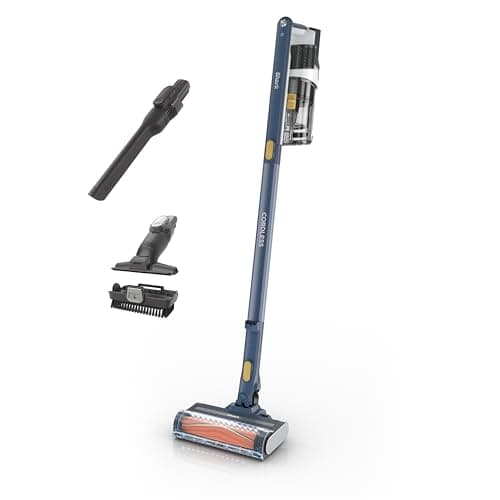
Shark Cordless Pet (IY143H)Doubles the dust cup over the IX141 and adds the self-cleaning brushroll, which is the single feature that matters if a dog lives here.
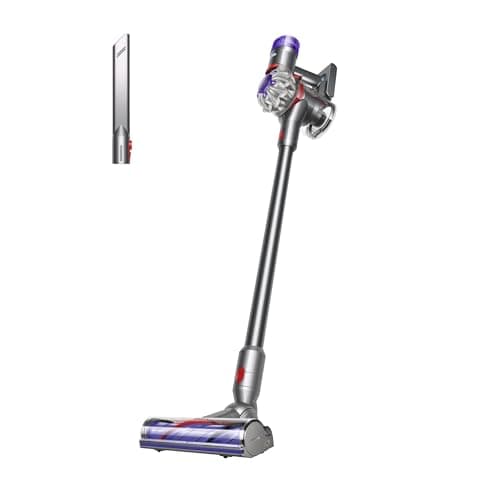
Dyson V8 Cordless VacuumThe cheapest current Dyson, and the honest comparison point: 40 minutes and 5.6 lb, the same rated runtime as a Shark costing far less.
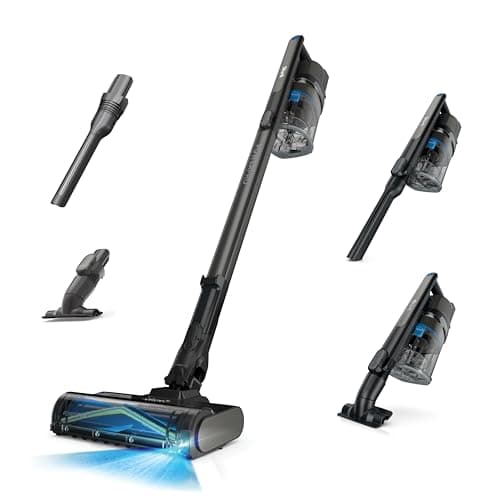
Shark PowerPro Reveal Plus (IZ376H)The 0.79-quart cup is the largest published in Shark's cordless line, which is what actually decides whether you finish a floor in one pass.
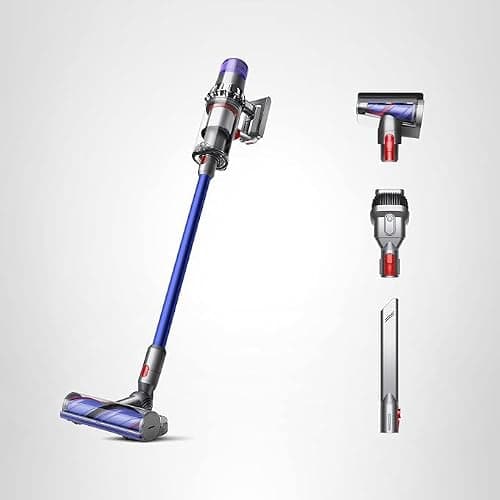
Dyson V11 Origin Cordless Vacuum185 air watts and 60 minutes, published — and the only machine on this site that publishes air watts at all, which is exactly the problem.
Scores are ours, from the published rubric on the How We Pick page. They are editorial judgments about published specifications — not test results. We have not handled these machines.
01 · Best for long pet hair
Shark Cordless Pet (IY143H)
Doubles the dust cup over the IX141 and adds the self-cleaning brushroll, which is the single feature that matters if a dog lives here.
HEPA with Complete Seal, rated to capture over 99.97% of dust and allergens
Brushroll
Self-cleaning Turbo Pro, published as anti-hair-wrap
Floor detection
FloorDetect, adjusts brushroll speed by floor type
Suction in air watts or Pa
Not published
Every figure above is the manufacturer's own published number. Where a manufacturer publishes nothing, the row says "Not published" rather than an estimate.
What the numbers say
+0.7-quart cup is double the IX141's, which is the difference between one empty and three
+Self-cleaning brushroll is published as anti-hair-wrap, and that claim is specific rather than decorative
+FloorDetect removes the nozzle-swapping step between rug and hardwood
Where it stops
−Still no published suction figure
−Heavier than the IX141 by 0.2 lb, which you notice on stairs and nowhere else
−Battery is not published as user-removable on this model
Who it is for
Pet households with a mix of rug and hard floor, where hair wrap is the actual daily annoyance.
Skip it if
Your floors are entirely hard surface and nothing sheds. You are paying for the anti-tangle brushroll, and on bare floor it does nothing for you.
Our score: 7.5 out of 10
Published power6.0
Runtime7.0
Bin and filtration8.5
Weight and handling7.5
Running cost8.0
Scored against the published rubric on How We Pick. These are judgments about spec sheets, not measurements.
02 · The flagship entry point
Dyson V8 Cordless Vacuum
The cheapest current Dyson, and the honest comparison point: 40 minutes and 5.6 lb, the same rated runtime as a Shark costing far less.
Whole-machine, rated to trap 99.99% of particles down to 0.3 microns
Cleaner head
Motorbar, de-tangles hair as it cleans
Warranty
2-year limited
Modes
Two
Every figure above is the manufacturer's own published number. Where a manufacturer publishes nothing, the row says "Not published" rather than an estimate.
What the numbers say
+5.6 lb with a metal-and-polycarbonate build that outlasts the plastic budget machines
+Two-year warranty plus Dyson's own long-term parts support
+Trigger power control genuinely stretches the battery
Where it stops
−0.14 gallons is a small bin — smaller than the Levoit and less than half the Tikom
−40 minutes is the same published figure as a Shark IX141
−Two modes only; the LCD and detection features are on the dearer machines
Who it is for
People who keep vacuums for a decade and want the parts to still exist.
Skip it if
You are buying on the runtime number. It is 40 minutes, the same as machines costing a fraction as much — the money buys build and support, not minutes.
Our score: 7.9 out of 10
Published power8.0
Runtime7.0
Bin and filtration8.0
Weight and handling9.5
Running cost5.0
Scored against the published rubric on How We Pick. These are judgments about spec sheets, not measurements.
03 · Biggest bin in the range
Shark PowerPro Reveal Plus (IZ376H)
The 0.79-quart cup is the largest published in Shark's cordless line, which is what actually decides whether you finish a floor in one pass.
Up to 40 minutes, measured at the handheld in standard mode
Motor
181 watts
Battery
21.6 V
Weight
7.9 lb
Dust cup
0.79 quarts
Filtration
Anti-Allergen Complete Seal with HEPA
Brushroll
Self-cleaning PowerFins
Suction in air watts or Pa
Not published
Every figure above is the manufacturer's own published number. Where a manufacturer publishes nothing, the row says "Not published" rather than an estimate.
What the numbers say
+0.79 quarts is more than double the IX141 and the practical difference is one empty per clean instead of three
+PowerFins self-cleaning brushroll plus FloorDetect
+Dirt-Reveal lighting is a gimmick that turns out to be useful on dark hardwood
Where it stops
−7.9 lb is the heaviest cordless on this page, and above-floor work is where you feel it
−Same 181 W motor and same 40-minute rating as the cheaper IX141
−Costs more for capacity and lighting, not for power
Who it is for
Larger single-floor homes where the interruption you resent is emptying the bin, not recharging.
Skip it if
You mostly clean stairs and above-floor. At 7.9 lb this is the wrong machine for overhead work; the 6.2 lb Levoit or the 6.9 lb IX141 is the better buy.
Our score: 7.3 out of 10
Published power6.0
Runtime7.0
Bin and filtration9.0
Weight and handling6.0
Running cost8.0
Scored against the published rubric on How We Pick. These are judgments about spec sheets, not measurements.
04 · The 60-minute reference
Dyson V11 Origin Cordless Vacuum
185 air watts and 60 minutes, published — and the only machine on this site that publishes air watts at all, which is exactly the problem.
HEPA whole-machine, rated to trap 99.99% of particles down to 0.3 microns
Modes
Eco, Auto, Boost, with an LCD showing remaining runtime to the second
Rated noise
70 dB
Warranty
2-year limited
Every figure above is the manufacturer's own published number. Where a manufacturer publishes nothing, the row says "Not published" rather than an estimate.
What the numbers say
+Publishes air watts — a comparable unit — where the budget field publishes Pa, wattage, or nothing
+60 minutes rated, and the LCD counts down real remaining time rather than showing three bars
+Hair screw tool is the best answer to long hair on any machine here
Where it stops
−The price is the objection and there is no way around it
−0.2 gallons is still a small bin for a whole-house clean
−Replacement batteries are priced like a whole budget vacuum
Who it is for
Large homes where a single uninterrupted clean is worth real money.
Skip it if
You clean a one-bedroom apartment. Sixty minutes of runtime is being sold to houses; a 40-minute machine finishes a flat twice over.
Our score: 8.4 out of 10
Published power9.5
Runtime9.0
Bin and filtration8.5
Weight and handling8.0
Running cost4.5
Scored against the published rubric on How We Pick. These are judgments about spec sheets, not measurements.
The arithmetic, stated plainly
Put the V8 next to the IY143H. Same rated runtime. The Shark has the larger bin. The Dyson is 1.5 lb lighter and carries a published 2-year warranty. That is the entire difference on published specification — and everything else you are paying for is build quality and long-term parts availability, which do not appear on a spec sheet but are genuinely worth buying if you keep appliances for ten years.
Put the V11 Origin next to the IZ376H and the case changes shape: now you are buying 20 extra rated minutes, a published air-watt figure, three power modes with an LCD countdown, and the warranty. That is a more substantial package, and for a large house it is a reasonable purchase. For a two-bedroom flat it is 20 minutes you will never use.
Who should buy which
Buy the Shark if you are cleaning under about 1,200 square feet, if you expect to replace the machine in five years anyway, or if bin capacity is what irritates you most.
Buy the Dyson V8 if weight matters — stairs, above-floor work, a bad back — or if the published warranty is what lets you sleep.
Buy the Dyson V11 Origin if you have a large house and genuinely need 60 rated minutes, or if you want a comparable suction number rather than an incomparable one.
Buy neither if your floors are mostly hard. A corded stick does that job better for less, with no battery to replace.
What we cannot tell you
Which one cleans better. Nobody publishes a common test standard for pickup, air watts and motor watts are not the same measurement, and we have not run either machine. What we can tell you is exactly what each manufacturer claims, in its own words, with the gaps left visible — and where a gap exists we say "not published" rather than filling it in.
Common questions
Is a Shark cordless as good as a Dyson?+−
On published runtime and bin capacity, Shark's mid-range machines match or beat the Dyson V8. On published warranty, weight and comparable suction figures, Dyson leads. Nobody publishes a common pickup test, so 'as good' cannot be answered from specifications alone — and we have not tested either.
Why do Shark and Dyson both claim 40 minutes?+−
Because both rate runtime in a low-power configuration. Shark states its qualifier explicitly: measured at the hand vac in standard mode. Dyson's V8 figure is described as fade-free power across two modes. The rated numbers match; the measurement conditions are not identical and neither brand publishes enough to reconcile them.
Which has the bigger dust cup?+−
Shark, on these models. The IY143H holds 0.7 quarts and the IZ376H 0.79 quarts, against the Dyson V8's 0.14 gallons (about 0.56 quarts) and the V11 Origin's 0.2 gallons (about 0.8 quarts).
Is the Dyson warranty worth the price difference?+−
It is the clearest thing the money buys: Dyson publishes 2 years plus lifetime support, and Shark publishes no warranty length on these cordless listings. Whether that plus the build quality is worth the delta depends entirely on how long you keep appliances.
Which is better for pet hair?+−
Both publish anti-tangle designs. Dyson's hair screw tool is the better published dedicated attachment; Shark's self-cleaning brushroll on the main floor head addresses the daily annoyance and is published far cheaper. For a shedding household, our pet-hair roundup ranks the field on exactly that specification.
Sources
Manufacturer-published specifications — Every runtime, wattage, capacity, weight, filtration and warranty figure quoted on this page is the manufacturer's own published number for that model, retrieved September 1, 2026. Where a manufacturer publishes no figure, the page says 'Not published' rather than estimating one.
ASTM F1977 — standard test method for vacuum cleaner filtration efficiency — Named by Shark (tested by IBR Laboratories, per ASTM F1977-22) and by Levoit (ASTM F1977-22) in their own published filtration claims. Where a brand names this standard we treat the claim as checkable; where a brand states a bare percentage we do not.
Sweep & Suction — How We Pick — Our published method, including the scoring rubric, the three-year running-cost formula and an explicit statement of what published specifications cannot tell you.