They are not competitors. One keeps the baseline down without being asked; the other does everything the first one cannot reach. The mistake is buying either as if it were both.
Everyone in this category says they tested twenty vacuums. We have not tested any, and we say so. What we do instead is read the manuals, compile the published specifications, and work out what each machine costs to run for three years — the method is written out in full.
We earn a commission if you buy through the links on this page, at no extra cost to you. It never changes what we recommend or the order we recommend it in. Full disclosure.
The verdict: buy the stick first, then add the robot. A cordless stick can do every job in the house — floors, stairs, upholstery, the car, the ceiling corner. A robot can do exactly one job, floors, and only the parts of the floor it can physically reach. If you own nothing, the stick is the machine you cannot do without. If you already own a decent vacuum and the problem is that you do not use it often enough, the robot is the better purchase and it is not close.
The numbers, side by side
Every figure is the manufacturer's own published number for that model.
Published figure
Roomba 105 Vac AutoEmpty
Roborock Q7 L5
Tineco A30S
Shark IY143H
Type
Robot, self-empty dock
Robot, no dock
Cordless stick
Cordless stick
Rated runtime
200 min
150 min
60 min crevice / 40 min brush
Up to 40 min
Capacity
0.1 gal on board; dock up to 75 days
270 ml
1 L
0.7 qt
Suction figure
Not published in Pa
8,000 Pa stated
160 W stated suction
Not published
Navigation
ClearView LiDAR
360-degree LiDAR
You
You
Weight
6.2 lb
7.3 lb
5.3 lb
7.1 lb
Anti-tangle
Not published
Anti-tangle main + zero-tangle side
ZeroTangle
Self-cleaning Turbo Pro
Stairs, upholstery, car
No
No
Yes, with tools
Yes, with tools
Robot runtimes and stick runtimes are not comparable quantities. A robot's 200 minutes is unattended coverage time; a stick's 40 is how long you are standing there holding it.
What the robot genuinely does better
It runs without a decision. This is the entire argument and it is a good one. The published runtimes — 200 minutes on the Roomba, 150 on the Roborock — are unattended, which means the floor gets cleaned on days you would not have done it. Nothing about a stick vacuum's specification competes with that, because the limiting factor on a stick is you.
It keeps a baseline instead of doing a clean. A robot run every day beats a thorough clean every fortnight for how the floor actually looks most of the time, especially in a shedding house.
Under furniture. A published robot height of under three inches reaches beds and sofas that a stick's head has to be shoved under at an angle, if it fits at all.
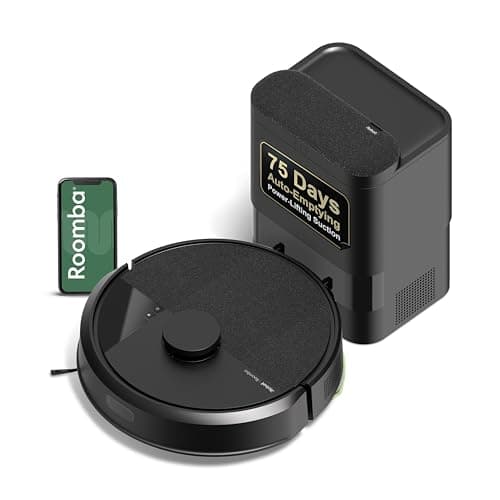
With a dock, it removes the emptying decision too. The Roomba here publishes up to 75 days hands-free, with dock bags rated to trap 99% of allergens as small as 0.7 microns.
What the stick does that the robot cannot
Stairs. No robot on this site does stairs. In a two-story house that is not a minor gap — it is the dirtiest surface in the building and the robot's answer to it is nothing.
Upholstery, mattresses, the car and above-floor work. Both sticks here convert to a handheld with tools. A robot has no answer at all.
Carpet, properly. Several robot manufacturers publish "medium pile" as their own stated limit. A cordless stick with a driven anti-tangle head is better on pile than any robot here, and a corded upright is better than both — which is the point the carpet roundup makes with the published motor figures.
The mess that just happened. A robot cleans on a schedule. A stick cleans the broken glass, the spilled cereal and the tracked-in mud in the ninety seconds after it happens, which is the only time it matters.
Capacity, oddly. The Tineco publishes a 1-liter cup. The Roborock publishes 270 ml. The handheld machine holds nearly four times what the robot does.
#
Product
Best for
Score
Price
01
iRobot Roomba 105 Vac with AutoEmpty DockThe same robot as the 105 Vac with the dock that changes how you live with it: 75 days between bag changes instead of an emptying chore every run.
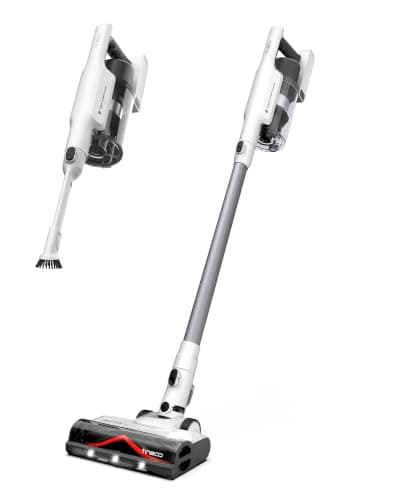
Tineco A30S Cordless VacuumSixty minutes on the crevice tool and forty with the powered head, published separately — and 67 dB, which is the quietest figure on this page.
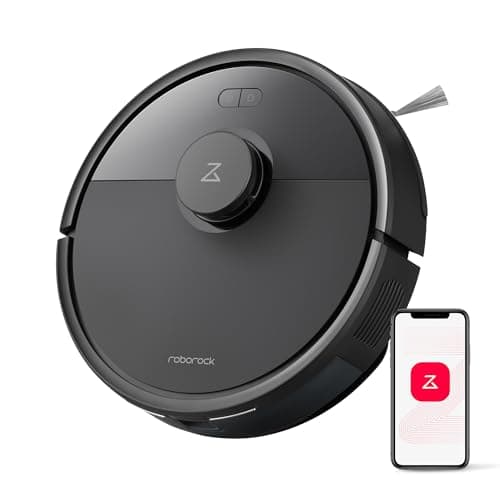
Roborock Q7 L5 Robot Vacuum and Mop8,000 Pa, 360-degree LiDAR and dual anti-tangle brushes — the most specified sheet at this price, with a 270 ml tank that is the catch.
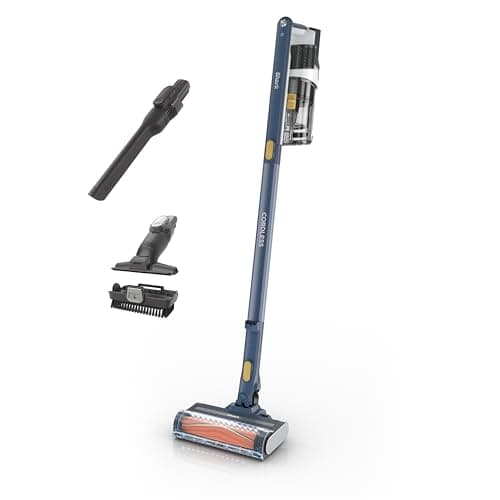
Shark Cordless Pet (IY143H)Doubles the dust cup over the IX141 and adds the self-cleaning brushroll, which is the single feature that matters if a dog lives here.
Scores are ours, from the published rubric on the How We Pick page. They are editorial judgments about published specifications — not test results. We have not handled these machines.
01 · Best self-empty under $400
iRobot Roomba 105 Vac with AutoEmpty Dock
The same robot as the 105 Vac with the dock that changes how you live with it: 75 days between bag changes instead of an emptying chore every run.
Ongoing consumable — roughly five bag changes a year at the stated 75-day interval
Suction in Pa
Not published
Every figure above is the manufacturer's own published number. Where a manufacturer publishes nothing, the row says "Not published" rather than an estimate.
What the numbers say
+75 days between interactions is the single biggest quality-of-life feature in this category
+Bagged dock means emptying does not put dust back in the room, which matters for allergies
+Identical mapping and runtime to the cheaper 105 Vac — you are paying only for the dock
Where it stops
−Dock bags are a permanent running cost that the dockless version does not have
−The dock is bulky and needs clear floor space either side
−0.1-gallon on-board bin is small, which is fine only because the dock exists
Who it is for
Pet households and larger homes, where the on-board bin fills every single run.
Skip it if
Your floor is mostly hard surface and lightly used. At that dirt load the on-board bin lasts a week anyway, and the dock is solving a problem you do not have.
Our score: 8.4 out of 10
Published suction6.5
Navigation9.0
Runtime10.0
Bin and dock9.5
Running cost6.0
Scored against the published rubric on How We Pick. These are judgments about spec sheets, not measurements.
02 · Longest published runtime
Tineco A30S Cordless Vacuum
Sixty minutes on the crevice tool and forty with the powered head, published separately — and 67 dB, which is the quietest figure on this page.
Up to 60 minutes with the 2-in-1 crevice brush; 40 minutes with the ZeroTangle brush
Suction
160 W suction, manufacturer-stated
Weight
5.3 lb
Dust cup
1 liter
Filtration
HEPA
Rated noise
67.1 dB
Brushroll
ZeroTangle
First charge
4-5 hours before first use, manufacturer-stated
Every figure above is the manufacturer's own published number. Where a manufacturer publishes nothing, the row says "Not published" rather than an estimate.
What the numbers say
+Publishes a suction figure (160 W) at all, which most of this price band refuses to do
+1-liter bin, 5.3 lb, and the runtime split is stated by tool
+67.1 dB rated — around 13 dB below the Shark line, which is a large perceived difference
Where it stops
−Tineco's spare parts network is thinner than Shark's or Bissell's
−The 60-minute headline is the crevice-tool figure; the number that matters is 40
−No stated battery-cycle rating, so battery life over years is unknowable from the sheet
Who it is for
Apartments and shared walls, where 67 dB versus 80 dB is the difference between cleaning at 9pm and not.
Skip it if
You want to buy replacement parts at a big-box store in three years. Shark and Bissell consumables are on shelves; Tineco's mostly are not.
Our score: 8.0 out of 10
Published power7.5
Runtime8.5
Bin and filtration8.5
Weight and handling9.0
Running cost6.5
Scored against the published rubric on How We Pick. These are judgments about spec sheets, not measurements.
03 · Best published suction under $300
Roborock Q7 L5 Robot Vacuum and Mop
8,000 Pa, 360-degree LiDAR and dual anti-tangle brushes — the most specified sheet at this price, with a 270 ml tank that is the catch.
360-degree LiDAR with multi-floor maps and no-go zones
Brushes
Anti-tangle main brush plus zero-tangle side brush
Rated noise
60 dB
Wi-Fi
2.4 GHz only
Every figure above is the manufacturer's own published number. Where a manufacturer publishes nothing, the row says "Not published" rather than an estimate.
What the numbers say
+Publishes a suction figure, unlike most of the field
+Dual anti-tangle brushes — both main and side, which most brands only claim for one
+Multi-floor mapping stored on the robot, so it works in a two-story house
+Vacuums and mops in the same pass
Where it stops
−270 ml dustbin is barely half the Lefant M210's, so it fills fast in a pet home
−Pa figures are not comparable across brands and Roborock does not publish their method
−No self-empty dock in this configuration
Who it is for
Multi-floor homes that want proper mapping and are willing to empty a small bin.
Skip it if
You have shedding pets and no self-empty dock. A 270 ml bin in a dog house is a daily chore, and the Q7 M5+ exists specifically to fix that.
Our score: 7.8 out of 10
Published suction8.5
Navigation9.0
Runtime8.5
Bin and dock5.0
Running cost7.5
Scored against the published rubric on How We Pick. These are judgments about spec sheets, not measurements.
04 · Best for long pet hair
Shark Cordless Pet (IY143H)
Doubles the dust cup over the IX141 and adds the self-cleaning brushroll, which is the single feature that matters if a dog lives here.
HEPA with Complete Seal, rated to capture over 99.97% of dust and allergens
Brushroll
Self-cleaning Turbo Pro, published as anti-hair-wrap
Floor detection
FloorDetect, adjusts brushroll speed by floor type
Suction in air watts or Pa
Not published
Every figure above is the manufacturer's own published number. Where a manufacturer publishes nothing, the row says "Not published" rather than an estimate.
What the numbers say
+0.7-quart cup is double the IX141's, which is the difference between one empty and three
+Self-cleaning brushroll is published as anti-hair-wrap, and that claim is specific rather than decorative
+FloorDetect removes the nozzle-swapping step between rug and hardwood
Where it stops
−Still no published suction figure
−Heavier than the IX141 by 0.2 lb, which you notice on stairs and nowhere else
−Battery is not published as user-removable on this model
Who it is for
Pet households with a mix of rug and hard floor, where hair wrap is the actual daily annoyance.
Skip it if
Your floors are entirely hard surface and nothing sheds. You are paying for the anti-tangle brushroll, and on bare floor it does nothing for you.
Our score: 7.5 out of 10
Published power6.0
Runtime7.0
Bin and filtration8.5
Weight and handling7.5
Running cost8.0
Scored against the published rubric on How We Pick. These are judgments about spec sheets, not measurements.
The cost question, honestly
A robot has running costs a stick does not: dock bags if it is a bagged design, side brushes, filters, and a battery nobody publishes a cycle rating for. The robot running-cost page works through the published intervals in full. A cordless stick has one expensive consumable — its battery — and the same absence of a published cycle rating. Neither is cheap to keep over five years, and both are cheaper than a flagship of the other type.
The genuinely cheap answer, and the one this site keeps arriving at, is a corded machine plus a robot: no battery in the corded half, and the robot handles the daily pass. On published prices a budget corded upright and a mid-range robot together cost less than one flagship cordless stick. That is the arithmetic the value desk exists for.
So which do you buy first?
Own nothing? The stick, every time. It is the machine that can do all the jobs, including the ones a robot has no answer for.
Own a vacuum you rarely use? The robot. Your problem is not capability, it is frequency, and that is the one problem a robot is built to solve.
Single-story, mostly hard floor, shedding pet? The robot does more of the real work than anything else you could spend the money on.
Two or more stories, or wall-to-wall carpet? The stick, or better, a corded upright. Half your floors are somewhere the robot cannot go, and pile is where the published figures stop favoring it.
Common questions
Should I buy a robot vacuum or a stick vacuum?+−
Buy the stick first if you own nothing — it does floors, stairs, upholstery, the car and above-floor work, and a robot does none of those except floors. Buy the robot first if you already own a vacuum and the real problem is that you do not use it often enough. Those are different problems and they have different answers.
Can a robot vacuum replace a regular vacuum?+−
Not on the published specifications. No robot on this site does stairs, upholstery, a car or above-floor work, and several manufacturers publish medium pile as their own stated carpet limit. A robot replaces the routine floor pass, not the vacuum.
Which is better for pet hair, a robot or a stick vacuum?+−
They solve different halves. A robot keeps the daily shed off the floor without anybody deciding to do it — and with a dock, published intervals run 60 to 75 days between interventions. A stick lifts hair out of upholstery, stairs and the car, which no robot can reach. In a shedding house the honest answer is usually both, and the robot second.
Is a robot vacuum's runtime comparable to a stick vacuum's?+−
No, and the numbers mislead. A robot's 150 to 200 published minutes is unattended coverage time. A cordless stick's 40 is how long you stand there holding it. Two hundred robot minutes and forty stick minutes are not the same quantity measured differently — they are different quantities.
Do robot vacuums have bigger bins than stick vacuums?+−
Almost always smaller. The Roborock Q7 L5 publishes 270 ml and the Roomba 105 publishes 0.1 gallons on board. The Tineco A30S stick publishes a full liter. The robot's answer to the gap is a self-emptying dock, not a bigger bin.
What is the cheapest combination that covers everything?+−
On published prices, a budget corded upright plus a mid-range robot costs less than one flagship cordless stick, and covers more: unlimited runtime and real motor power on carpet from the corded machine, plus a daily unattended pass from the robot. The trade is two machines to store and a cord to move.
Sources
Manufacturer-published specifications — Every runtime, wattage, capacity, weight, filtration and warranty figure quoted on this page is the manufacturer's own published number for that model, retrieved September 1, 2026. Where a manufacturer publishes no figure, the page says 'Not published' rather than estimating one.
Sweep & Suction — How We Pick — Our published method, including the scoring rubric, the three-year running-cost formula and an explicit statement of what published specifications cannot tell you.