Mapping is the one robot feature that changes how well the floor gets cleaned rather than how impressive the app looks. Five machines here publish it, and they do not all publish the same thing.
Everyone in this category says they tested twenty vacuums. We have not tested any, and we say so. What we do instead is read the manuals, compile the published specifications, and work out what each machine costs to run for three years — the method is written out in full.
We earn a commission if you buy through the links on this page, at no extra cost to you. It never changes what we recommend or the order we recommend it in. Full disclosure.
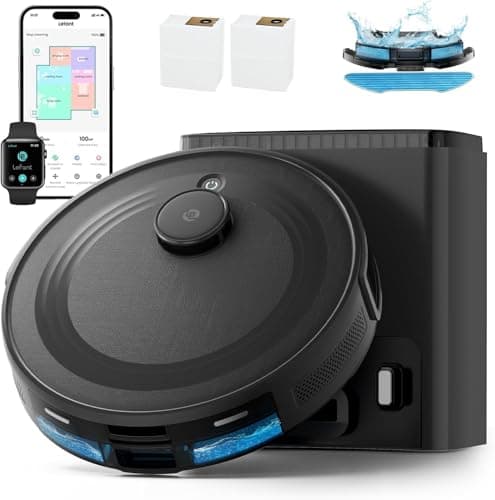
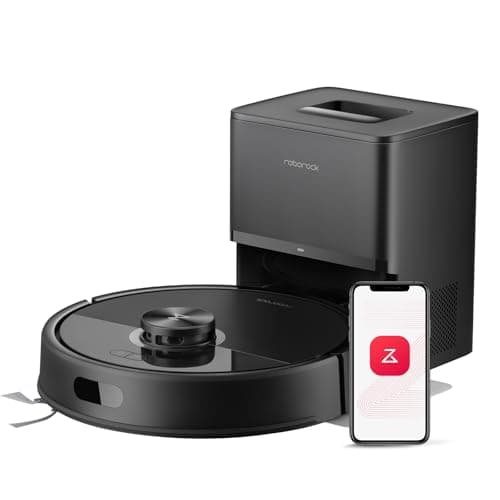
The short answer: the Roborock Q7 M5+. It publishes PreciSense LiDAR with real-time mapping, 10,000 Pa of stated suction and a self-emptying dock, which is the most complete published package on this page. If you want mapping at the lowest price, the Lefant M2 Plus publishes 360-degree LiDAR with multi-floor mapping and no-go zones for a fraction of the money. And if you want the mapping without the app becoming a subscription relationship, the Roomba 105 Vac publishes ClearView LiDAR from the brand with the deepest parts network in the category.
Why mapping is the robot feature worth paying for
A robot without mapping cleans by bouncing: it drives until it hits something, turns, and repeats. It covers a room eventually, misses patches, and cannot tell you where it has been. A robot with LiDAR — a spinning laser that measures distance in 360 degrees — builds a floor plan, then cleans in efficient parallel rows and knows which rooms it has finished.
That difference produces three things you can actually use: efficient coverage (the floor gets done in one battery rather than two), room targeting ("clean the kitchen" instead of "clean everything"), and no-go zones (the dog bowl, the cable nest, the rug with a fringe). We argued on the obstacle-avoidance page that mapping is worth buying and camera-based object recognition mostly is not at this price. This is the page that ranks the machines that deliver it.
What we looked at
What kind of mapping the listing actually publishes. All five publish LiDAR. Three go further and publish multi-floor maps, no-go zones or virtual walls by name, which is what makes the map useful rather than decorative.
Multi-floor support. If you have stairs, a robot that stores one map has to relearn the house every time you carry it. Two machines here publish multi-floor maps explicitly.
Suction claims, treated with suspicion. Four of these publish pascals — 6,000 to 10,000 Pa — and not one publishes a measurement method. We report the figures and do not rank on them.
Bin and dock. A map is worthless if the robot fills up halfway through. One machine here publishes a self-emptying dock, which changes how often you touch it at all.
What the app requires. Mapping means an app, an account and a network connection. That is a real trade and we say so rather than treating it as a free feature.
What each machine publishes
Manufacturer-published navigation claims, transcribed as printed.
Machine
Mapping published
Multi-floor
No-go zones
Stated suction
Roborock Q7 M5+
PreciSense LiDAR, real-time mapping
Not stated on the listing
Not stated on the listing
10,000 Pa
ILIFE A30 Pro
LDS LiDAR with SLAM
Not stated on the listing
Yes, plus virtual walls
Up to 10,000 Pa
Roomba 105 Vac
ClearView LiDAR with cliff sensors
Not stated on the listing
Not stated on the listing
Per its card
Roborock Q7 L5
360-degree LiDAR
Yes
Yes
8,000 Pa
Lefant M2 Plus
360-degree LiDAR
Yes
Yes
6,000 Pa
Compiled from each robot's own published listing. Pascal figures are manufacturer-stated with no published measurement method, and are not comparable between brands.
The useful thing in that table is not the suction column — it is that the two cheapest machines here publish the most complete mapping feature set. Roborock's Q7 L5 and Lefant's M2 Plus both name multi-floor maps and no-go zones explicitly, while the more expensive Q7 M5+ publishes real-time mapping and leaves the rest unstated. That is a disclosure gap rather than proof of a capability gap, and we rank on what is published.
Multi-floor maps, and who actually needs them
If your house has one floor, ignore this row entirely. If it has two or three, it is the difference between a robot that works upstairs and one that has to remap every time you carry it up. A stored second map means the robot knows the upstairs layout, keeps its no-go zones, and starts cleaning instead of exploring.
Two machines here publish it by name. For a larger single-floor home the more relevant figure is coverage per charge, which is what the large-home robot page ranks on instead.
#
Product
Best for
Score
Price
01
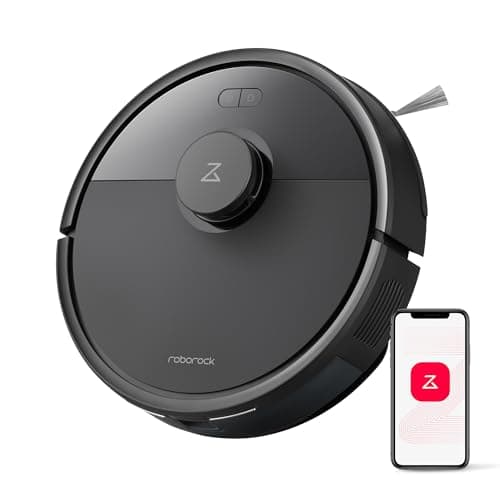
Roborock Q7 M5+ Robot Vacuum and Mop10,000 Pa published and a 2.7-liter sealed dock bag rated at seven to nine weeks: the pet-hair answer, at a real price.
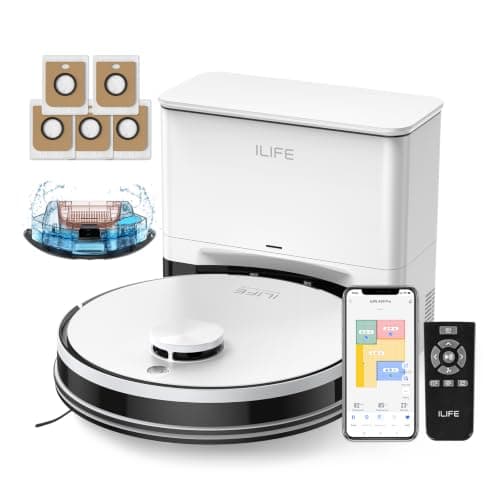
ILIFE A30 Pro Robot Vacuum and Mop10,000 Pa and a five-bag box that ILIFE rates at up to 280 days of hands-free running — the longest published interval on the site.
Roborock Q7 L5 Robot Vacuum and Mop8,000 Pa, 360-degree LiDAR and dual anti-tangle brushes — the most specified sheet at this price, with a 270 ml tank that is the catch.
Ranked by our published rubric. Every machine here publishes LiDAR; what varies is whether the listing also publishes multi-floor maps, no-go zones and virtual walls, which is the row to read.
01 · Best self-empty for pet hair
Roborock Q7 M5+ Robot Vacuum and Mop
10,000 Pa published and a 2.7-liter sealed dock bag rated at seven to nine weeks: the pet-hair answer, at a real price.
JawScrapers main brush plus zero-tangle side brush
Mopping
Three adjustable water levels, simultaneous with vacuuming
Rated noise
65 dB
Every figure above is the manufacturer's own published number. Where a manufacturer publishes nothing, the row says "Not published" rather than an estimate.
What the numbers say
+Highest published suction figure on the site, at 10,000 Pa
+2.7-liter dock bag is larger than the iRobot's and rated for a comparable interval
+Anti-tangle on both brushes, which is the pet-hair spec that matters
+150 minutes plus recharge-and-resume covers a large floor
Where it stops
−Dock bags are a permanent consumable
−The dock is large and 65 dB when emptying is genuinely startling the first time
−Pa figures remain incomparable between brands, however impressive 10,000 sounds
Who it is for
Pet households with real square footage, where the on-board bin is the daily annoyance.
Skip it if
You live in a studio. This is a whole-floor machine with a dock the size of a wastebasket and you will resent the footprint.
Our score: 8.5 out of 10
Published suction9.5
Navigation9.0
Runtime8.5
Bin and dock9.5
Running cost6.0
Scored against the published rubric on How We Pick. These are judgments about spec sheets, not measurements.
02 · Longest dock interval
ILIFE A30 Pro Robot Vacuum and Mop
10,000 Pa and a five-bag box that ILIFE rates at up to 280 days of hands-free running — the longest published interval on the site.
2.5 liters, five in the box, rated up to 280 days hands-free in total
Tank
2-in-1 integrated: 200 ml dustbin plus 200 ml water tank
Navigation
LDS LiDAR with SLAM mapping, no-go zones and virtual walls
Weight
10.4 lb
Rated noise
72 dB
Every figure above is the manufacturer's own published number. Where a manufacturer publishes nothing, the row says "Not published" rather than an estimate.
What the numbers say
+Five bags in the box is real money that the competition charges separately for
+Full LiDAR SLAM mapping with virtual walls at a budget price
+10,000 Pa published, matching the dearest robot here
Where it stops
−72 dB is the loudest robot figure on the site
−200 ml dustbin is the smallest here — the 2-in-1 tank splits capacity with the water
−The 150-minute rating is explicitly the gentle-suction number
Who it is for
Buyers optimizing for the longest possible gap between touching the thing.
Skip it if
You want to run it while you are home. At 72 dB it is a run-it-when-you-are-out machine.
Our score: 8.2 out of 10
Published suction9.0
Navigation8.5
Runtime8.0
Bin and dock8.5
Running cost7.0
Scored against the published rubric on How We Pick. These are judgments about spec sheets, not measurements.
03 · Best mapping under $300
iRobot Roomba 105 Vac
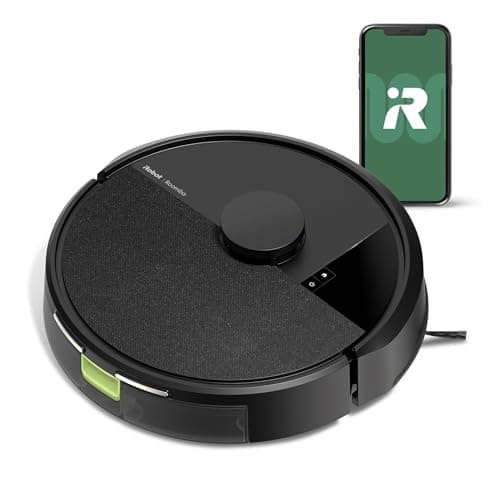
LiDAR mapping, keep-out zones and a 200-minute rating from the brand that will still be supporting the app in five years.
70x more power-lifting suction, compared by the manufacturer against the Roomba 600 series
Control
Roomba Home app, on-device buttons, voice assistants
Wi-Fi
2.4 GHz required for setup and operation
Suction in Pa
Not published
Every figure above is the manufacturer's own published number. Where a manufacturer publishes nothing, the row says "Not published" rather than an estimate.
What the numbers say
+200 minutes rated, the longest published runtime of any robot on this site
+Real LiDAR mapping, keep-out zones and room targeting at a budget price
+Recharge-and-resume, so a large floor completes without you
+iRobot's app and parts supply are the most durable bet in the category
Where it stops
−The 70x suction claim is measured against iRobot's own decade-old 600 series, not against a competitor
−No self-empty dock in this configuration — you empty the on-board bin
−No published bin volume
Who it is for
Multi-room homes that want scheduled, mapped cleaning without a self-empty dock's price.
Skip it if
Nobody in the house will install an app. Half of what you are paying for is mapping, zones and scheduling, and none of that exists without the phone.
Our score: 8.0 out of 10
Published suction6.5
Navigation9.0
Runtime10.0
Bin and dock6.0
Running cost7.5
Scored against the published rubric on How We Pick. These are judgments about spec sheets, not measurements.
04 · Best published suction under $300
Roborock Q7 L5 Robot Vacuum and Mop
8,000 Pa, 360-degree LiDAR and dual anti-tangle brushes — the most specified sheet at this price, with a 270 ml tank that is the catch.
360-degree LiDAR with multi-floor maps and no-go zones
Brushes
Anti-tangle main brush plus zero-tangle side brush
Rated noise
60 dB
Wi-Fi
2.4 GHz only
Every figure above is the manufacturer's own published number. Where a manufacturer publishes nothing, the row says "Not published" rather than an estimate.
What the numbers say
+Publishes a suction figure, unlike most of the field
+Dual anti-tangle brushes — both main and side, which most brands only claim for one
+Multi-floor mapping stored on the robot, so it works in a two-story house
+Vacuums and mops in the same pass
Where it stops
−270 ml dustbin is barely half the Lefant M210's, so it fills fast in a pet home
−Pa figures are not comparable across brands and Roborock does not publish their method
−No self-empty dock in this configuration
Who it is for
Multi-floor homes that want proper mapping and are willing to empty a small bin.
Skip it if
You have shedding pets and no self-empty dock. A 270 ml bin in a dog house is a daily chore, and the Q7 M5+ exists specifically to fix that.
Our score: 7.8 out of 10
Published suction8.5
Navigation9.0
Runtime8.5
Bin and dock5.0
Running cost7.5
Scored against the published rubric on How We Pick. These are judgments about spec sheets, not measurements.
05 · Cheapest self-empty
Lefant M2 Plus Robot Vacuum and Mop
6,000 Pa, LiDAR mapping and a 2.5-liter self-empty station rated at 75 days, from the least-known brand here.
2.5 liters, rated up to 75 days hands-free; ships with two bags
Dustbin
250 ml on-robot
Water tank
300 ml, three suction levels
Navigation
360-degree LiDAR with multi-floor mapping and no-go zones
Obstacle detection
190-degree PSD detection, stated to avoid objects from 1.6 inches away
Wi-Fi
Dual-band 2.4 GHz and 5 GHz
Every figure above is the manufacturer's own published number. Where a manufacturer publishes nothing, the row says "Not published" rather than an estimate.
What the numbers say
+Self-empty dock at the bottom of the price band, which is where the genuine saving is in this category
+Carpet detection lifts or avoids depending on whether the mop holder is fitted
+Dual-band Wi-Fi — the only robot here that does not force you onto 2.4 GHz
+Two dock bags in the box
Where it stops
−6,000 Pa is the lowest published suction of the self-empty machines here
−250 ml on-robot bin is tiny, which the dock only partly excuses
−Small brand: app longevity and dock-bag availability in year four are unknowns
Who it is for
Buyers who want self-emptying at the lowest possible entry price and accept the brand risk.
Skip it if
You want the app to still work in 2032. iRobot and Roborock are safer bets on software support, and a self-empty robot is worthless once its dock bags stop being sold.
Our score: 7.7 out of 10
Published suction7.0
Navigation8.5
Runtime8.5
Bin and dock8.5
Running cost6.0
Scored against the published rubric on How We Pick. These are judgments about spec sheets, not measurements.
The ones to skip
Skip any robot sold as "smart navigation" or "gyroscope mapping" without the word LiDAR. Gyroscopic navigation is dead reckoning — the robot estimates where it is from wheel rotation, with no laser measuring the room. It produces a tidier path than random bouncing and it drifts, and the listings that use the phrase are usually avoiding saying there is no laser.
Skip mapping entirely if your floors are mostly loose rugs and cables. A map does not stop a robot eating a phone charger or bunching a light rug — that needs obstacle avoidance, which nothing at this price publishes. The honest fix is fifteen minutes of tidying before each run, and if that sounds worse than vacuuming yourself, the robot-versus-stick page is the page to read before buying anything.
And skip the pascal comparison. Four machines here publish between 6,000 and 10,000 Pa, no two brands measure the figure the same way, and none publishes a method. A 10,000 Pa claim from one brand and an 8,000 Pa claim from another are not a ranking. The full argument is here.
What mapping costs you beyond the price
An app and an account. Every mapping robot requires one, because the map has to live somewhere and be drawn for you. That means a network connection, a login and a company that stays in business and keeps its servers running. This is a genuine long-term risk on a cheap robot and it is not on any spec sheet.
A floor plan of your house, held by a manufacturer. A LiDAR map is exactly what it sounds like. If that matters to you, it is worth knowing before you buy rather than after, and no listing on this page raises it.
We have not used any of these machines. A spec sheet cannot tell you how well a map survives furniture being moved, how often a robot loses its dock, or whether an app is still supported in three years. Our method page states exactly where our evidence stops.
How to choose in one paragraph
Want the most complete published package and a dock that empties itself: the Roborock Q7 M5+. Want no-go zones and virtual walls without paying for a dock: the ILIFE A30 Pro. Want the brand with the deepest parts network and the simplest setup: the Roomba 105 Vac. Want multi-floor maps and no-go zones at the lowest price that still publishes both: the Roborock Q7 L5. And if the budget is the whole constraint, the Lefant M2 Plus publishes 360-degree LiDAR, multi-floor mapping and no-go zones for less than anything else here — which five years ago was a flagship feature list.
Common questions
What is the best robot vacuum with mapping?+−
On published specifications, the Roborock Q7 M5+: PreciSense LiDAR with real-time mapping, 10,000 Pa of stated suction and a self-emptying dock. If you want the fullest published mapping feature set rather than the fullest machine, the Roborock Q7 L5 and the Lefant M2 Plus both name multi-floor maps and no-go zones explicitly and cost considerably less.
Is mapping worth it on a robot vacuum?+−
Yes, and it is the one robot feature we think is clearly worth paying for at this price. A mapping robot cleans in efficient rows instead of bouncing, finishes a floor on one charge more reliably, and lets you say "clean the kitchen" or "never go here". What it does not do is dodge socks and cables — that is obstacle avoidance, a separate feature that lives above $400.
What is the difference between LiDAR and gyroscope navigation?+−
LiDAR is a spinning laser that measures distance in 360 degrees and builds a real floor plan. Gyroscopic navigation estimates position from wheel rotation with no laser, which is better than random bouncing and drifts over a long run. If a listing says "smart navigation" or "gyro mapping" without naming LiDAR, assume there is no laser.
Do budget robot vacuums have multi-floor maps?+−
Some do. Two machines on this page publish multi-floor mapping by name, and both are at the cheaper end. It matters only if you carry the robot between floors: with one stored map, the robot has to relearn the layout every time, which wastes a chunk of the battery it should be spending cleaning.
Do mapping robot vacuums need wifi?+−
Yes. The map has to be stored and drawn for you, which means an app, an account and a network connection. That is a real trade rather than a free feature: it adds a login, a company that has to keep its servers running, and a floor plan of your house held by a manufacturer. No listing on this page mentions any of that.
Will a mapping robot avoid cables and socks?+−
No. Mapping is done at wheel height by a laser that sees walls and furniture, not small objects on the floor. Avoiding a charging cable needs camera-based object recognition, which none of the machines on this page publishes. A mapping robot will still drive into a sock — just in a straighter line.
Sources
Manufacturer-published specifications — Every runtime, wattage, capacity, weight, filtration and warranty figure quoted on this page is the manufacturer's own published number for that model, retrieved September 1, 2026. Where a manufacturer publishes no figure, the page says 'Not published' rather than estimating one.
Sweep & Suction — How We Pick — Our published method, including the scoring rubric, the three-year running-cost formula and an explicit statement of what published specifications cannot tell you.