The rest of this site argues the budget machine is usually enough. This page argues the other side as hard as we can, because you should hear it before you spend.
Everyone in this category says they tested twenty vacuums. We have not tested any, and we say so. What we do instead is read the manuals, compile the published specifications, and work out what each machine costs to run for three years — the method is written out in full.
We earn a commission if you buy through the links on this page, at no extra cost to you. It never changes what we recommend or the order we recommend it in. Full disclosure.
You give up four things, consistently, across every category: a comparable suction figure, a published warranty, materials, and parts supply in year six. Everything else — runtime, capacity, filtration claims, anti-tangle brushrolls — the budget tier matches. Those four are real and they are worth stating without hedging.
1. A number you can compare
This is the one that bothers us most, and it is systematic across the whole budget field.
Dyson publishes 185 air watts for the V11 Origin. Air watts describe work done at the cleaner head. Now look at what the budget field publishes: Tineco states 160 W (a suction-power rating, not air watts). Tikom states 40,000 Pa (sealed static pressure, measured by a method nobody discloses). Shark publishes 181 watts (motor consumption). Levoit publishes 180 watts (also consumption). Bissell publishes 200 W (consumption).
Not one of those is comparable to any other. So when a budget brand tells you its machine is powerful, you have no way to check, and neither do we. That is a genuine loss and we are not going to minimize it by dressing motor wattage up as a suction figure the way most of the category does.
2. A published warranty
Dyson publishes 2 years plus lifetime support on every machine. In the budget cordless field on this site — Shark, Tineco, Levoit, Bissell, Tikom, Vacmaster — not one publishes a warranty length on its listing.
There are exceptions elsewhere, and it is worth naming them: Bissell publishes 2 years on the PowerFresh steam mop, Hoover publishes 2 years on the PowerScrub Deluxe and 5 years on the SmartWash Pet, and Shark publishes 1 year across its steam mops. So budget brands can and do publish warranties — they just mostly do not, on cordless vacuums specifically.
3. Materials, which do not appear on any spec sheet
Dyson publishes that its machines are made from "strong materials selected for their durability and lightweight properties". That is marketing language, and it also happens to be describing something real: the difference between a machine that survives being knocked into a skirting board a thousand times and one that does not.
No manufacturer publishes a durability figure, so this is genuinely unmeasurable from the sheets. We include it because leaving it out would be dishonest by omission — build quality is a real difference and pretending otherwise because it is unquantifiable would be exactly the kind of convenient reasoning this site exists to avoid.
4. Parts supply in year six
The largest unpriced risk in every category on this site, and it applies differently in each:
Cordless vacuums: the battery. A cell with no published cycle rating, in a machine with no removable-battery option and no parts network, is a machine with an expiry date nobody will tell you.
Robot vacuums: the app. A mapped robot depends on a cloud service for its map and zones. When that is retired, it becomes a bump-and-run machine. Nobody publishes a support commitment.
Self-emptying robots: the dock bags. A dock whose bags are discontinued is a dock that does not work.
Carpet cleaners: the formula. These machines are designed around proprietary solutions, and a discontinued formula is a problem.
Bagged vacuums: the bags, for the same reason.
Established brands — Shark, Bissell, Hoover, iRobot, Dyson — carry substantially less of this risk than the newest entrants. That is worth weighting heavily and it is invisible in every specification comparison.
#
Product
Best for
Score
Price
01
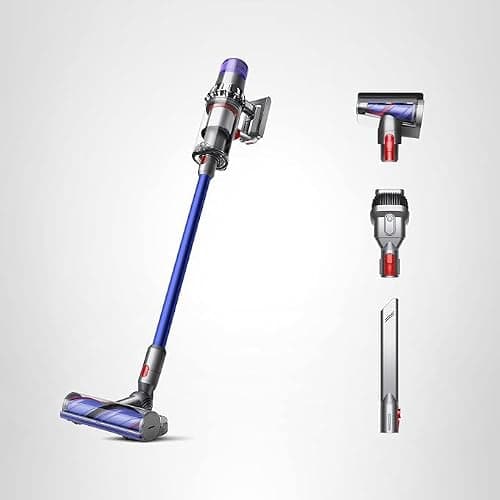
Dyson V11 Origin Cordless Vacuum185 air watts and 60 minutes, published — and the only machine on this site that publishes air watts at all, which is exactly the problem.
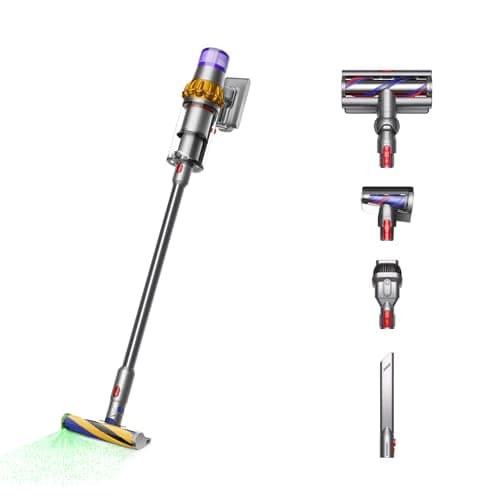
Dyson V15 Detect Cordless Vacuum60 minutes, a laser head, and a particle counter on an LCD screen — the machine every budget pick on this site is implicitly compared against.
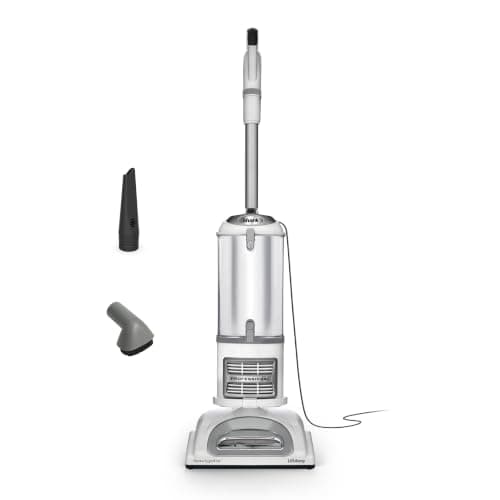
Shark Navigator Lift-Away (NV356E)1,200 W with a genuinely sealed HEPA system and a detachable pod, at a price the cordless machines cannot match on either count.
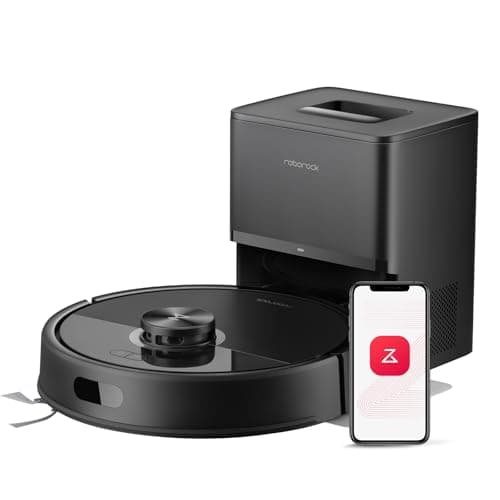
Roborock Q7 M5+ Robot Vacuum and Mop10,000 Pa published and a 2.7-liter sealed dock bag rated at seven to nine weeks: the pet-hair answer, at a real price.
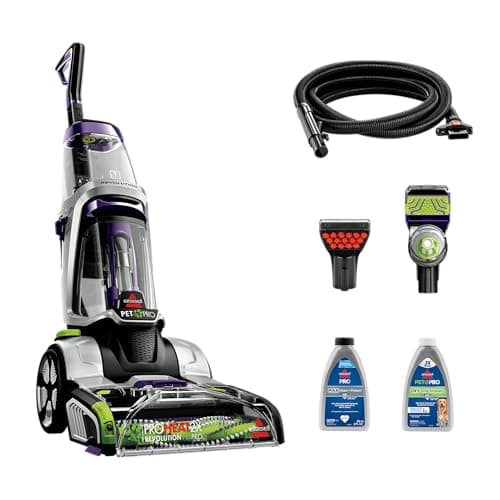
Bissell ProHeat 2X Revolution Pet Pro Plus (3588F)Dual brushrolls, a heater and an Express mode Bissell rates at about 30 minutes to dry — the only machine here that addresses drying time at all.
Scores are ours, from the published rubric on the How We Pick page. They are editorial judgments about published specifications — not test results. We have not handled these machines.
01 · The 60-minute reference
Dyson V11 Origin Cordless Vacuum
185 air watts and 60 minutes, published — and the only machine on this site that publishes air watts at all, which is exactly the problem.
HEPA whole-machine, rated to trap 99.99% of particles down to 0.3 microns
Modes
Eco, Auto, Boost, with an LCD showing remaining runtime to the second
Rated noise
70 dB
Warranty
2-year limited
Every figure above is the manufacturer's own published number. Where a manufacturer publishes nothing, the row says "Not published" rather than an estimate.
What the numbers say
+Publishes air watts — a comparable unit — where the budget field publishes Pa, wattage, or nothing
+60 minutes rated, and the LCD counts down real remaining time rather than showing three bars
+Hair screw tool is the best answer to long hair on any machine here
Where it stops
−The price is the objection and there is no way around it
−0.2 gallons is still a small bin for a whole-house clean
−Replacement batteries are priced like a whole budget vacuum
Who it is for
Large homes where a single uninterrupted clean is worth real money.
Skip it if
You clean a one-bedroom apartment. Sixty minutes of runtime is being sold to houses; a 40-minute machine finishes a flat twice over.
Our score: 8.4 out of 10
Published power9.5
Runtime9.0
Bin and filtration8.5
Weight and handling8.0
Running cost4.5
Scored against the published rubric on How We Pick. These are judgments about spec sheets, not measurements.
02 · The top of the market
Dyson V15 Detect Cordless Vacuum
60 minutes, a laser head, and a particle counter on an LCD screen — the machine every budget pick on this site is implicitly compared against.
LCD showing counted particles, power mode and runtime to the second
Filtration
Whole-machine, rated to trap 99.99% of particles down to 0.3 microns
Warranty
2-year limited
Every figure above is the manufacturer's own published number. Where a manufacturer publishes nothing, the row says "Not published" rather than an estimate.
What the numbers say
+The laser head genuinely reveals dust on hard floor that you would otherwise walk past
+Automatic power adjustment by detected debris, so Boost is not a manual chore
+Two heads in the box, which is the specialization the budget field cannot offer
Where it stops
−It is several times the price of every budget pick on this site
−The particle count is interesting exactly twice
−Same 0.2-gallon bin as the far cheaper V11 Origin
Who it is for
Large homes, allergy households, and buyers for whom this is not a stretch.
Skip it if
You want a clean floor rather than a dashboard. Almost everything the V15 adds over a V8 is information, not cleaning.
Our score: 8.6 out of 10
Published power10.0
Runtime9.0
Bin and filtration9.0
Weight and handling8.5
Running cost4.0
Scored against the published rubric on How We Pick. These are judgments about spec sheets, not measurements.
03 · Best sealed HEPA under $200
Shark Navigator Lift-Away (NV356E)
1,200 W with a genuinely sealed HEPA system and a detachable pod, at a price the cordless machines cannot match on either count.
Washable HEPA plus foam, Anti-Allergen Complete Seal; rated to trap 99.9% of dust and allergens per ASTM F1977-22, tested by IBR Laboratories
Rated noise
80 dB
Lift-Away
Detachable pod for above-floor cleaning
Runtime
Unlimited — corded
Every figure above is the manufacturer's own published number. Where a manufacturer publishes nothing, the row says "Not published" rather than an estimate.
What the numbers say
+Names its filtration test standard AND the lab that ran it — the most specific filtration claim on this site
+1,200 W on a driven brushroll deep-cleans carpet properly
+Lift-Away pod covers stairs, which is where most uprights fail
Where it stops
−13.7 lb is the heaviest machine we recommend anywhere
−Washable filters need genuine drying time, and people skip it
−Corded, with everything that implies
Who it is for
Allergy households on carpet who want measured filtration rather than a bare percentage.
Skip it if
You have a lot of stairs and no storage. It is heavy, it is bulky, and the Lift-Away pod only partly solves that.
Our score: 8.4 out of 10
Published power9.0
Runtime10.0
Bin and filtration9.5
Weight and handling4.5
Running cost9.0
Scored against the published rubric on How We Pick. These are judgments about spec sheets, not measurements.
04 · Best self-empty for pet hair
Roborock Q7 M5+ Robot Vacuum and Mop
10,000 Pa published and a 2.7-liter sealed dock bag rated at seven to nine weeks: the pet-hair answer, at a real price.
JawScrapers main brush plus zero-tangle side brush
Mopping
Three adjustable water levels, simultaneous with vacuuming
Rated noise
65 dB
Every figure above is the manufacturer's own published number. Where a manufacturer publishes nothing, the row says "Not published" rather than an estimate.
What the numbers say
+Highest published suction figure on the site, at 10,000 Pa
+2.7-liter dock bag is larger than the iRobot's and rated for a comparable interval
+Anti-tangle on both brushes, which is the pet-hair spec that matters
+150 minutes plus recharge-and-resume covers a large floor
Where it stops
−Dock bags are a permanent consumable
−The dock is large and 65 dB when emptying is genuinely startling the first time
−Pa figures remain incomparable between brands, however impressive 10,000 sounds
Who it is for
Pet households with real square footage, where the on-board bin is the daily annoyance.
Skip it if
You live in a studio. This is a whole-floor machine with a dock the size of a wastebasket and you will resent the footprint.
Our score: 8.5 out of 10
Published suction9.5
Navigation9.0
Runtime8.5
Bin and dock9.5
Running cost6.0
Scored against the published rubric on How We Pick. These are judgments about spec sheets, not measurements.
05 · Best heated cleaner
Bissell ProHeat 2X Revolution Pet Pro Plus (3588F)
Dual brushrolls, a heater and an Express mode Bissell rates at about 30 minutes to dry — the only machine here that addresses drying time at all.
MAX Clean, and Express Clean rated to leave carpets dry in about 30 minutes
Hose
8 feet
Tools
2-in-1 pet upholstery tool and 3" tough stain tool
Pre-treatment
CleanShot pre-treater with OXY, built in
Formulas
Pro Max Clean + Protect and Pet Pro Oxy Urine Eliminator, both included
Machine weight
Not published in a comparable form on the listing
Every figure above is the manufacturer's own published number. Where a manufacturer publishes nothing, the row says "Not published" rather than an estimate.
What the numbers say
+Dual counter-rotating brushrolls double the agitation of the single-brush machines
+A published drying-time claim, which almost nobody in this category makes
+Built-in pre-treater means you are not carrying a spray bottle around as well
+8-foot hose, the longest here
Where it stops
−Two formulas included means two formulas to keep buying
−The most expensive machine on this page
−Bissell does not publish a comparable machine weight for this model
Who it is for
Households with recurring pet accidents, where the same spots get cleaned repeatedly.
Skip it if
You clean carpets twice a year. This is a machine that repays frequent use; for occasional deep cleans, renting is the better arithmetic.
Our score: 7.6 out of 10
Tank capacity8.5
Brush system9.5
Tools and reach9.0
Weight and handling5.5
Running cost5.5
Scored against the published rubric on How We Pick. These are judgments about spec sheets, not measurements.
What you do NOT give up
Having argued the case as hard as we can, here is the counterweight, and it is also from published figures:
Where the budget tier matches or beats the flagship, on published specifications.
Specification
Budget tier
Flagship tier
Verdict
Rated runtime
40 min (several machines)
40 min (Dyson V8)
Identical
Bin capacity
Up to 1.3 L
0.14-0.2 gal (0.53-0.76 L)
Budget wins
Anti-tangle brushroll
Published on most
Published
Match
Sealed HEPA
Published by Shark, Bissell, Levoit
Published
Match
Filtration test standard named
Shark names ASTM F1977-22 and IBR Laboratories
Percentage only
Budget is MORE specific
Runtime breakdown published
Levoit 3-way, Bissell 2-way, Tineco by tool
Single figure
Budget is more honest
Noise rating published
Tineco 67.1 dB, Levoit 77.5 dB, Shark 80 dB
Dyson V11 70 dB only
Budget publishes more often
Weight
Tineco A30S 5.3 lb
Dyson V8 5.6 lb
Budget wins on the lightest
The honest summary
The budget tier costs you verifiability, a warranty, materials and long-term parts. It does not cost you runtime, capacity, filtration or hair management, and on several disclosure measures the budget brands are genuinely more forthcoming than the flagship.
Whether that trade is worth making comes down to one question: how long do you intend to keep the machine? Five years and the budget tier is clearly the better value. Ten years and the parts argument dominates everything else on this page. That is the entire decision, and it is not a specification question at all.
What we cannot tell you
How long any of these machines actually last. That is the single most important number in this whole argument and not one manufacturer publishes it. We have not owned any of these machines for years, and anyone who tells you a specific lifespan for a specific model is guessing at best.
Common questions
What do you actually give up buying a budget vacuum?+−
Four things, consistently: a suction figure you can compare between brands, a published warranty, build materials, and a parts supply that will still exist in year six. Runtime, bin capacity, filtration and anti-tangle brushrolls are matched by the budget tier.
Do budget vacuums break sooner?+−
No manufacturer publishes a durability figure, so this cannot be answered from specifications and we are not going to guess. What is structural is that a cordless machine with a sealed battery, no published cycle rating and a thin parts network has an expiry date nobody will state.
Are budget brands less honest about their specs?+−
Frequently the opposite, which surprised us. Levoit splits runtime three ways, Bissell publishes both its high and low figures, Tineco splits by tool, and Shark names ASTM F1977-22 and the laboratory that ran its filtration test. Dyson publishes single figures and percentages.
When is a flagship vacuum clearly the right buy?+−
When you intend to keep it for ten years. Over that horizon the parts-supply argument dominates every specification comparison, and it is the strongest reason to pay flagship prices.
Is there a category where budget is a bad idea?+−
Connected robots carry the most risk, because a mapped robot depends on a cloud service nobody commits to supporting. If the app is retired the machine loses the feature you paid most for, and the newest brands carry the most of that risk.
Sources
Manufacturer-published specifications — Every runtime, wattage, capacity, weight, filtration and warranty figure quoted on this page is the manufacturer's own published number for that model, retrieved September 1, 2026. Where a manufacturer publishes no figure, the page says 'Not published' rather than estimating one.
ASTM F1977 — standard test method for vacuum cleaner filtration efficiency — Named by Shark (tested by IBR Laboratories, per ASTM F1977-22) and by Levoit (ASTM F1977-22) in their own published filtration claims. Where a brand names this standard we treat the claim as checkable; where a brand states a bare percentage we do not.
Sweep & Suction — How We Pick — Our published method, including the scoring rubric, the three-year running-cost formula and an explicit statement of what published specifications cannot tell you.