Every rival prints a suction figure on the box. iRobot prints one comparison — against its own older machine. That single asymmetry is most of what this question is really about.
Everyone in this category says they tested twenty vacuums. We have not tested any, and we say so. What we do instead is read the manuals, compile the published specifications, and work out what each machine costs to run for three years — the method is written out in full.
We earn a commission if you buy through the links on this page, at no extra cost to you. It never changes what we recommend or the order we recommend it in. Full disclosure.
The short answer: a Roomba is worth it for the reasons iRobot does not advertise, and not for the ones it does. On published specifications the Roomba 105 Vac wins on rated runtime (200 minutes, the longest on this site), on weight (6.2 lb, the lightest mapped robot here) and on dock filtration stated as an actual number. It loses on published suction, because iRobot does not publish a suction figure in any unit at all — while Roborock publishes 10,000 Pa, ILIFE 10,000 Pa and Roborock's cheaper Q7 L5 8,000 Pa. What the premium genuinely buys is the thing nobody prints on a box: the highest confidence in this category that the app running your map will still exist in five years.
The number iRobot will not print
Every mapped robot on this site publishes a suction claim except the Roombas. Roborock publishes 10,000 Pa on the Q7 M5+ and 8,000 on the Q7 L5. ILIFE publishes up to 10,000 Pa. Lefant publishes 6,000, Tikom 5,000. iRobot publishes nothing — no pascals, no air watts, no motor wattage. Our specification tables say "Suction in Pa: Not published" on all three Roombas here, because that is what the listings say.
Before that reads as an indictment, hold two things at once. First, pascal figures are not comparable across brands anyway. Pa measures sealed static pressure at the motor inlet with the airway blocked, every manufacturer measures it differently, and none publish their method — the argument our robot hub makes at length. A 10,000 Pa Roborock and a 10,000 Pa ILIFE are two companies' internal numbers that happen to match, not a tie. So iRobot declining to join that game is defensible.
Second, and less comfortably: it still leaves you with nothing to compare. Whatever a pascal figure is worth, it is a number the manufacturer has committed to in writing. iRobot has committed to no number, which means on the single specification most buyers think they are shopping on, a Roomba cannot be placed against anything. That is a real cost of buying one, and it is not the cost the price tag implies.
The one suction claim iRobot does make, read carefully
The Roomba 105 Vac's listing does carry a suction claim: "70x more power-lifting suction." Read the comparison it names. It is measured against iRobot's own Roomba 600 series — a machine iRobot launched years ago and no longer sells at the top of its range. It is not a comparison against a Roborock, a Shark, an ILIFE or anything else you might buy instead.
This is not dishonest and iRobot states the baseline plainly, which is more than several rivals do with their pascal numbers. It is simply a claim that tells you how much better a 2026 Roomba is than an older Roomba. If you are upgrading from a 600-series Roomba, that is exactly the figure you want. If you are choosing between brands, it tells you nothing at all, and reading it as a competitive claim is the most common mistake made on this shelf.
The figures, side by side
Every cell is the manufacturer's own published number, or "Not published" where there is none.
Published figure
Roomba 105 Vac AutoEmpty
Roborock Q7 M5+
ILIFE A30 Pro
Shark AV2501AE
Suction
Not published in any unit
10,000 Pa stated
Up to 10,000 Pa stated
Not published in Pa
Rated runtime
200 min
150 min
150 min
120 min, recharge and resume
Navigation
ClearView LiDAR
PreciSense LiDAR
LDS LiDAR with SLAM
360-degree LiDAR, Matrix Clean
Dock interval
Up to 75 days
7-9 weeks, 2.7 L sealed bag
Up to 280 days across 5 bags
60 days, BAGLESS
Dock filtration
99% of allergens to 0.7 microns
Sealed bag, class not published
Sealed bag, class not published
True HEPA, 99.97% to 0.3 microns
Anti-tangle brush
Not published
JawScrapers main + zero-tangle side
Not published
Self-cleaning brushroll
Rated noise
Not published
65 dB
72 dB
Not published
Weight
6.2 lb
10.6 lb
10.4 lb
15.3 lb
Pascal figures are not comparable between manufacturers. They are listed because the manufacturers published them, not because 10,000 of one brand's pascals equals 10,000 of another's.
Where iRobot genuinely wins
Rated runtime, by a clear margin. 200 minutes on the 105 Vac against 150 for both Roborock and ILIFE and 120 for the Shark. That is the longest published runtime of any robot on this site, and unlike a pascal figure it is a quantity that means roughly the same thing at every brand. On a large single floor it is the difference between finishing and coming back after a recharge. One caveat we will not bury: that 200-minute figure comes from the retail listing, and iRobot's own product page for the 105 Vac states no runtime at all. Both documents are iRobot's. Only one of them commits to a number, which is a smaller version of the same pattern this whole page is about.
Dock filtration stated as a number. iRobot publishes that its AutoEmpty dock bags trap 99% of allergens as small as 0.7 microns. Roborock and ILIFE publish "sealed bag" and stop — a description of a part, not a claim about performance. Only Shark publishes better, and it publishes considerably better: true HEPA at 99.97% down to 0.3 microns, on a base with no bag to buy.
Weight, which nobody thinks about until they own one. 6.2 lb against 10.4, 10.6 and 15.3. You pick a robot up to free it from a rug tassel, to carry it to another floor, to fish it out from under a bed. Doing that with a 6.2 lb machine and a 15.3 lb one are different experiences, and the published gap here is more than double.
Mopping that gets carpet right without configuration. On the 105 Combo, iRobot publishes automatic carpet detection and avoidance while mopping, stating explicitly that no programming is required, plus a micro-pump metering water to keep the pad uniformly moist. Several rivals solve the same problem by asking you to draw no-mop zones on a map. Both work. Only one works on the day it arrives.
Where the cheaper robots match or beat it
A published suction figure of any kind. Whatever its limits, Roborock's 10,000 Pa and ILIFE's 10,000 Pa are numbers those companies put in writing. iRobot's silence is the single largest gap in its published sheet.
Anti-tangle brush design, published. Roborock publishes JawScrapers on the main brush and a zero-tangle side brush; Shark publishes a self-cleaning brushroll. iRobot publishes a 3-stage system — multi-surface brush, edge-sweeping brush, suction — with no anti-tangle claim attached. In a shedding household that is the specification that decides how often you flip the machine over, and it is the argument the pet-hair robot roundup is built on.
A noise rating. Roborock publishes 65 dB on the Q7 M5+ and 60 on the Q7 L5; ILIFE publishes 72. iRobot publishes nothing. For a machine specifically designed to run while you are in the house, that is a strange figure to omit.
Hands-free interval, at the top end. iRobot's up to 75 days is respectable and Roborock's 7 to 9 weeks is comparable. ILIFE publishes up to 280 days across the five bags in its box, which is a different order of magnitude — and Shark removes the bag entirely with a bagless base, so there is no consumable to run out of at all.
Price per published feature. We do not print prices in prose on this site and the live figures are on the buy controls below. What the published sheets show is that the specifications a Roomba is missing — suction, anti-tangle, a noise rating — are all present on machines that sit lower in this category's price order, not higher.
#
Product
Best for
Score
Price
01
Roborock Q7 M5+ Robot Vacuum and Mop10,000 Pa published and a 2.7-liter sealed dock bag rated at seven to nine weeks: the pet-hair answer, at a real price.
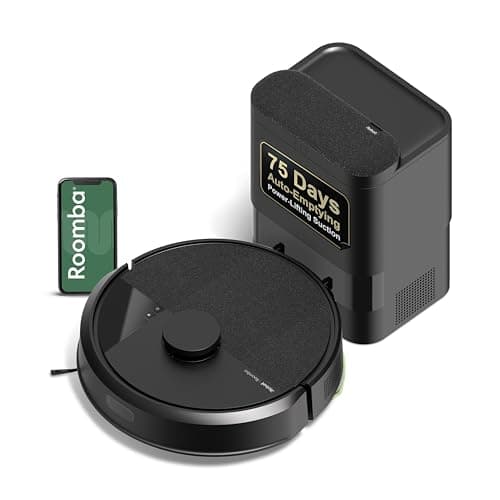
iRobot Roomba 105 Vac with AutoEmpty DockThe same robot as the 105 Vac with the dock that changes how you live with it: 75 days between bag changes instead of an emptying chore every run.
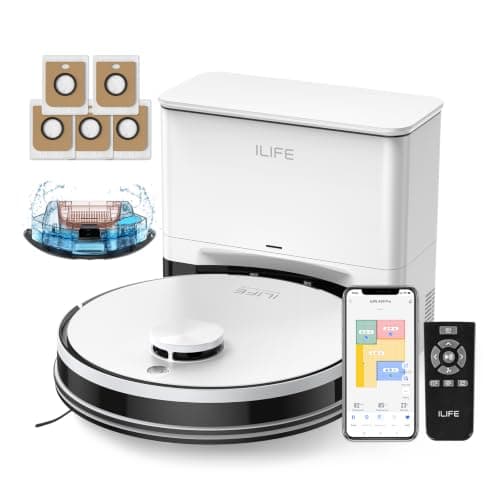
ILIFE A30 Pro Robot Vacuum and Mop10,000 Pa and a five-bag box that ILIFE rates at up to 280 days of hands-free running — the longest published interval on the site.
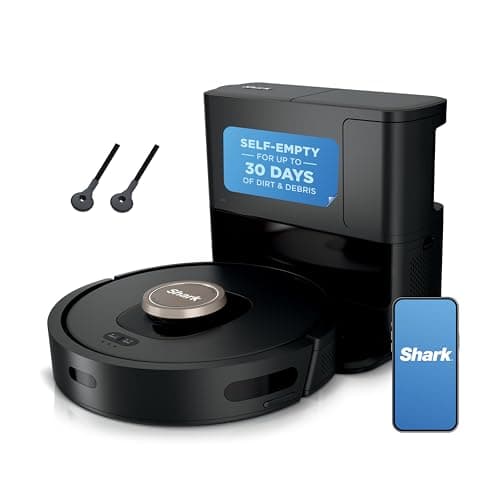
Shark AI Robot with XL HEPA Self-Empty Base (AV2501AE)The only self-empty dock here with no bags to buy — bagless, HEPA-filtered and rated at 60 days, which changes the three-year arithmetic completely.
Roborock Q7 L5 Robot Vacuum and Mop8,000 Pa, 360-degree LiDAR and dual anti-tangle brushes — the most specified sheet at this price, with a 270 ml tank that is the catch.
iRobot Roomba 105 Combo with AutoEmpty DockIt detects carpet and stops mopping over it without being told, which is the one thing budget combos routinely get wrong.
Ranked by our published rubric, which is why a Roborock sits above the Roomba on a page with Roomba in the title. The rubric does not know what the headline says.
01 · Best self-empty for pet hair
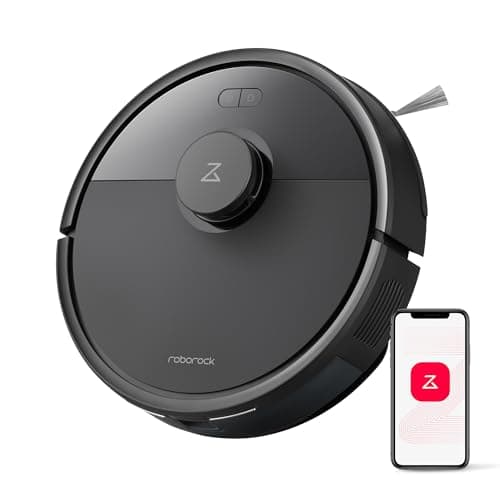
Roborock Q7 M5+ Robot Vacuum and Mop
10,000 Pa published and a 2.7-liter sealed dock bag rated at seven to nine weeks: the pet-hair answer, at a real price.
JawScrapers main brush plus zero-tangle side brush
Mopping
Three adjustable water levels, simultaneous with vacuuming
Rated noise
65 dB
Every figure above is the manufacturer's own published number. Where a manufacturer publishes nothing, the row says "Not published" rather than an estimate.
What the numbers say
+Highest published suction figure on the site, at 10,000 Pa
+2.7-liter dock bag is larger than the iRobot's and rated for a comparable interval
+Anti-tangle on both brushes, which is the pet-hair spec that matters
+150 minutes plus recharge-and-resume covers a large floor
Where it stops
−Dock bags are a permanent consumable
−The dock is large and 65 dB when emptying is genuinely startling the first time
−Pa figures remain incomparable between brands, however impressive 10,000 sounds
Who it is for
Pet households with real square footage, where the on-board bin is the daily annoyance.
Skip it if
You live in a studio. This is a whole-floor machine with a dock the size of a wastebasket and you will resent the footprint.
Our score: 8.5 out of 10
Published suction9.5
Navigation9.0
Runtime8.5
Bin and dock9.5
Running cost6.0
Scored against the published rubric on How We Pick. These are judgments about spec sheets, not measurements.
02 · Best self-empty under $400
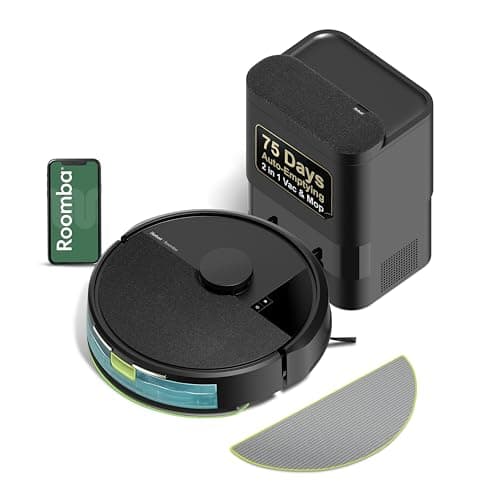
iRobot Roomba 105 Vac with AutoEmpty Dock
The same robot as the 105 Vac with the dock that changes how you live with it: 75 days between bag changes instead of an emptying chore every run.
Ongoing consumable — roughly five bag changes a year at the stated 75-day interval
Suction in Pa
Not published
Every figure above is the manufacturer's own published number. Where a manufacturer publishes nothing, the row says "Not published" rather than an estimate.
What the numbers say
+75 days between interactions is the single biggest quality-of-life feature in this category
+Bagged dock means emptying does not put dust back in the room, which matters for allergies
+Identical mapping and runtime to the cheaper 105 Vac — you are paying only for the dock
Where it stops
−Dock bags are a permanent running cost that the dockless version does not have
−The dock is bulky and needs clear floor space either side
−0.1-gallon on-board bin is small, which is fine only because the dock exists
Who it is for
Pet households and larger homes, where the on-board bin fills every single run.
Skip it if
Your floor is mostly hard surface and lightly used. At that dirt load the on-board bin lasts a week anyway, and the dock is solving a problem you do not have.
Our score: 8.4 out of 10
Published suction6.5
Navigation9.0
Runtime10.0
Bin and dock9.5
Running cost6.0
Scored against the published rubric on How We Pick. These are judgments about spec sheets, not measurements.
03 · Longest dock interval
ILIFE A30 Pro Robot Vacuum and Mop
10,000 Pa and a five-bag box that ILIFE rates at up to 280 days of hands-free running — the longest published interval on the site.
2.5 liters, five in the box, rated up to 280 days hands-free in total
Tank
2-in-1 integrated: 200 ml dustbin plus 200 ml water tank
Navigation
LDS LiDAR with SLAM mapping, no-go zones and virtual walls
Weight
10.4 lb
Rated noise
72 dB
Every figure above is the manufacturer's own published number. Where a manufacturer publishes nothing, the row says "Not published" rather than an estimate.
What the numbers say
+Five bags in the box is real money that the competition charges separately for
+Full LiDAR SLAM mapping with virtual walls at a budget price
+10,000 Pa published, matching the dearest robot here
Where it stops
−72 dB is the loudest robot figure on the site
−200 ml dustbin is the smallest here — the 2-in-1 tank splits capacity with the water
−The 150-minute rating is explicitly the gentle-suction number
Who it is for
Buyers optimizing for the longest possible gap between touching the thing.
Skip it if
You want to run it while you are home. At 72 dB it is a run-it-when-you-are-out machine.
Our score: 8.2 out of 10
Published suction9.0
Navigation8.5
Runtime8.0
Bin and dock8.5
Running cost7.0
Scored against the published rubric on How We Pick. These are judgments about spec sheets, not measurements.
04 · Best bagless self-empty
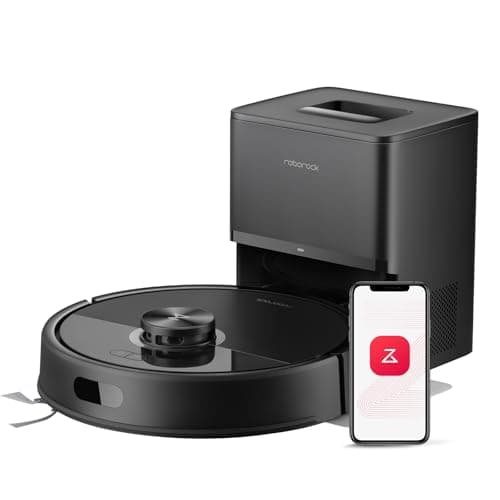
Shark AI Robot with XL HEPA Self-Empty Base (AV2501AE)
The only self-empty dock here with no bags to buy — bagless, HEPA-filtered and rated at 60 days, which changes the three-year arithmetic completely.
True HEPA, rated to capture 99.97% of dust and allergens down to 0.3 microns
Rated runtime
120 minutes with recharge and resume
Navigation
360-degree LiDAR with Matrix Clean grid coverage
Brushroll
Self-cleaning
Weight
15.3 lb
Suction in Pa
Not published
Every figure above is the manufacturer's own published number. Where a manufacturer publishes nothing, the row says "Not published" rather than an estimate.
What the numbers say
+Bagless dock — no consumable at all, which no other self-empty robot on this site can say
+True HEPA on the dock, so emptying does not re-release what it collected
+Matrix Clean makes multiple passes over dirty areas rather than one
+Self-cleaning brushroll
Where it stops
−Emptying a bagless dock does put you back in contact with the dust, HEPA or not
−No published suction figure in any unit
−15.3 lb with the base is the heaviest robot package here
Who it is for
Anyone who has done the maths on dock bags over five years and did not like the answer.
Skip it if
Allergies are the reason you are buying a self-empty robot at all. A bagged dock is the better answer for that specific problem, even though it costs more to run.
Our score: 8.1 out of 10
Published suction6.0
Navigation8.5
Runtime8.0
Bin and dock9.0
Running cost9.0
Scored against the published rubric on How We Pick. These are judgments about spec sheets, not measurements.
05 · Best mapping under $300
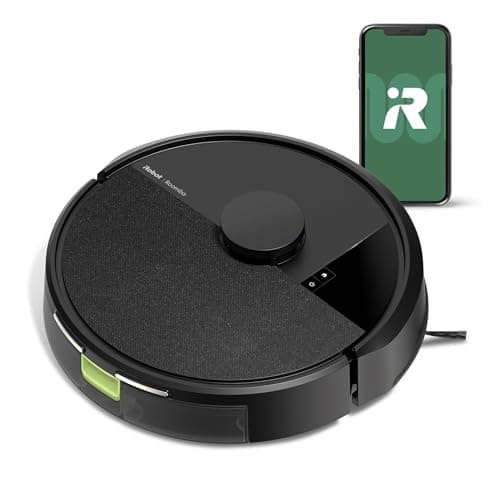
iRobot Roomba 105 Vac
LiDAR mapping, keep-out zones and a 200-minute rating from the brand that will still be supporting the app in five years.
70x more power-lifting suction, compared by the manufacturer against the Roomba 600 series
Control
Roomba Home app, on-device buttons, voice assistants
Wi-Fi
2.4 GHz required for setup and operation
Suction in Pa
Not published
Every figure above is the manufacturer's own published number. Where a manufacturer publishes nothing, the row says "Not published" rather than an estimate.
What the numbers say
+200 minutes rated, the longest published runtime of any robot on this site
+Real LiDAR mapping, keep-out zones and room targeting at a budget price
+Recharge-and-resume, so a large floor completes without you
+iRobot's app and parts supply are the most durable bet in the category
Where it stops
−The 70x suction claim is measured against iRobot's own decade-old 600 series, not against a competitor
−No self-empty dock in this configuration — you empty the on-board bin
−No published bin volume
Who it is for
Multi-room homes that want scheduled, mapped cleaning without a self-empty dock's price.
Skip it if
Nobody in the house will install an app. Half of what you are paying for is mapping, zones and scheduling, and none of that exists without the phone.
Our score: 8.0 out of 10
Published suction6.5
Navigation9.0
Runtime10.0
Bin and dock6.0
Running cost7.5
Scored against the published rubric on How We Pick. These are judgments about spec sheets, not measurements.
06 · Best published suction under $300
Roborock Q7 L5 Robot Vacuum and Mop
8,000 Pa, 360-degree LiDAR and dual anti-tangle brushes — the most specified sheet at this price, with a 270 ml tank that is the catch.
360-degree LiDAR with multi-floor maps and no-go zones
Brushes
Anti-tangle main brush plus zero-tangle side brush
Rated noise
60 dB
Wi-Fi
2.4 GHz only
Every figure above is the manufacturer's own published number. Where a manufacturer publishes nothing, the row says "Not published" rather than an estimate.
What the numbers say
+Publishes a suction figure, unlike most of the field
+Dual anti-tangle brushes — both main and side, which most brands only claim for one
+Multi-floor mapping stored on the robot, so it works in a two-story house
+Vacuums and mops in the same pass
Where it stops
−270 ml dustbin is barely half the Lefant M210's, so it fills fast in a pet home
−Pa figures are not comparable across brands and Roborock does not publish their method
−No self-empty dock in this configuration
Who it is for
Multi-floor homes that want proper mapping and are willing to empty a small bin.
Skip it if
You have shedding pets and no self-empty dock. A 270 ml bin in a dog house is a daily chore, and the Q7 M5+ exists specifically to fix that.
Our score: 7.8 out of 10
Published suction8.5
Navigation9.0
Runtime8.5
Bin and dock5.0
Running cost7.5
Scored against the published rubric on How We Pick. These are judgments about spec sheets, not measurements.
07 · Best vacuum-and-mop combo
iRobot Roomba 105 Combo with AutoEmpty Dock
It detects carpet and stops mopping over it without being told, which is the one thing budget combos routinely get wrong.
Automatically detects and avoids carpet while mopping — manufacturer states no programming required
Mopping
Micro-pump controls water flow to keep the pad uniformly moist
Modes
Vacuum only, mop only, combined
Navigation
ClearView LiDAR
Dock bag filtration
Traps 99% of allergens as small as 0.7 microns
Suction in Pa
Not published
Every figure above is the manufacturer's own published number. Where a manufacturer publishes nothing, the row says "Not published" rather than an estimate.
What the numbers say
+Automatic carpet avoidance while mopping, with no map editing required
+Micro-pump water control instead of a pad that soaks then dries out
+Three genuinely separate modes
+The 75-day dock applies to the combo too
Where it stops
−100 minutes is half the vacuum-only 105's rating — mopping costs you battery
−A flat pad drags dirt; it does not scrub, whatever any combo claims
−Mop pads are a consumable on top of dock bags
Who it is for
Hard-floor and rug homes that want a daily light mop rather than a deep clean.
Skip it if
Your floors are mostly carpet. You would be buying a mop that spends the whole run avoiding your floor.
Our score: 7.6 out of 10
Published suction6.5
Navigation9.0
Runtime6.5
Bin and dock9.5
Running cost5.5
Scored against the published rubric on How We Pick. These are judgments about spec sheets, not measurements.
The argument for the premium that actually holds
Here is the part that does not appear on any spec sheet and is, in our reading, the real case for buying a Roomba. A mapped robot is a cloud-dependent appliance. Its map, its zones, its schedules and its no-go lines live on a manufacturer's service. If that service is retired, a mapped robot does not become a dumber mapped robot — it degrades into an expensive bump-and-run machine, and the feature you paid the premium for is the feature that disappears.
No manufacturer in this category publishes a support commitment. Not one states how many years the app will be maintained. So the only evidence available is institutional: how long the company has existed, how many product generations it has supported, and whether it is a floor-care company or a firm that has been selling robots for three years. On that evidence iRobot is the safest bet available in this category, and the small brands are the least safe. The robot-vacuum worth-it page reaches the same conclusion from the other direction.
That is a genuine, defensible reason to pay more. It is just not a cleaning reason, and it is emphatically not the reason the marketing gives you. It is the same shape as the argument the Dyson alternatives page reaches about cordless vacuums: the premium buys longevity and support, not measured performance — and whether that is worth it comes down entirely to how long you intend to keep the thing.
So is a Roomba worth it? By household
Upgrading from an older Roomba? Yes, and this is the one case where iRobot's own 70x claim is the relevant figure rather than a distraction. You also keep the app, the account and the habits.
Large single floor, and runtime is your constraint? Yes. 200 published minutes against 150 is a real advantage and it is measured in a unit that means the same thing everywhere.
Planning to keep it five years or more, and the map matters to you? Yes, on the app-longevity argument above — which is the strongest case for the premium and the one nobody markets.
Shedding pets on carpet? Not on the published figures. Nothing iRobot publishes about its brushes addresses hair wrap, and two rivals publish a claim that does.
Shopping on suction, or comparing spec sheets across brands? No — not because a Roomba cleans worse, but because iRobot has given you nothing to compare with. If a number on the box is what decides your purchase, buy from a manufacturer that printed one.
On the tightest budget? No. The mapped machines below the Roomba's price publish more, not less, and the budget robot roundup ranks them properly.
What we cannot tell you
Whether a Roomba actually picks up more than a Roborock. There is no shared test standard for robot vacuum pickup, one of these two brands publishes no suction figure at all, and the other publishes one measured by its own undisclosed method. We have not run any of these machines and we will not imply otherwise.
We also cannot tell you how long any of these apps will be supported. Our reading that iRobot is the safest bet on that risk is an inference from company history, not a published commitment, and we have flagged it as an inference rather than dressing it up as a specification. Our method page sets out exactly where this kind of judgment starts and the evidence stops.
Common questions
Is a Roomba worth it?+−
For an upgrade from an older Roomba, for a large single floor where 200 published minutes of runtime matters, or for a household planning to keep the machine five years and relying on its map — yes. For a shedding pet household, for anyone shopping on a suction figure, or for the tightest budget — no, because iRobot publishes no suction number and no anti-tangle brush claim, and cheaper mapped rivals publish both.
Are Roombas worth the money compared to cheaper robots?+−
On published specifications the cheaper mapped robots give you more printed figures, not fewer: suction in pascals, anti-tangle brush designs and noise ratings, none of which iRobot publishes. What the Roomba premium genuinely buys is the longest published runtime here (200 minutes), the lightest mapped body (6.2 lb), dock filtration stated as an actual number, and the strongest institutional bet that the app running your map still exists in five years.
Does iRobot publish a suction figure for the Roomba?+−
No — not in pascals, air watts or motor watts. Our specification tables say "Suction in Pa: Not published" on all three Roombas covered here, because that is what the listings say. The one suction claim iRobot does make, "70x more power-lifting suction", is measured against iRobot's own Roomba 600 series, not against any competitor.
What does 70x more suction mean on a Roomba?+−
It means 70 times the power-lifting suction of iRobot's own older Roomba 600 series, which is the baseline the listing names. It is a generational claim, not a competitive one. If you are replacing a 600-series Roomba it is exactly the figure you want; if you are choosing between brands it tells you nothing.
Roomba or Roborock — which is better?+−
They win on different published figures. Roomba: 200 minutes of rated runtime against 150, 6.2 lb against 10.6, and dock filtration stated as 99% of allergens to 0.7 microns. Roborock: a published suction figure at all, an anti-tangle main brush plus a zero-tangle side brush, a published 65 dB noise rating, and a comparable 7-to-9-week dock interval. Neither publishes anything that proves it cleans better.
Is the Roomba AutoEmpty dock worth the extra?+−
In a shedding household it is the feature that changes daily life, because hair fills the small on-board bin fastest. iRobot publishes up to 75 days hands-free and dock bags rated to trap 99% of allergens as small as 0.7 microns. The cost is a bag consumable forever — roughly five bag changes a year at that stated interval. The full arithmetic is on our self-emptying page.
How long do Roombas last?+−
No manufacturer in this category publishes a lifespan, a battery cycle rating or an app support commitment, so nobody can answer that from evidence. What can be said is that a mapped robot is a cloud-dependent appliance, and on company history iRobot is the safest bet in this category that the service behind the map will still be running years from now. That is an inference, not a published figure.
Sources
Manufacturer-published specifications — Every runtime, wattage, capacity, weight, filtration and warranty figure quoted on this page is the manufacturer's own published number for that model, retrieved September 1, 2026. Where a manufacturer publishes no figure, the page says 'Not published' rather than estimating one.
Sweep & Suction — How We Pick — Our published method, including the scoring rubric, the three-year running-cost formula and an explicit statement of what published specifications cannot tell you.