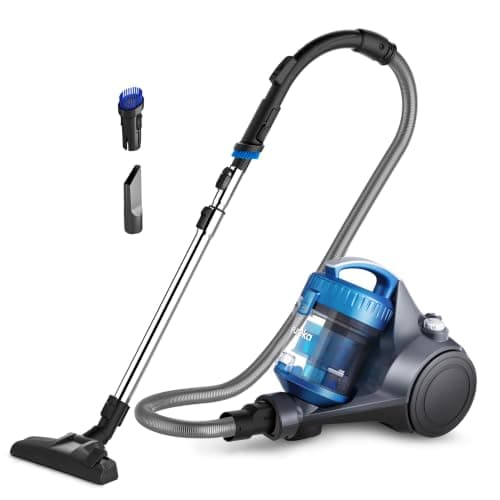
The Whirlwind NEN110A wins more rankings on this site than any other machine, and it is the cheapest thing on the shelf. That is not an accident, and the reason it happens is also the reason it is the wrong buy for a carpeted house.
Everyone in this category says they tested twenty vacuums. We have not tested any, and we say so. What we do instead is read the manuals, compile the published specifications, and work out what each machine costs to run for three years — the method is written out in full.
We earn a commission if you buy through the links on this page, at no extra cost to you. It never changes what we recommend or the order we recommend it in. Full disclosure.
The verdict: on published specifications the Whirlwind NEN110A is the best-value machine on this site, and it wins eight of our roundups. Eureka publishes 960 watts, 8.2 lb, a 2.5-liter container, washable HEPA filtration, 82 dB, automatic cord rewind and a telescoping metal wand. It has no bags and no battery, so the only running cost is about $20.60 of electricity over three years. What it does not have is a powered brushroll — and that single omission is why it never appears on a carpet page.
What Eureka publishes for the NEN110A
Eureka's own published specification for this model, as read from its retail listing.
Figure
Published value
Motor
960 watts
Weight
8.2 lb
Dust container
2.5 liters
Filtration
HEPA, washable
Rated noise
82 dB
Cord
Automatic rewind
Wand
Telescoping metal wand with integrated crevice tool
Runtime
Unlimited — corded
Suction in air watts or Pa
Not published
Filtration test standard
Not published
Cord length
Not published
Hose length
Not published
Cleaning width
Not published
Warranty
Not published
Every row is Eureka's own published figure for this model. Where a row says "Not published", we could not find the figure on the listing and have not estimated one.
Why one cheap canister wins eight rankings
This machine appears on fifteen pages of this site and finishes first on eight of them: stairs, apartments, canisters, tile floors, cat litter, area rugs, sand and under $100. Eight wins from one listing looks like a scoring artifact. It is not, and the reason is worth setting out plainly, because it is the whole argument for buying the boring shape.
Those eight jobs all reward the same four properties, and this machine publishes all four. Suction without agitation (tile, sand, bare floor, fringed rugs — surfaces where a spinning brushroll scatters grit or chews a fringe). Capacity, because 2.5 liters is as much as any budget canister here publishes, and heavy grit fills a bin fast. A body that stays on the floor, which is what makes a staircase tolerable. And a washable filter with no bag, which is what makes fine clay dust from a litter tray or beach sand an annoyance rather than a consumable bill.
The rivals each fail one of those four. The lighter Bissell Zing is a pound lighter but publishes no HEPA claim at all and a six-foot hose. Eureka's own bagged 3670M matches the 2.5-liter capacity and then publishes a foam filter, 90 dB and a 1.7-foot hose. The Kenmores publish real reach and triple HEPA and weigh 22.6 lb. Nothing in the budget band publishes the Whirlwind's combination, which is why the same machine keeps coming out on top of pages about completely different problems.
The one page it never wins
Carpet. The Whirlwind does not appear on the carpet roundup, the shag carpet roundup or the hardwood-and-carpet roundup at all, and that is deliberate rather than an oversight. Its floor tool is not powered. Suction lifts what is loose on top of the pile; a driven brushroll is what agitates fiber and releases what is down in it. No amount of wattage substitutes for that, and a machine with eight wins on hard floors and rugs has no business being recommended for wall-to-wall pile.
This is the single most useful thing to understand about canisters generally, and it is not a budget problem. Of the canisters on this site, only the Kenmore 600 Series publishes a motorized floor tool — the Miele Classic C1 Pure Suction, at several times the Whirlwind's price, publishes a combination floorhead whose brush strip is deployed by a foot switch rather than driven by a motor. Paying more buys a quieter motor, a bigger bag and better filtration. On this shelf it mostly does not buy agitation. If your floors are carpet, that is the fact that should decide the purchase, and the canister roundup names the only machine here that fixes it.
What it does not publish, and why each gap matters
No suction figure in any comparable unit. 960 watts is electricity drawn, not dirt lifted. The Kenmore 600 Series publishes 183 W measured at the hose end, which is the figure that would actually let you compare two canisters — and it is the only machine in this category that publishes it.
No filtration test standard. The listing says HEPA and washable, and stops. Shark names ASTM F1977-22 and the laboratory that ran it, and Levoit names the same standard; Kenmore and Miele at least publish a percentage. A bare "HEPA" is the weakest form of the claim, which is why this machine sits second rather than first on the allergy roundup.
No cord or hose length. Automatic rewind is published; how much cord it rewinds is not. For a canister the working radius is the whole ergonomic argument, and the Kenmore 400 Series publishes 26 feet of cord and nine feet of wand reach against a blank here.
How it compares with the rest of the canister shelf
Eureka 3670M — the same brand, a near-identical price and the same 2.5 liters, but bagged, with a foam filter and no HEPA claim, 90 dB, and a 1.7-foot hose on its own listing. Five bags ship in the box, and then you buy bags forever. It is the cheaper sheet in every sense; "Eureka canister" is not one product.
Bissell Zing 2154A — 7.5 lb, the lightest here, with automatic cord rewind and a 2.5-liter bag. Its electrical specification contradicts itself, so 9 amps is the only figure worth quoting, and it publishes no HEPA claim — which removes the usual reason to accept a bag.
Kenmore 600 Series 81615 — the machine that solves the agitation problem: a Pet PowerMate motorized attachment, 183 W at the hose end, triple HEPA stated at 99.97%, a 28-foot retractable cord and 75 dB. It also weighs 22.6 lb, costs several times as much, and is bagged with no published bag capacity.
If the honest summary helps: buy the Whirlwind for hard floors, stairs and rugs; buy the Kenmore 600 Series if the house is carpeted and you still want a canister; and buy neither of the other two, because each gives up filtration without buying anything back.
#
Product
Best for
Score
Price
01
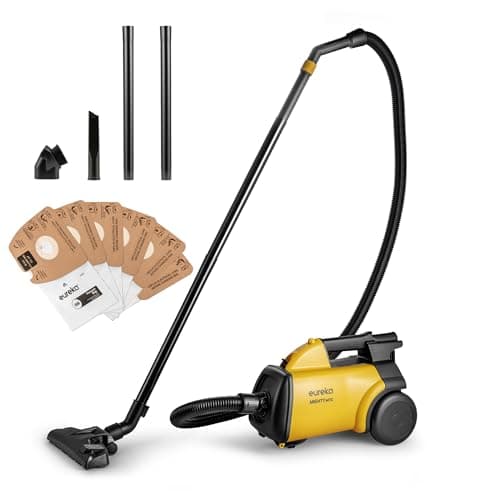
Eureka Whirlwind Bagless Canister (NEN110A)960 W, a 2.5-liter bin, automatic cord rewind and washable filters — the canister case, made cheaply and made honestly.
Eureka Bagged Canister (3670M)Eight and a half pounds, a 2.5-liter bag and five bags in the box, at the lowest price any real brand charges for a canister — with a foam filter and 90 dB to show for it.
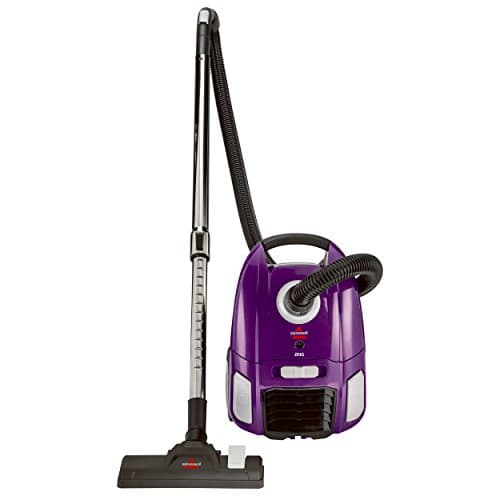
Bissell Zing Bagged Canister (2154A)Seven and a half pounds with automatic cord rewind and a 2.5-liter bag — the canister shape at its lightest, as long as you never need to know how many watts it draws.
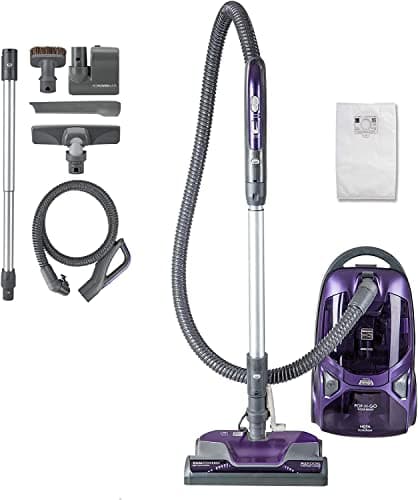
Kenmore 600 Series Pet Friendly Bagged Canister (81615)The only canister on this site that publishes a motorized floor tool and a suction figure measured at the hose end, which together fix the two things canisters are usually bad at.
The Whirlwind beside its own bagged Eureka sibling, the lightest budget canister, and the one canister on this site that publishes a motorized floor tool. Scores are our rubric applied to published specifications, not test results — we have not handled any of these machines.
01 · Best canister under $120
Eureka Whirlwind Bagless Canister (NEN110A)
960 W, a 2.5-liter bin, automatic cord rewind and washable filters — the canister case, made cheaply and made honestly.
Telescoping metal wand with integrated crevice tool
Every figure above is the manufacturer's own published number. Where a manufacturer publishes nothing, the row says "Not published" rather than an estimate.
What the numbers say
+2.5-liter bin and washable HEPA — no bags, no filter bills
+The body stays on the floor, so stairs and above-floor work are far easier than with an upright
+Automatic cord rewind, which is a small luxury that is missing at this price everywhere else
Where it stops
−No powered brushroll, so deep pile carpet is not its job
−Dragging a canister around furniture annoys some people permanently
−82 dB
Who it is for
Hard floors, stairs, cars and upholstery — the classic canister case.
Skip it if
Wall-to-wall carpet is your main floor. Suction alone does not agitate pile; you want a driven brushroll.
Our score: 8.4 out of 10
Published power8.5
Runtime10.0
Bin and filtration8.5
Weight and handling7.0
Running cost9.5
Scored against the published rubric on How We Pick. These are judgments about spec sheets, not measurements.
02 · Cheapest canister here
Eureka Bagged Canister (3670M)
Eight and a half pounds, a 2.5-liter bag and five bags in the box, at the lowest price any real brand charges for a canister — with a foam filter and 90 dB to show for it.
1,200 watts and a 12-amp motor, both published on the same listing. Twelve amps at 120 volts is 1,440 watts, so the two figures do not reconcile
Dust bag capacity
2.5 liters
Weight
8.6 lb
Filtration
Foam filter. No HEPA claim of any kind
Rated noise
90 dB
Hose length
1.7 feet, per the listing's own field
Tools
Two extension wands, crevice tool, dusting brush, and five dust bags in the box
Wheels
Two
Warranty
1 year
Cord length
Not published
Motorized floor tool
Not included
Every figure above is the manufacturer's own published number. Where a manufacturer publishes nothing, the row says "Not published" rather than an estimate.
What the numbers say
+The cheapest machine in this category by a clear margin, from a brand with a parts network behind it
+Five dust bags ship in the box, which is the first year of consumables handed to you
+8.6 lb and two extension wands make it genuinely good at ceilings, vents and car interiors
Where it stops
−A foam filter and no HEPA claim, which is the weakest filtration specification of any machine in this category
−90 dB is the loudest rating on this page by 10 decibels
−The listing publishes a 1.7-foot hose and no cord length, so you cannot work out its working radius before it arrives
Who it is for
A second vacuum, a garage, a rental, or a first canister bought to find out whether the shape suits you before spending more.
Skip it if
Anyone in the house reacts to dust. A foam filter and a bagged machine is the wrong half of both arguments: you get the consumable cost of bags without the filtration that usually justifies them.
Our score: 7.1 out of 10
Published power6.5
Runtime10.0
Bin and filtration6.0
Weight and handling6.5
Running cost6.5
Scored against the published rubric on How We Pick. These are judgments about spec sheets, not measurements.
03 · Best bagged under $100
Bissell Zing Bagged Canister (2154A)
Seven and a half pounds with automatic cord rewind and a 2.5-liter bag — the canister shape at its lightest, as long as you never need to know how many watts it draws.
9 amps. The listing separately prints 220 volts and 1,200 watts, neither of which can be right for a machine sold on US 120-volt mains
Dust bag capacity
2.5 liters
Weight
7.5 lb
Filtration
Washable, reusable pre-motor and post-motor filters. No HEPA claim and no test standard published
Hose length
6 feet
Cord
Automatic rewind. Length not published
Wand
Telescoping
Floor nozzle
Multi-surface, carpet-to-hard-floor switch. Not powered
Rated noise
80 dB
Warranty
Limited 1 year
Every figure above is the manufacturer's own published number. Where a manufacturer publishes nothing, the row says "Not published" rather than an estimate.
What the numbers say
+7.5 lb is the lightest canister on this site, and a third of what the Kenmores weigh
+A 2.5-liter bag is the same published capacity as the Eureka Whirlwind's bin, in a machine that seals it shut before you throw it away
+Both filters are published as washable and reusable, which keeps the running cost down to bags alone
Where it stops
−The published electrical specification is self-contradictory, so the only figure worth quoting is 9 amps
−No HEPA claim at all, which is unusual in a bagged machine — the sealed-bag advantage is not backed by a filtration one
−A 6-foot hose and an unpublished cord length mean the working radius is the shortest here that we can actually check
Who it is for
A small home or an apartment where the vacuum has to be carried up a flight of stairs and stored in a closet, and where 2.5 liters is several cleans between bags.
Skip it if
You want the bagged machine for allergy reasons. Bissell publishes no HEPA claim and names no standard on this model; the Kenmores and the Miele all do.
Our score: 7.6 out of 10
Published power6.5
Runtime10.0
Bin and filtration7.0
Weight and handling8.0
Running cost6.5
Scored against the published rubric on How We Pick. These are judgments about spec sheets, not measurements.
04 · The only powered brush here
Kenmore 600 Series Pet Friendly Bagged Canister (81615)
The only canister on this site that publishes a motorized floor tool and a suction figure measured at the hose end, which together fix the two things canisters are usually bad at.
12 amps, two-motor system. The listing's own specification table separately prints 5 amps and 600 watts, which does not reconcile with the bullet
Agitation
Pet PowerMate motorized attachment, plus a Pop-N-Go bare-floor brush
Filtration
Triple HEPA filter system, stated to trap 99.97% of dirt, with a HEPA cloth bag. No test standard named
Cord
28 feet, retractable
Hose reach with attachments
10 feet
Wand
Aluminum telescoping
Cleaning width
14 inches
Weight
22.6 lb
Rated noise
75 dB
Warranty
1 year manufacturer
Dust bag capacity
Not published
Every figure above is the manufacturer's own published number. Where a manufacturer publishes nothing, the row says "Not published" rather than an estimate.
What the numbers say
+A motorized Pet PowerMate is in the box, which is the one thing that stops a canister being the wrong tool for carpet
+183 W measured at the hose end is the only figure in this category that describes suction where the dirt is rather than power at the wall
+28 feet of retractable cord plus 10 feet of hose reach is the longest working radius of any canister on this site
Where it stops
−22.6 lb is the heaviest machine in this category, three times the Bissell Zing
−Bagged, so there is a consumable for as long as you own it — and Kenmore does not publish the bag's capacity anywhere
−The listing publishes 12 amps in its bullets and 5 amps in its specification table, and both cannot be true
Who it is for
A house with carpet or rugs and a shedding pet, where every other canister's missing brushroll is the reason a canister was ruled out in the first place.
Skip it if
You are buying a canister specifically because you are tired of heaving a vacuum around. At 22.6 lb this is heavier than most uprights on this site, and it only stays easy while it is rolling behind you.
Our score: 8.3 out of 10
Published power9.5
Runtime10.0
Bin and filtration8.5
Weight and handling7.5
Running cost6.0
Scored against the published rubric on How We Pick. These are judgments about spec sheets, not measurements.
What it costs to own
This is the strongest part of the case and it is easy to overlook. At the U.S. average residential price of 18.34 cents per kWh, running a 960-watt canister 45 minutes a week for three years — 117 hours — costs about $20.60 in electricity. Beyond that, nothing: the HEPA filter is washable, there is no bag, and there is no battery.
Set that against the alternatives on this page. Both bagged machines commit you to a consumable for as long as you own them, and Kenmore publishes no bag capacity at all, so the ongoing cost cannot even be estimated before purchase. Miele's genuine FilterBags and AirClean filters are the most expensive consumable in the category and the machine is designed around them. And every cordless on this site carries a cell with no published cycle rating, which is the component that ends the machine — the arithmetic is here. A corded bagless machine with a washable filter has no recurring cost at all, and at this price that is remarkable rather than merely adequate.
Who should buy it
Hard floors, tile and area rugs. Suction without a driven brush is the right tool on surfaces where a brushroll scatters grit or catches a fringe.
Stairs and above-floor work. The body stays on the tread while you work, which is the thing every upright is worst at — and at 8.2 lb it is light enough to carry when it has to be.
Apartments, and anyone counting consumables. 82 dB is mid-pack rather than quiet, but washable HEPA with no bag and no battery means the three-year cost is $20.60 and a rinse.
Heavy grit — litter trays, sand, workshop dust. A 2.5-liter container is as large as any budget canister here publishes, and grit fills a small bin fast.
Who should not
Wall-to-wall carpet. No powered brushroll. This is the whole decision, and the Kenmore 600 Series is the canister that fixes it.
Allergy households who want evidence. The HEPA claim names no test standard. Shark's ASTM F1977-22 claim, tested by a named laboratory, is a materially stronger piece of paper.
Anyone who hates dragging a machine. A canister follows you around furniture, and some people never stop finding that irritating. Stick versus upright versus canister is the page that argues the shapes against each other.
We have not used this machine. Everything above is read off Eureka's own published specification and compared with other manufacturers' published specifications. A spec sheet cannot tell you how the hose kinks, whether the bin empties cleanly, or how the cord rewind holds up in year four — and on that last point Eureka publishes no warranty at all. Our method page states exactly where our evidence stops and why we publish a score anyway.
Common questions
Is the Eureka Whirlwind NEN110A worth it?+−
On published specifications it is the best value on this site: 960 watts, 8.2 lb, a 2.5-liter container, washable HEPA, 82 dB, automatic cord rewind and a telescoping metal wand, with no bags and no battery. The three-year electricity cost is about $20.60 and there are no other consumables. The one disqualifier is carpet — the floor tool is not powered.
Is the Eureka Whirlwind good for carpet?+−
No, and we do not list it on any carpet page. Its floor tool has no motor, so it offers suction without agitation. Suction lifts what sits on top of the pile; a driven brushroll is what releases what is down in it. For a carpeted house that still wants a canister, the Kenmore 600 Series is the only machine in this category that publishes a motorized floor tool.
Does the Eureka Whirlwind have a HEPA filter?+−
Eureka publishes washable HEPA filtration for this model. What it does not publish is a test standard or a percentage, so the claim is weaker evidence than Shark's rating of 99.9% per ASTM F1977-22 tested by IBR Laboratories, or Kenmore's stated 99.97%. The filter being washable is the part with a hard financial consequence: there is no filter to buy.
How much does the Eureka Whirlwind cost to run?+−
About $20.60 in electricity over three years, calculated from its published 960 watts at 45 minutes a week and the U.S. average residential price of 18.34 cents per kWh. There is nothing else: the HEPA filter is washable, there is no bag and there is no battery. That is the lowest total running cost of any machine in this category.
Eureka Whirlwind NEN110A or Eureka 3670M?+−
The Whirlwind, clearly. Both publish 2.5 liters of capacity at close to the same price, but the 3670M is bagged with a foam filter and no HEPA claim, rates 90 dB against the Whirlwind's 82, and publishes a 1.7-foot hose. The 3670M also commits you to buying bags. Same brand, same money, materially weaker sheet.
Why does this vacuum win so many of your rankings?+−
Because eight of our pages reward the same four published properties and this listing has all of them: suction without agitation, a container no budget canister here beats, a body that stays on the floor for stairs, and a washable filter with no bag. It wins pages about tile, sand, cat litter, area rugs, stairs, apartments, canisters and the under-$100 ceiling. It wins nothing about carpet, for the same structural reason.
Sources
Manufacturer-published specifications — Every runtime, wattage, capacity, weight, filtration and warranty figure quoted on this page is the manufacturer's own published number for that model, retrieved September 1, 2026. Where a manufacturer publishes no figure, the page says 'Not published' rather than estimating one.
ASTM F1977 — standard test method for vacuum cleaner filtration efficiency — Named by Shark (tested by IBR Laboratories, per ASTM F1977-22) and by Levoit (ASTM F1977-22) in their own published filtration claims. Where a brand names this standard we treat the claim as checkable; where a brand states a bare percentage we do not.
Sweep & Suction — How We Pick — Our published method, including the scoring rubric, the three-year running-cost formula and an explicit statement of what published specifications cannot tell you.